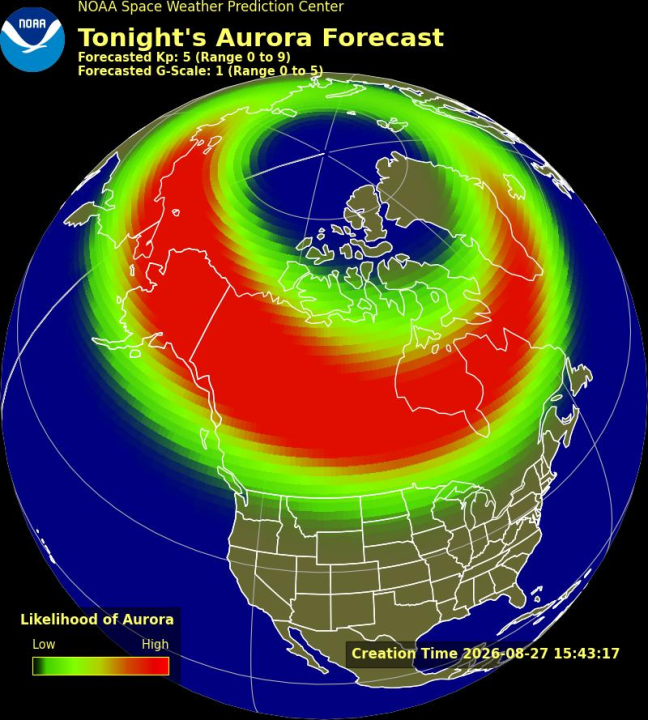
In addition to this week’s blood moon eclipse, you could potentially see the northern lights due to recent solar activity. The aurora occurs when solar material collides with Earth’s atmosphere, interacting with atmospheric gases. This interaction can also lead to geomagnetic storms.
Recently, the sun released substantial material, which may trigger the aurora. The Space Weather Prediction Center (SWPC) of the National Weather Service has issued geomagnetic storm watches for Thursday and Friday due to a coronal hole high-speed stream (CH HSS). These watches were extended to Saturday following coronal mass ejections (CMEs) from the sun.
The SWPC forecasts stronger conditions on Friday and Saturday. The arrival of solar material might generate enough energy to display the northern lights, especially in the northern U.S. According to SWPC’s forecast, the geomagnetic storm conditions could intensify at approximately 5 p.m. EDT Thursday and continue after sunset, ideal for viewing the aurora.
Conditions may attain a moderate G2 level from 8 p.m. to 11 p.m. EDT on Thursday, which could allow the northern lights to be visible as far south as New York and Idaho. Most of Canada and Alaska will likely have the best chance for viewing the aurora. For those near the Canadian border, there’s a slight possibility of visibility, primarily along the northern horizon.
On Thursday night, the storms might weaken as Friday begins, but predictions suggest they could strengthen again around 5 p.m. EDT. On Friday, conditions might peak between 8 p.m. and 11 p.m. EDT before subsiding. The forecast for Friday mirrors Thursday’s predictions.
The SWPC’s forecast covers up to 11 p.m. EDT on Saturday. It’s uncertain if conditions will strengthen further for viewing. Geomagnetic storm activity can sometimes deviate from predictions due to the variable interaction of solar material with Earth’s atmosphere.
To optimize viewing opportunities, look toward the northern horizon. If aurora visibility is challenging, try using your phone. Modern digital cameras, with their light-sensitive lenses, can better capture the hues of the aurora than the human eye.
Copyright 2026 Nexstar Media Inc. All rights reserved. This material cannot be published, broadcast, rewritten, or redistributed without permission.
Leave a Reply