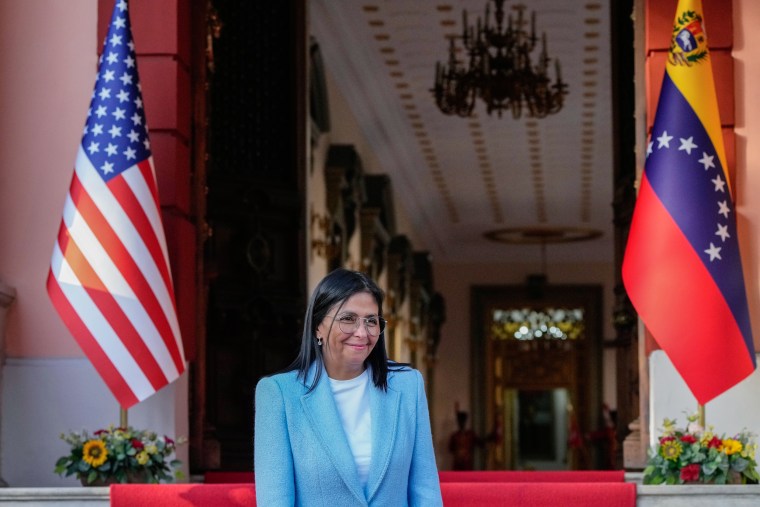
WASHINGTON – On Monday, the White House announced a partnership with North American Blue Energy Partners (NABEP) as part of President Donald Trump’s initiative to engage with Venezuela’s oil industry. This deal grants the Pentagon a stake in approximately 20% of the country’s extensive oil reserves. Details of the agreement were released on Monday night, following Trump’s claim of it being the largest oil deal in history. Analysts have expressed skepticism, warning that it may take several years to revive Venezuela’s oil production. However, Trump and his administration view it as an opportunity to establish a new oil powerhouse in the Western Hemisphere.
The agreement involves the creation of a private company through a joint venture with NABEP. Originally withheld by the White House, NABEP is owned by Venezuelan businessman Alejandro Betancourt and is the second-largest operator in Venezuela, following Chevron.
“Venezuela is blessed with an abundance of natural resources, hardworking people and untapped potential,” Betancourt stated.
According to the deal, Venezuela’s acting President Delcy Rodríguez has granted the company 100-year rights over 17 oil fields, with proven reserves totaling 65 billion barrels. Many fields were previously controlled by Russian or Chinese firms, as noted by the White House.
The Pentagon will hold a 35% stake in the joint venture, and the State Department will secure rights to purchase 20% of the production at cost. Betancourt’s company is pledging $100 billion for new oil infrastructure.
Betancourt shared his extensive experience in the Venezuelan oil sector, noting that the company employs over 5,000 staff members and collaborates with more than 10,000 contractors.
The White House emphasized that the deal is “at zero cost” to the U.S., granting the government veto power on board members, who primarily will be U.S. citizens.
NABEP will have reputable U.S. auditors, lawyers, and advisers, and the U.S. government’s agreement with NABEP is governed by U.S. law and is subject to U.S. court jurisdiction,” the White House stated.
Former U.S. government energy advisers have warned of political risks tied to the agreement, highlighting possible challenges from future administrations in Venezuela or the U.S. Analysts caution that considerable time may be needed to rejuvenate Venezuela’s depleted energy sector.
Trump acknowledged that gas price reductions might not be immediate.
“If it was two years, you know, that’s a short period of time,” Trump remarked.
Rodríguez endorsed the deal as a chance to modernize Venezuela’s oil sector and expedite its revival. Despite criticism over resource concession, Rodríguez assured the protection of Venezuela’s sovereignty.
Lawmakers on Capitol Hill are seeking more details about the agreement. Republican Congressman Rick Crawford expressed interest in learning more from the Trump administration promptly. Democratic Senator Jack Reed recommended rejecting the deal, criticizing the use of military assets in a private oil venture and demanding a complete review of its legal basis.
“President Trump’s effort to turn the U.S. military into an investor in Venezuelan oil is a blatant abuse of power and taxpayer dollars,” Reed commented.
On Tuesday, Trump plans to meet with oil refiners to explore ways to boost U.S. capacity for refining oil into gasoline. The meeting will address rising fuel costs, partly driven by the conflict with Iran, with national averages climbing to $4.08 per gallon, a 28% rise over the past year according to AAA.
The White House is also considering increasing refineries and expanding existing facilities to eventually lower consumer prices. This includes Venezuelan oil processing capability. Interior Secretary Doug Burgum, Energy Secretary Chris Wright, and Jarrod Agen, Director of the White House National Energy Dominance Council, will attend the meeting.
Leave a Reply