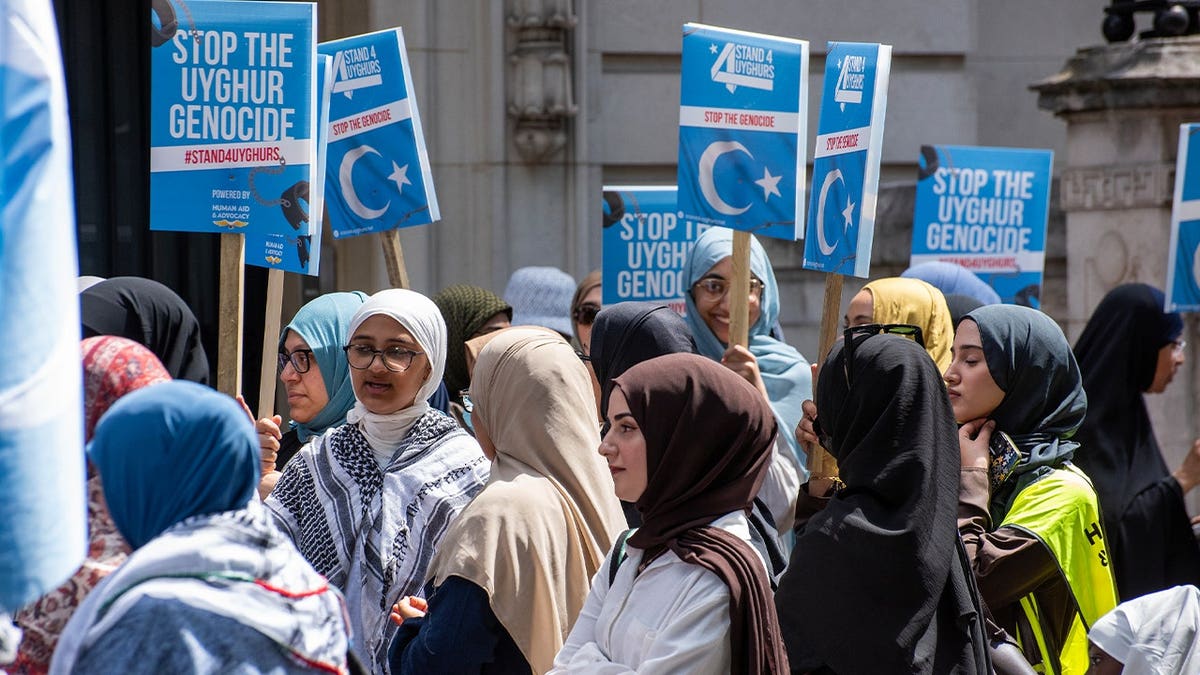
The House Select Committee on the Chinese Communist Party has requested a briefing from the Department of Homeland Security regarding the Uyghur Forced Labor Prevention Act (UFLPA). The act aims to prevent the import of goods made with forced labor in China. According to a letter shared with Fox News Digital, the committee seeks to understand how DHS is implementing the law.
Passed in 2021, the UFLPA tasked DHS’s Forced Labor Enforcement Task Force with creating a strategy to stop imports of goods manufactured with forced labor in China’s Xinjiang Uyghur Autonomous Region (XUAR). Human rights groups have highlighted claims that the CCP is oppressing Uyghurs, a Muslim ethnic minority in XUAR.
The Uyghurs are facing political persecution and are forced to abandon their religion and immerse themselves into Chinese culture. They are subjected to labor with little or no pay and endure long working hours.
– Rep. Ro Khanna
Rep. Ro Khanna, a ranking member of the House Select Committee on Strategic Competition, emphasized that the enforced UFLPA goes beyond morality, touching on economic and national security concerns for Americans. Khanna pointed out that products such as steel, aluminum, and textiles produced under forced labor are undermining U.S. manufacturers.
In a bipartisan letter, addressed to DHS Secretary Markwayne Mullin, the committee outlined 10 specific concerns, including efforts by DHS and Customs and Border Protection (CBP) to maintain and update the list of companies using forced labor, known as the UFLPA Entity List. Recently, DHS added 43 companies to this list. Khanna suggested that the administration recognized the importance of the committee’s actions, which may have prompted this addition.
The committee’s concerns include fears that goods from companies on the list, originating from XUAR, are still reaching U.S. consumers. The letter mentions a New York Times report regarding forced labor involvement in cotton used for Labubu dolls.
Khanna described strategies used by China to evade import bans, such as relocating manufacturing to other countries like Malaysia and Vietnam. He stressed the need to trace products back to their production source and ensure that items linked to forced Uyghur labor are not sold in the U.S.
Ultimately, Khanna reiterated the bipartisan nature of this issue, as evidenced by the letter signed by both Democrat and Republican lawmakers, stressing its impact on fair trade and human rights.
Fox News Digital reached out to DHS, Customs and Border Protection, the Chinese Embassy, and Pop Mart for further remarks.
Leave a Reply