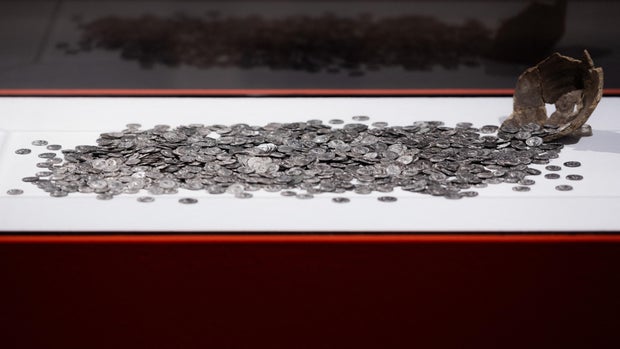
An amateur archaeologist in western Germany uncovered a remarkable discovery while searching with his metal detector. Oliver Riedl stumbled upon several Roman silver coins in a field, which led to a greater find. As the detector continued to signal, Riedl called the authorities. A team of experts soon uncovered 934 Roman silver denarii. This discovery represents the largest coin treasure from Roman Emperor Hadrian’s era found in Germany, according to the local office for archaeological monuments.
“There was clearly more buried here,” remarked Riedl. His detector kept indicating more finds near Wesseling, south of Cologne. Discovered a year ago, the hoard weighs 3.1 kilograms (6.8 pounds) and is now exhibited at the LVR-LandesMuseum Bonn. Most coins date back to the Flavian emperors (A.D. 69-96), with the oldest minted in 148 B.C., as the museum reported.
Roman coins from the time are currently displayed at the LVR State Museum in Bonn, Germany, dated September 22, 2026. Officials believe the collection was likely intentionally buried in the second quarter of the second century A.D., according to the LVR Office for the Preservation of Archaeological Monuments in the Rhineland. Erich Classen, state archaeologist and director of the office, speculates, “It’s probable someone intended to safeguard these coins, given the absence of banks back then.” He further noted the treasure’s owner might have died without retrieving it or passing down information about its location.
Finding treasure hoards from the Roman era or other ancient times is not rare. However, few from the second century match the expanse of this find in Wesseling. The coins’ exact value at the time remains elusive, but known salaries of Roman legionaries provide context. Rahel Otte, a research associate at the archaeological office, explains, “A legionary earned 300 denarii annually, though roughly half went towards food and equipment expenses.” Therefore, a soldier would need to save all surplus income for about six years to gather the Wesseling treasure. It’s still unclear who ultimately amassed this significant wealth.
The Cologne region was under Roman rule from about 39 B.C. to A.D. 459. Roman General Marcus Vipsanius Agrippa established presence there to secure the empire’s border along the Rhine River. This led to the creation of a military outpost, later named Colonia Agrippina, now known as Cologne.
Roman coins, such as one dating back to 148 B.C. when Rome was a republic, are part of the display at the LVR State Museum in Bonn. Recent years have seen several Roman-era treasures unearthed across Europe. In February, Welsh metal detectorists found two Roman-era lead ingots. In 2024, a hoard of Roman coins worth over $125,000 was discovered during a construction project in central England. That same year, Polish metal detectorists helped uncover a substantial cache of ancient Roman coins. Additionally, a collection of ancient Roman coins surfaced on a small Mediterranean island.
Leave a Reply