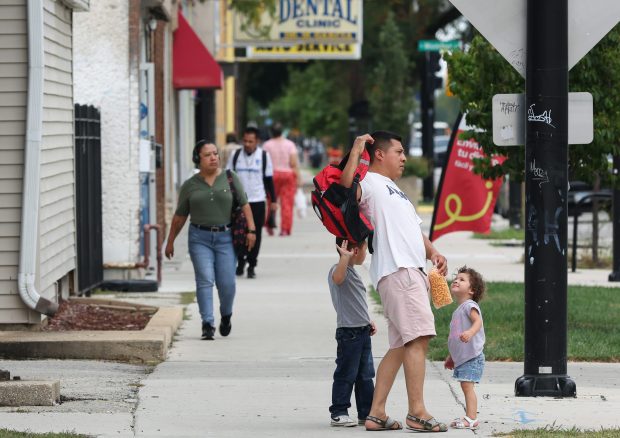
For years, Little Village has been a vital part of Latino culture in Chicago, illustrated by the thousands attending the 55th annual Mexican Independence Parade along the 26th Street corridor. However, a new study by the University of Illinois Chicago reveals that neither Little Village nor Pilsen holds the largest Latino population in the city anymore. That distinction belongs to Belmont Cragin, a neighborhood 8 miles north, according to a report from UIC’s Great Cities Institute.
The findings show that more than 57,000 Latino residents, making up about 80% of its population, live in Belmont Cragin. This neighborhood represents a significant shift in Chicago’s Latino community. The report also highlights changes in income, education, and employment as the Latino population, which constitutes nearly 30% of the city, expands beyond traditional areas.
“For us, it’s about taking a comprehensive look at who the Latino community actually is,” said Oswaldo Alvarez, executive director of the Illinois Legislative Latino Caucus Foundation. “It’s about having a snapshot of who the Latino community is and how the Latino community has been able to bring Chicago to its next level, without necessarily Chicago’s help.”
Belmont Cragin’s demographic shifts are reflected in the Mexican, Argentinian, and Colombian flags displayed on homes, and multilingual storefront signs along Fullerton Avenue. This avenue has become Chicago’s busiest commercial corridor, yielding $181 million in taxable sales in 2024. This surpasses the Mexican Magnificent Mile on 26th Street, which generated $177 million, experiencing the largest annual increase among UIC’s studied corridors.
While Mexican residents remain the largest Latino group in Belmont Cragin, the study also notes significant Puerto Rican, Central American, and South American communities, including Guatemalans and Ecuadorians. Luisa Rodriguez, who runs Niko’s Multiservices and Cell near North Parkside and Fullerton avenues, serves customers from across Latin America. She notes the wide diversity, with clients from Guatemala, the Dominican Republic, and Honduras.
The study observes a broader trend in the Latino population distribution. While the Southwest and Southeast sides remain predominantly Mexican, the Northwest Side hosts a variety of Latino groups. This includes Ecuadorian, Guatemalan, Colombian, Salvadoran, and Honduran populations. Austin, a majority-Black area in the West Side, saw the largest increase in Latino residents. Garfield Ridge, Chicago Lawn, Ashburn, Clearing, and West Lawn also experienced growth in their Latino populations, challenging historical demographic associations.
Conversely, established communities like Logan Square, Avondale, Albany Park, Irving Park, and Pilsen saw declines in Latino residents. No single reason explains the migrations to areas like Austin or Belmont Cragin, but housing costs and homeownership are key factors, according to Alvarez.
Gentrification has pushed residents away from the city center, particularly in Logan Square and Humboldt Park. About half of Latino renters are cost-burdened, spending at least one-third of their income on rent and utilities. Despite these challenges, some families are acquiring homes and building wealth in new areas. Latino homeownership is above 80% in Ashburn and Garfield Ridge. In 2024, Latino borrowers made up over 90% of new mortgages in Gage Park, West Lawn, and Chicago Lawn.
The landscape coincides with a rising Latino middle class. Nearly one-third of Latino households now earn at least $100,000 annually, up from 20.7% a decade ago. The number of Latino households earning six figures is now 77,798, an increase of nearly 35,000 in that period. Moreover, the percentage of Latino adults with bachelor’s degrees or higher rose from 12.6% to 20.4%. Latino workers in management, business, science, and art occupations have also increased.
Despite these gains, the report warns against assuming the disappearance of Chicago’s Latino working class. Nearly 60% of Latino employment remains in traditionally lower-paying industries. Alvarez aims for the report to encourage questions about cross-issue areas and challenge prevailing perceptions of the Latino community.
Leave a Reply