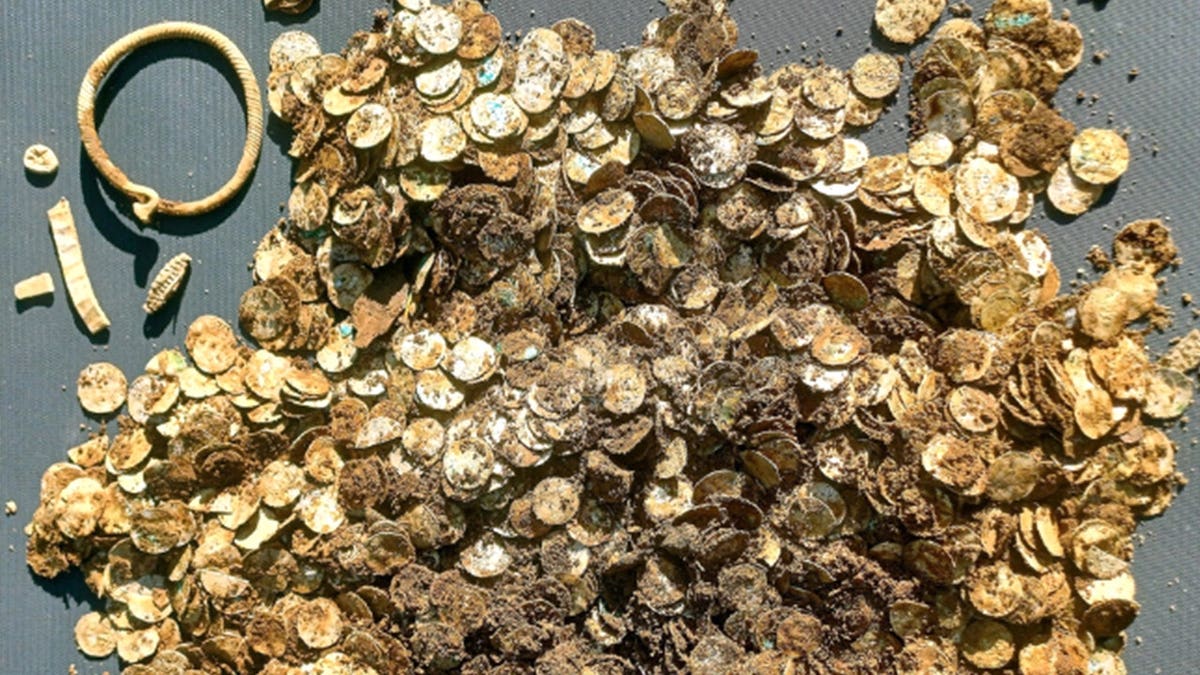
A remarkable discovery in Finland has brought to light a Viking Age silver hoard comprising over 4,000 coins. This find, the largest of its kind recorded in the country, was uncovered by metal detectorist Kalle Lappinen near the village center of Sysmä, approximately 105 miles northeast of Helsinki.
Discovery and Examination
Lappinen found the silver hoard on September 3 and quickly informed the authorities. Archaeologists from Lahti Museums began the recovery process the following day. According to the museum release, the hoard includes thousands of silver coins, hack silver, a silver bracelet, a mount, and a bead.
The coins originated from areas presently known as Sweden, Britain, and Germany, along with dirhams from regions that are now part of Turkey and Iran. The total weight of the coins is about 10 pounds, with preliminary dating placing them between 1000 and 1050 A.D., as explained by Lahti Museums archaeologist Esko Tikkala.
Historical Context and Importance
Tikkala, who directed the hoard’s excavation, mentioned that while he has uncovered other Late Iron Age hoards, the scale of this discovery is unprecedented. He highlighted that previous finds rarely amounted to more than a few hundred coins, whereas this hoard includes thousands.
Even at an early stage, the discovery suggests that Sysmä was a significant center during the Late Iron Age, with extensive trade connections. Today, Sysmä might appear as a modest place, but archaeological evidence from that period indicates a different historical context.
Comparisons and Theories
The number of coins found in this hoard more than doubles Finland’s previous largest Viking Age coin hoard discovered in Nousiainen in 1895, which contained around 1,700 coins. While the hoard’s original owner remains unknown, there are several theories regarding its burial reasons.
“It is very difficult to determine what actually happened or who the owner was,” said Tikkala.
Possible explanations include the hoard being buried by a merchant for safekeeping or by a wealthy local resident due to threats or conflicts.
Implications for Research
Frida Ehrnsten, the keeper of numismatic collections at the National Museum of Finland, noted that the find offers new perspectives on the silver economy of that era. Despite not being Vikings, as the term is reserved for people from Scandinavia, the region’s inhabitants during the Viking Age can provide valuable insights into cultural contexts of the time.
An intriguing feature of this discovery is the separation into two deposits about 39 feet apart, a rare occurrence in historical finds. The role of hobby metal detectorists in unearthing such treasures is crucial, contributing significantly to our understanding of history. From 7,000 known Viking Age coins in Finland 25 years ago, there are now approximately 14,000 thanks largely to hobbyist discoveries. These efforts enrich the historical narrative of the Viking Age and how wealth was managed in the region.
Leave a Reply