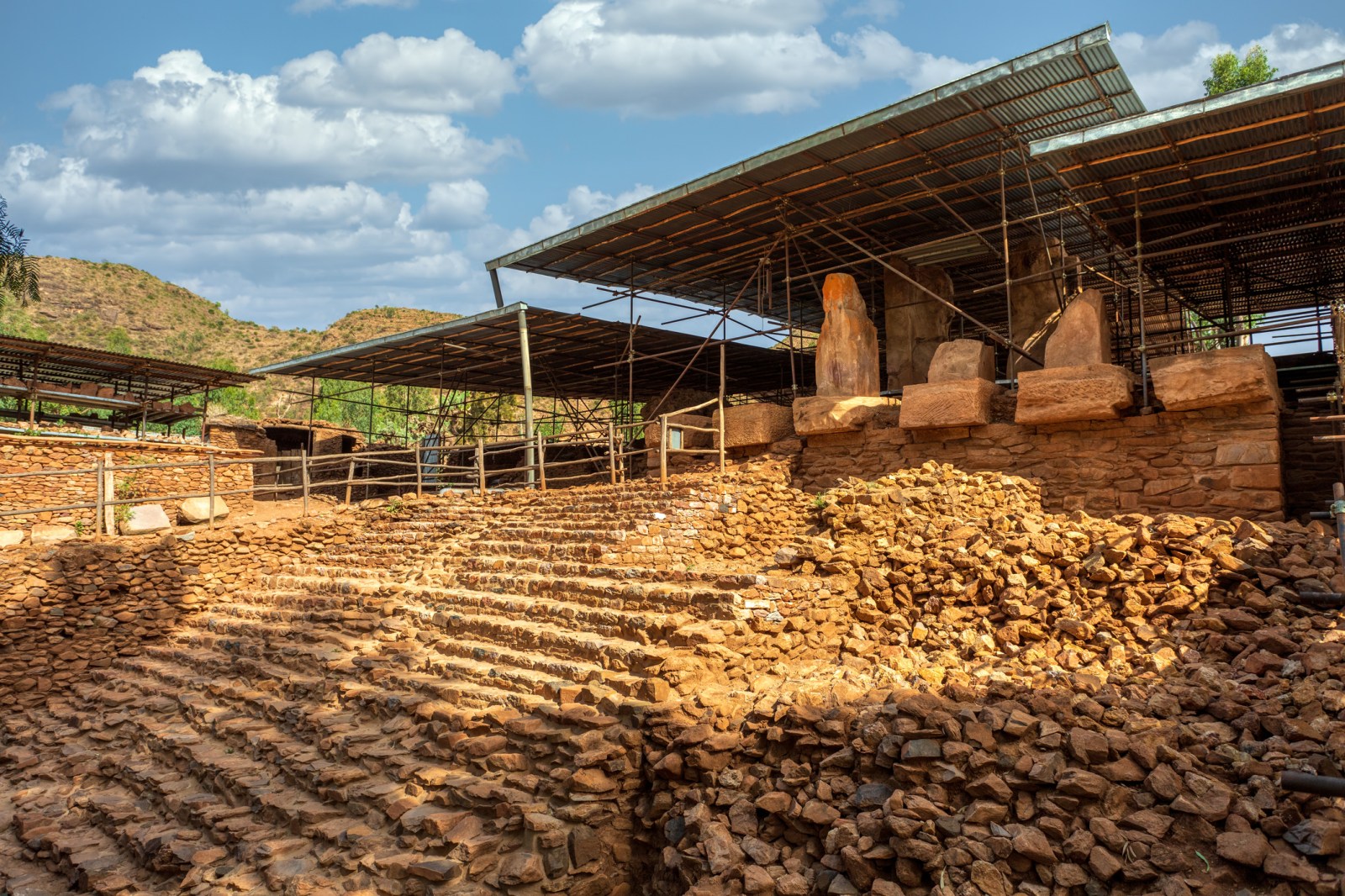
Recent research on an ancient palace in Ethiopia suggests it could have attained significant height and size. The study, led by the German Archaeological Institute and Brandenburg University of Technology Cottbus-Senftenberg, focused on the Grat Be’al Gibri palace at Yeha in the Ethiopian-Eritrean highlands. This palace, the largest known complex from its era in South Arabia and East Africa, spans about 60 by 60 meters.
Constructed around 800 B.C., the palace was likely destroyed by fire in ancient times. Only parts of the ground floor and podium remain, according to a statement from BTU.
Grat Be’al Gibri palace used rubble masonry with clay mortar reinforced by horizontal timber beams,explained Professor Davide Tanasi, a classical archaeologist at the University of South Florida.
In the study, researchers developed a virtual 3D model of two sections of the palace’s walls and analyzed their structural capacity using the finite element method. The study confirms that the construction techniques used, involving clay walls, timber, and stone with horizontally positioned wooden beams, were well-established in the region.
Historian Kwasi Konadu highlighted that these simulations demonstrated the construction system’s remarkable load-bearing capacity. This system was more effective than what the remaining structure suggests. Ancient sources had mentioned multi-story structures reaching up to 20 floors, corroborated by rock carvings and wall paintings. However, these claims lacked scientific engineering analysis until now.
This would have meant that the Palace of Yeha could well have reached skyscraper proportions,reported BTU.
Yet, Konadu clarified that while the wall could support 19 floors, it does not imply the palace stood 19 floors high. The figure refers to the structural load, not actual height.
Both Tanasi and Konadu advised against labeling the Grat Be’al Gibri palace as a modern skyscraper, although the findings reshape insights on ancient construction capabilities.
The research also challenges previous assumptions that Arabia was the exclusive source of such architectural systems in the northern Horn of Africa. Local traditions of monumental building were significant, as demonstrated by African builders calculating height and load three thousand years ago.
This study broadens views of advanced engineering in ancient times, traditionally centered on Egypt, Mesopotamia, Greece, and Rome. Yeha reveals sophisticated traditions in the Ethio-Sabaean context, where African and South Arabian methods met.
Martin Drieschner, lead researcher in the study, emphasized the potential of modern civil engineering methods, such as finite element analysis and modeling, in understanding ancient construction. This underscores the powerful capabilities of numerical simulation beyond traditional applications.
Leave a Reply