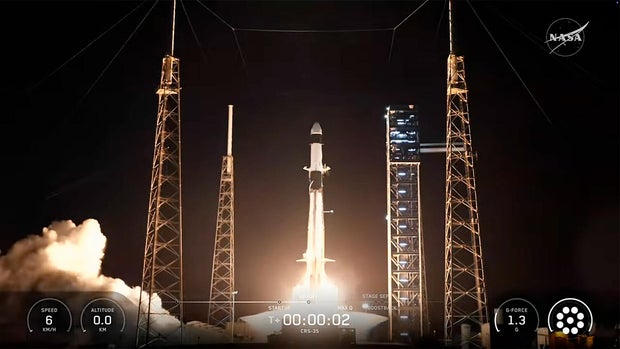
SpaceX successfully launched an unpiloted Dragon cargo ship aboard a Falcon 9 rocket, aiming for a rendezvous with the International Space Station (ISS). The mission, launched on Tuesday, aims to deliver over 6,300 pounds of research materials, spare parts, and supplies for the crew onboard the ISS by Thursday.
Solar Array Upgrade
The cargo ship carries two new roll-out solar array blankets, marking the final phase in a crucial upgrade designed to offset age-related wear of the station’s initial eight solar wings. The installation of six IROSA blankets commenced in June 2021 during multiple spacewalks. The recently transported seventh and eighth arrays are scheduled for installation in forthcoming spacewalks at the end of October and early November.
Launch Details
At 6:33 a.m. EDT, the Falcon 9 rocket ignited its nine first-stage engines, generating 1.7 million pounds of thrust to lift off from Cape Canaveral Space Force Station. About two and a half minutes post-launch, the first stage detached and returned to Cape Canaveral, landing near its launch pad at 6:41 a.m. Meanwhile, the second stage continued its orbital ascent.
As the second stage advanced, viewers at Kennedy Space Center witnessed a remarkable view of the ISS soaring 260 miles above, alongside the rocket’s exhaust trail. A time exposure captured this scene, displaying the first stage booster separating with an arcing streak.
Cargo Dragon’s Journey
The Cargo Dragon separated from the Falcon 9 several moments after engine shutdown, preparing for its journey to the ISS. Assuming all proceeds as planned, the craft will autonomously dock at the Harmony module’s space-facing port at 11 a.m. Thursday. This launch delivered a visual spectacle, attributed to the “jellyfish effect”—a phenomenon where sunlight illuminates the expanding exhaust plume from the rocket’s second stage.
Supplies and Equipment
The comprehensive cargo includes 844 pounds of crew supplies, 1,307 pounds of scientific equipment, 417 pounds of spacewalk gear, and 880 pounds of hardware and computing resources. Notably, the shipment features fresh food items such as oranges, apples, grapefruit, tomatoes, blueberries, baby carrots, and mini sweet peppers. Popular among the astronauts is the pizza kit, along with cookies, candy, and special holiday treats.
“There’s also the always popular pizza kit, cookies and candy, as well as some special holiday items,” said Bill Spetch, space station program manager.
Inside the Dragon’s unpressurized trunk section are the IROSA solar arrays, weighing 2,635 pounds. Each blanket generates 20 kilowatts, revitalizing power levels to factory-fresh standards. These new arrays install over existing ones, enhancing power efficiency and output due to modern solar cell technology.
“The new arrays are installed on top, over in front of the existing solar arrays. The exposed portion of the old arrays will still be generating power in parallel with the new arrays,” explained Dana Weigel, director of low-Earth orbit operations at Johnson Space Center.
Overall, the IROSA arrays’ advanced solar cells offer higher energy density, efficiently boosting power output compared to the original arrays when new.
Leave a Reply