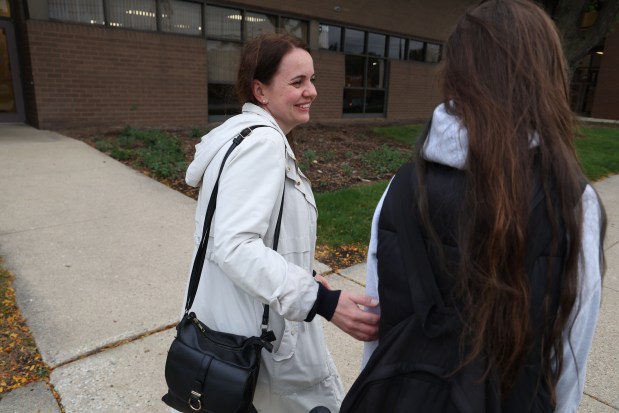
Yaryna Levchuk embodies a strong work ethic. In Ukraine, during the war more than four years ago, she balanced her pharmacy job with volunteering. When her family relocated to the U.S., settling near Chicago, she started working promptly after receiving permission. Protecting her right to work has been essential, driven by pride and necessity.
Recent policy changes and delays now threaten her ability to work. Her husband may soon face a similar dilemma. The uncertainty looms large: can they remain in the U.S.? Levchuk shared her concerns, emphasizing her willingness to contribute through work.
More than 100,000 Ukrainians in the U.S. under temporary protected status (TPS) find their status precarious. The humanitarian protections were due to expire, affecting the refugees’ ability to work, study, and remain in the U.S. Delays and changing policies continue to cause anxiety.
The Trump administration decided to temporarily extend TPS for Ukrainians, leaving final decisions pending. This holds many in a state of limbo, as immigration experts and advocates point out the uncertainty. Processing times for alternative pathways to security are also slow.
Amid recent geopolitical tension, fear of reduced U.S. support for Ukraine grows. This could extend to issues like TPS. Levchuk lost her job as a pharmacy technician when her work authorization expired. She remains uncertain about her husband’s employment prospects.
The Levchuk family originates from Ukraine, where they lived near Poland. Before the invasion, Levchuk considered how to protect her children. When Russia invaded in February 2022, her children and mother fled to Poland. Levchuk’s decision to stay was driven by her role as a pharmacist.
Levchuk’s husband joined the territorial army, and she continued working and volunteering. Eventually, due to family pressure, Levchuk left for the U.S. under the Uniting for Ukraine (U4U) program. This allowed them a temporary stay and work permit.
Levchuk quickly sought employment upon arrival, landing a pharmacy technician role despite language barriers. Her husband assisted with deliveries. They integrated gradually.
In 2024, Levchuk reapplied for U4U parole and TPS as her initial period expired. U4U and TPS are interconnected, offering a legal stay and work opportunities when home countries are unsafe.
Levchuk’s TPS application remains pending. TPS allows work eligibility before final approval, but complexities exist. With U4U, they temporarily maintained work rights. However, uncertain processing delays cause potential risks.
After his re-election, President Trump sought to end certain parole programs, including U4U. Processing has since resumed, but delays persist. Levchuk’s husband can work for now, yet their TPS status and work security remain fragile.
According to statute, TPS extensions should function automatically if not timely addressed. Yet, recent handling under Trump creates unpredictability. TPS designations have been contentious, posing challenges for refugees.
Responses to TPS changes remain vague. Employers hesitate to retain workers with uncertain statuses, compounding difficulties for refugees like Levchuk. Some senators have urged TPS extensions, but legislative solutions remain distant.
RefugeeOne, an organization assisting immigrants, reports confusion and stress among Ukrainian TPS holders. Families fear expired work permits and uncertain futures.
Levchuk’s son, nearing high school graduation, hopes to attend college. The family’s unstable status raises questions about affordability and aid eligibility.
Levchuk expresses gratitude for the refuge provided thus far, but the uncertainties and pain weigh heavily on her. She refrains from assigning blame, focusing on the time given to them in the U.S.
Leave a Reply