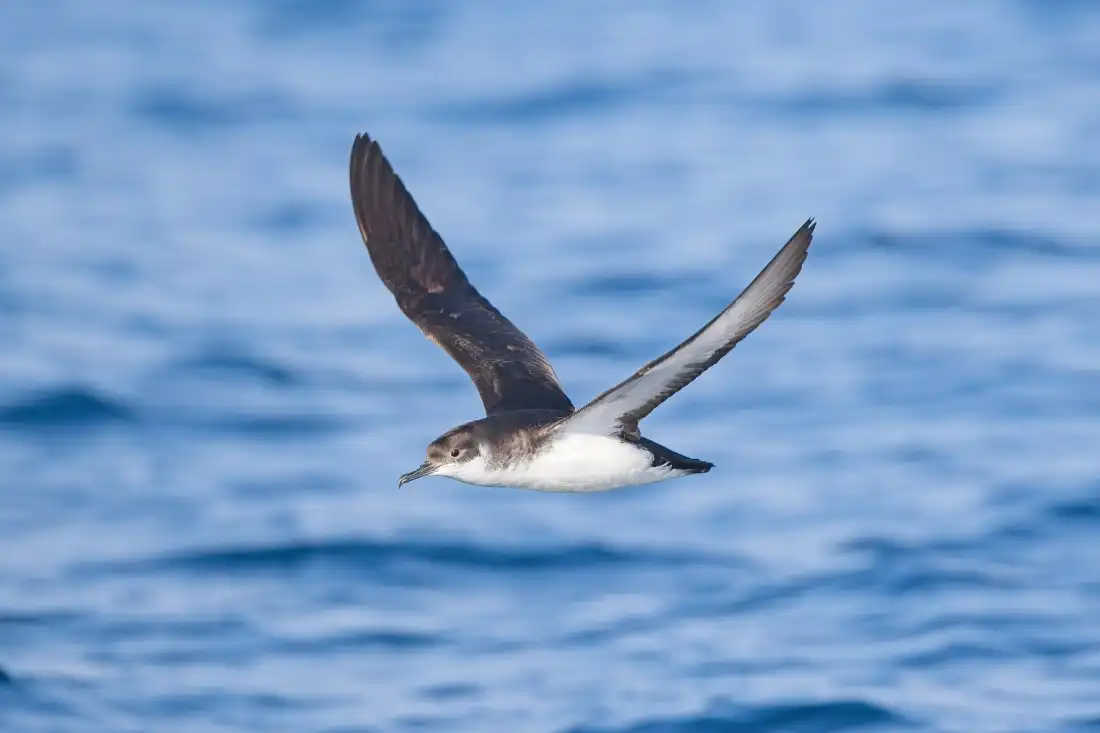
Manx shearwaters, after hunting at sea for weeks, race back to their nests. Recent research indicates they may experience a form of jet lag during their return. The study, published in Science, reveals that these seabirds become slightly disoriented while flying across the Atlantic Ocean. This disorientation, according to researchers, results from their internal clock desynchronizing with the sun’s position.
Manx shearwaters, prevalent in the British Isles, share similarities with seagulls but are closely related to albatrosses. As noted by Patrick Lewin, a behavioral ecologist at the University of Oxford, these birds mate for life. During breeding, couples lay one egg and alternate its incubation. While one incubates, the other hunts in the North Atlantic for fish and squid, often traveling hundreds of miles from the nest. Once satiated, these birds swiftly return to their colonies, often completing the journey in a day.
This observation led to an intriguing question: Do Manx shearwaters experience jet lag, or ‘flap lag,’ similar to humans? Lewin and his colleagues investigated this using GPS trackers that have been collecting data on these birds for 20 years. They aimed to detect signs of jet lag in the flights. Shearwaters are believed to use the sun for navigation. To navigate by the sun, they must know the time of day. For instance, in the northern hemisphere, the sun is in the east in the morning, south at midday, and west in the evening. Erroneous timekeeping results in incorrect navigation, which was indeed observed by Lewin.
During their return journey, the birds occasionally deviated, showing a maximum error of seven degrees. This might seem minor, as it resulted in a deviation of about three miles in a 600-mile journey. Nevertheless, the findings are fascinating.
Alice Boyle, a biologist at the Centre for Animals on the Move, Western University, Canada, who was not involved in the study, praised the research. She pointed out that while most animals navigate their environments, rarely do studies capture navigation decisions in action. The GPS data gained from these wild birds traveling to remote locations provides valuable insights into their navigation methods.
Leave a Reply