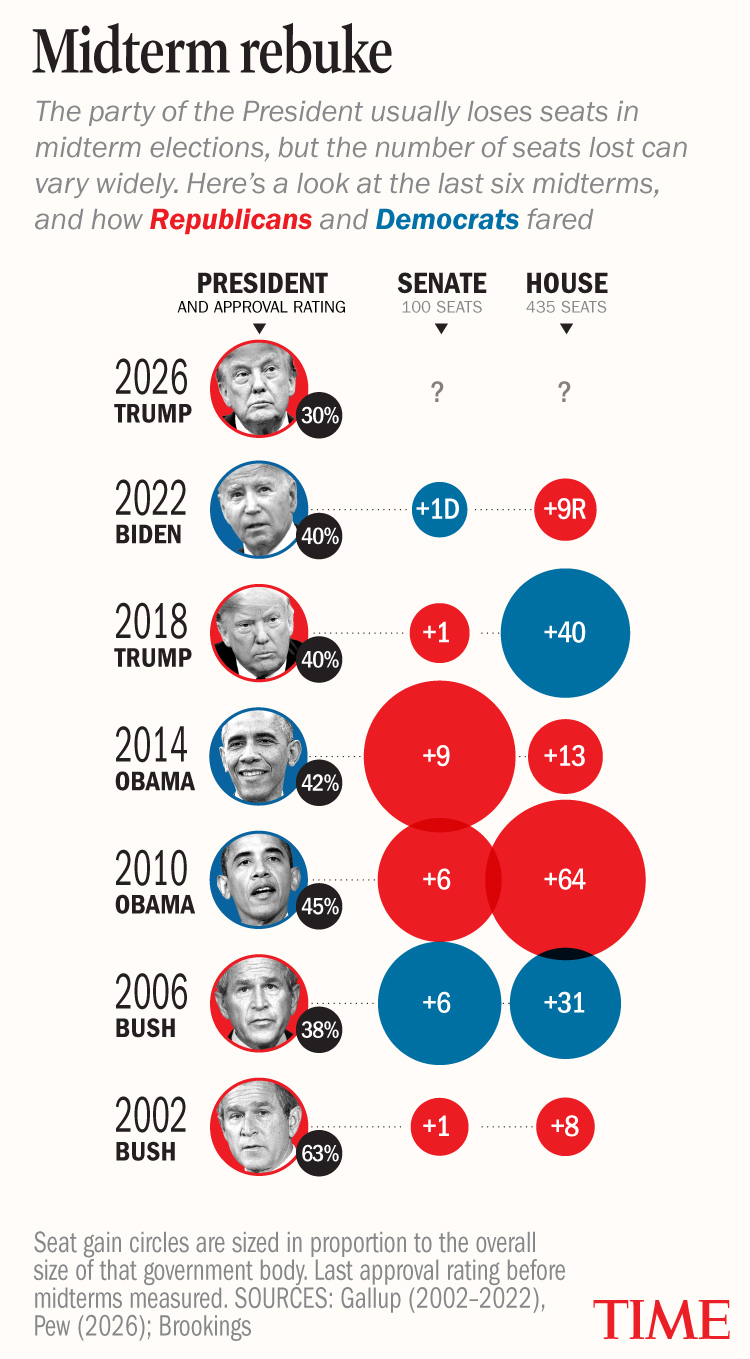
President Donald Trump’s approval rating has dropped to its lowest point of his second term. Pew Research Center reported a 30% approval rating in early October. This is the lowest for any president heading into the midterms in decades, with the last similar instance being Harry Truman in 1946.
Economic Concerns and Approval Ratings
A large part of the dissatisfaction with the Trump Administration seems tied to the economy. A survey by The Associated Press-NORC Center for Public Affairs Research found only 26% of U.S. adults support Trump’s handling of it. The poll further shows a mere 17% approval for managing the cost of living.
Moreover, the AP-NORC poll revealed that only 28% approve of Trump’s approach to the conflict with Iran. Peter Enns, a professor at Cornell University, emphasized that Trump’s approval ratings suffer because he supports unpopular policies.
Key Voting Issues
The economy appears to be a critical issue for voters. Pew Research Center found that 84% of registered voters consider it ‘very important’ for the midterms. Foreign policy also ranks high, with 57% identifying it as ‘very important’ for their choices.
Challenges for the Incumbent Party
Midterm elections are typically challenging for the sitting president’s party. Enns notes that the White House party usually loses congressional seats, a pattern driven by disappointment from supporters and opposition alike.
Costas Panagopoulos of Northeastern University suggests voters often seek ‘partisan balance in Washington.’ When policies do not satisfy, voters may back the opposition especially when one party, like the Republicans, controls the presidency and both Congress chambers.
Historical Exceptions and Trends
While 2002 saw Republicans gain seats, such outcomes are rare. The GOP’s success then is attributed to President George W. Bush’s high approval post-9/11. In 2022, despite low expectations due to President Biden’s approval rating, Democrats gained Senate seats unexpectedly.
Michele Swers from Georgetown University highlights events like the overturning of Roe v. Wade influencing election outcomes in ways not reflected in poll predictions.
Impact of Presidential Approval on Midterms
Swers regards midterms as a referendum on presidential performance. While not directly on the ballot, the President influences votes against his party; discontent affects congressional results.
Panagopoulos stresses that approval ratings forecast midterm outcomes effectively. A lower rating typically predicts more seat losses for the president’s party.
Republicans’ Prospects
Experts agree Republicans face a tough political climate. Generic ballot polls show Democrats leading. Democratic voter enthusiasm is higher, with 91% of Democrats versus 86% of Republicans expressing eagerness to vote, as per a PBS News/NPR/Marist poll.
Panagopoulos foresees Republicans losing seats in both chambers, questioning if it will suffice to lose majority control. Enns advises that polls offer a ‘snapshot in time’ and actual voter turnout remains uncertain until Election Day.
Leave a Reply