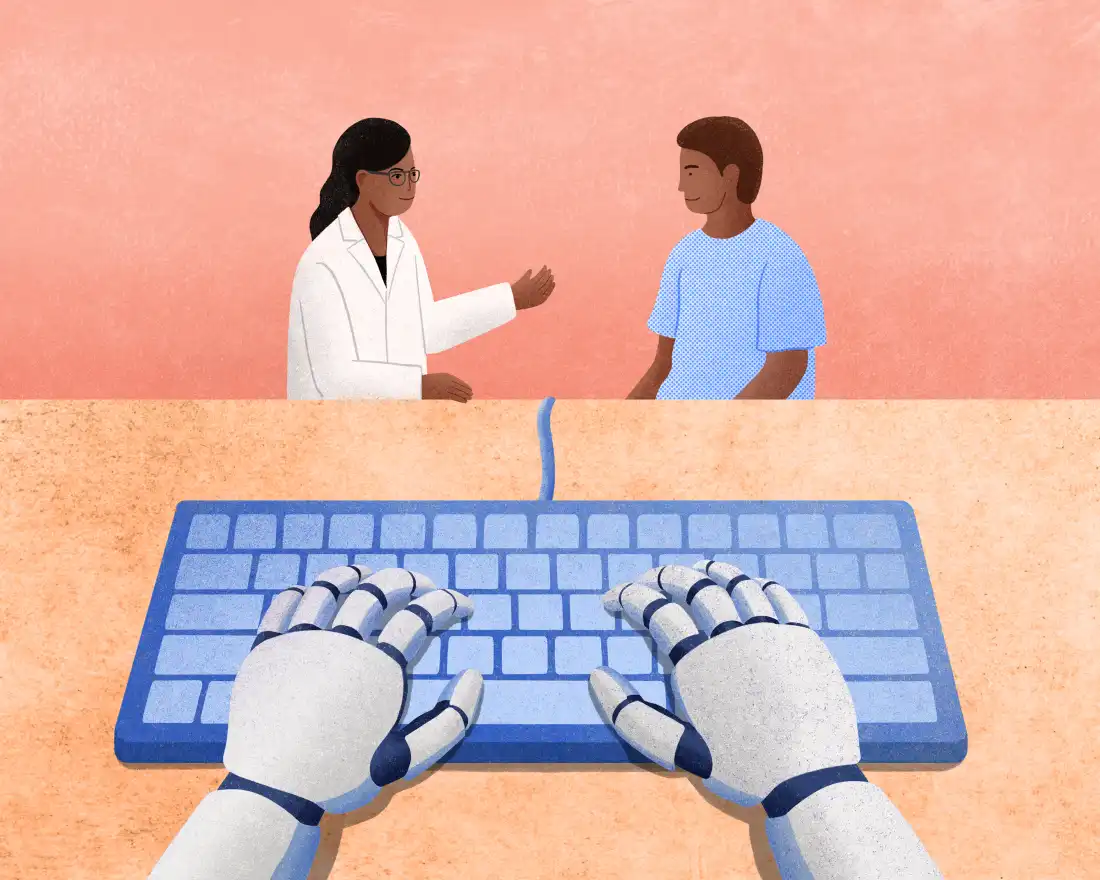
Dr. Mara Gordon, a family physician from Camden, N.J., discusses the rising trend of artificial intelligence (AI) scribes in medical practice. She explains both the benefits and concerns they bring.
Patient Concerns
Many patients express discomfort when AI is used to listen in on their medical discussions. Dr. Gordon states that AI scribes are becoming common across various medical fields. They help with notetaking by recording conversations and generating summaries for medical records.
Personal Experience
Dr. Gordon shares her own experience with AI scribes. They allow her to focus more on her patients by minimizing the need to multitask between recording and conversing. This enables better patient interaction without the distraction of constant typing.
How AI Scribes Function
AI scribes utilize technology known as ‘automatic speech recognition.’ When activated on a smartphone, they record conversations, differentiate voices, and transcribe them into preliminary notes following standard medical formats. These notes include patient discussions, physical findings, and medical decisions.
Software Characteristics
Users can choose from various AI scribe software, ranging from integrated systems to mobile apps. Dr. Gordon uses a personal smartphone app, which sometimes leads to operational hiccups, such as notifications interrupting recordings.
Privacy Considerations
Even when using personal devices, patient data is not stored on them. Instead, it’s uploaded to a HIPAA-compliant cloud, ensuring privacy. AI scribe companies are liable for protecting data and preventing breaches through encryption and controlled access.
Potential Errors
AI scribes can occasionally make mistakes in transcription. Dr. Gordon cites an instance where a patient’s misunderstanding led to incorrect medical record entries. According to Dr. Eileen Kim, such errors could proliferate if unchecked, affecting patient records significantly.
Doctor Responsibility
Doctors remain accountable for the accuracy of AI-generated notes. Dr. Gordon underscores the importance of reviewing and revising these notes to accurately reflect medical insights, despite AI assistance in administrative tasks.
Health Equity Issues
AI scribes currently support only English-speaking patients. This raises concerns about unequal access, potentially widening health disparities. Patients may also feel uncomfortable discussing sensitive topics, fearing AI eavesdropping might compromise their privacy.
Data Usage and Security
Generally, AI scribe companies delete recordings after use, focusing on patient privacy and liability reduction. Though deemed ‘digital gold’ for analyzing and improving doctor-patient communications, these recordings are not typically used for studies.
Opting Out
Patients have the option to decline AI scribing software, reverting to manual note-taking methods. However, completely avoiding AI in healthcare is challenging since AI is widespread across various applications like billing and risk assessments.
AI’s Future in Medicine
Many speculate about AI replacing doctors. Dr. Kim and Dr. Gordon agree that AI tools like scribes might shift patient experiences by freeing doctors from administrative tasks. Yet, the human element remains irreplaceable in medical care.
Dr. Mara Gordon remains optimistic about AI’s potential benefits and acknowledges the risks associated. However, she emphasizes the core doctor-patient relationship as irreplaceable by any technology.
Stay connected with Dr. Mara Gordon through her newsletter ‘Your Doctor Friend’ on Substack.
Leave a Reply