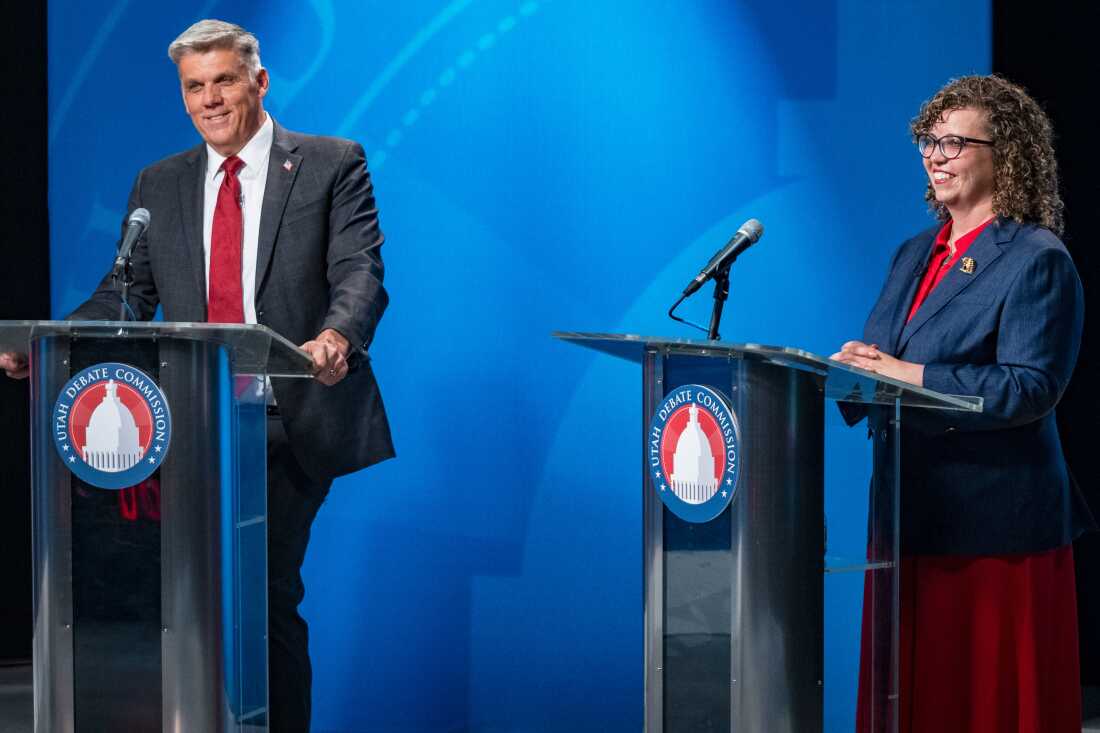
The GOP Debate in Utah’s 3rd Congressional District
During the Republican primary debate for Utah’s 3rd Congressional District, candidates Phil Lyman and Rep. Celeste Maloy presented their visions for Republican voters. Despite Utah’s conservative history, the state’s relationship with former President Trump has been complex, influencing the primary campaigns.
Utah’s Unique Conservative Landscape
Utah stands as a firmly Republican state. The last time it supported a Democrat for president was under Lyndon B. Johnson in 1964. However, Trump’s appeal in Utah differs from other red states. In 2016, he secured less than 50% of Utahns’ votes, marking the smallest margin of victory for a Republican state. Although Trump’s support increased in subsequent elections, he never exceeded 60%.
Political science professor Chris Karpowitz from Brigham Young University explained that while many Utah Republicans have accepted Trump enough to vote for him, they don’t necessarily support his style or all of his policies. Many voters remain loyal to the Republican Party rather than the president himself.
Trump’s Influence and Utah’s Congressional Primaries
The 3rd Congressional District candidates, Maloy and Lyman, both supporting Trump, have avoided extensively mentioning him on their campaigns. They focus on key district issues, diverging from the trend where loyalty to Trump was a defining factor in Republican candidacies.
Rep. Celeste Maloy, the more policy-driven candidate, contrasts with Phil Lyman, aligned with the America First and Freedom Caucus movements. The primary election will reveal the brand of Republican support in the new third congressional district.
The Diverse and Vast District
The new district emerged from redistricting after court intervention over voting map violations. It’s vast, stretching from Utah’s northern region to the southern border with Arizona, encompassing rural areas, national parks, Park City, Salt Lake suburbs, and regions like Provo, aligning heavily with the Church of Jesus Christ of Latter-day Saints.
Maloy secured Trump’s endorsement in 2024 but narrowly won the primary by over 200 votes. Meanwhile, Lyman, familiar to voters from his gubernatorial run, tries a new approach. Pardoned by Trump for an illegal protest, Lyman seeks to tackle governmental establishment, promote rural viability, and enhance transparency.
Lyman’s Vision and Freedom Caucus Alignment
Lyman advocates for limiting federal government, retaining individual autonomy, and believes closer governance to the people is preferable. Drawn to the Freedom Caucus, he desires to bolster middle-class roots within the Republican Party.
Missing in Lyman’s pitch is overt loyalty to Trump. While a known supporter, broadcasting his affiliation may not be advantageous. Karpowitz notes Utah Republicans are ambivalent about Trump, motivated more by party loyalty.
Campaign Strategies and Voter Engagement
In populous areas like Utah County, Lyman’s campaign volunteers focus on his transparency and anti-corruption stance rather than his Trump support. They emphasize his suitability for local concerns.
Maloy, emphasizing her legislative accomplishments, refrains from framing her initiatives as Trump’s policies, opting for broader appeal regarding tax cuts and committee work.
The Fine Line of Republican Representation
Damon Cann from Utah State University observes Utah’s Republican delegation successfully navigating party alignment without deeply embracing Trumpism or rejecting it.
As the primary approaches, Trump’s endorsement for Maloy on Truth Social could reinforce her campaign but lacks previous impact seen in states like Texas.
Karpowitz suggests Trump’s endorsement, although not detrimental, may not carry substantial weight given Utah Republicans’ ambivalent stance toward him.
Leave a Reply