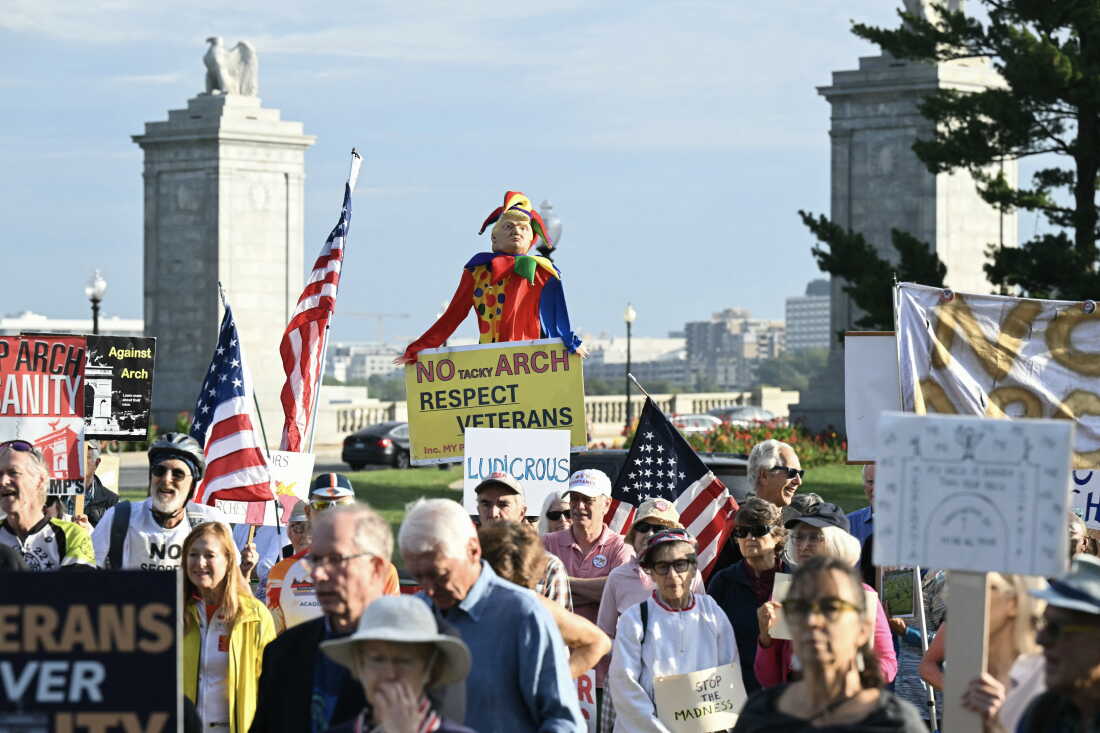
Dozens of demonstrators convened at Memorial Circle in Washington, D.C., on a Thursday morning. Their mission was to protest the proposed 250-foot-tall arch that President Trump aims to erect. This structure would be located at the traffic circle connecting the National Mall to Arlington National Cemetery, stirring controversy over its scale and impact.
Protesters, including veterans, retirees, and lawmakers, voiced their concerns about the arch’s massive size, its cost, its lack of Congressional approval, its impact on Arlington National Cemetery, and its aesthetic gaudiness. A mockup made of tarp stood at the site, showcasing the proposed arch’s dimensions, which would be 32 times taller.
“It’s the wrong monument, in the wrong place, at the wrong time, dedicated to the wrong man,” said Jon Gundersen, a retired Army veteran. Gundersen, who traveled from South Carolina, is among the Vietnam War veterans suing the Trump administration over the structure. The protest, labeled “Vets over Vanity,” was partly organized by Public Citizen, the group leading the lawsuit.
Gundersen emphasized bipartisan agreement against the arch, highlighting a shared view that it does not honor veterans but wastes money. Many speakers highlighted the inappropriate prominence of the arch over Arlington National Cemetery without input from veterans and gold star families.
Senator Tammy Duckworth, D-Ill., expressed strong opposition, criticizing the proposal for its perceived disregard for those who served and are commemorated in Arlington. Duckworth argued the funds could better serve veteran services rather than an extravagant monument with an observation deck.
In contrast, the White House asserted the arch would enhance the visitor experience at Arlington, serving as a visual tribute to American heroes’ sacrifices. Yet, Duckworth and others called for funding allocation towards veterans’ welfare rather than an ostentatious structure.
During the protest, participants stood near the mockup, calling attention to tourism concerns over funerals at Arlington. Gundersen remarked, “Imagine tourists coming up to this arch looking at the 24 to 27 funerals up there in Arlington. It’s obscene.”
In spontaneous gestures of support, cyclists and passing commuters showed solidarity with waves and honks as planes flew over the area, underscoring concerns about aviation safety raised by the proposal. Trust in the project faltered further following Trump’s announcement that military drones and snipers would feature in the structure.
“Who are the snipers going to shoot — the families at the graves or the tourists at the Lincoln Memorial?” questioned Representative Don Beyer, D-Va., referencing potential pretenses of national security and legal consequences.
The administration and relevant authorities have refrained from explaining military use and federal approval implications, despite confusion. Historic preservation groups received indication from the administration of proceeding with the arch’s original proposal.
The National Capital Planning Commission anticipates reviewing the proposal soon. Amid ongoing federal review, the National Park Service engaged with stakeholders to minimize harm to adjacent landmarks. Yet, recent cessation of the review process by the Advisory Council on Historic Preservation led to significant disquiet among preservation advocates, citing limited discussion.
Charles Birnbaum from The Cultural Landscape Foundation deplored the abrupt closure of the council’s review, interpreting it as an overlook of valuable stakeholder input. Consequently, the council will present recommendations directly to Interior Secretary Doug Burgum by October 7, advocating for ongoing historical site protection issues.
The matter has also intertwined with legislative developments, as a bipartisan permitting reform bill progresses in Congress, potentially affecting regulatory protections. Separate from legislative action, demonstrators vowed sustained protest against the arch’s construction.
“We have to continue to call in to our senators, our congresspeople, and let them say no to this arch,” asserted Julius D. “JD” Spain Sr., member of the Arlington County Board. He passionately promised to resist if construction succeeded, evoking a powerful response from the crowd.
Beyer echoed readiness for extensive resistance, projecting a “huge body of people ready to protest” the project.
There remains a governmental intervention prospect. Congress could impede the arch through budgetary constraints, yet earlier efforts faced GOP opposition. Duckworth criticized the Republican alignment, tying its electoral consequences to the upcoming midterms, potentially impacting project fate.
Leave a Reply