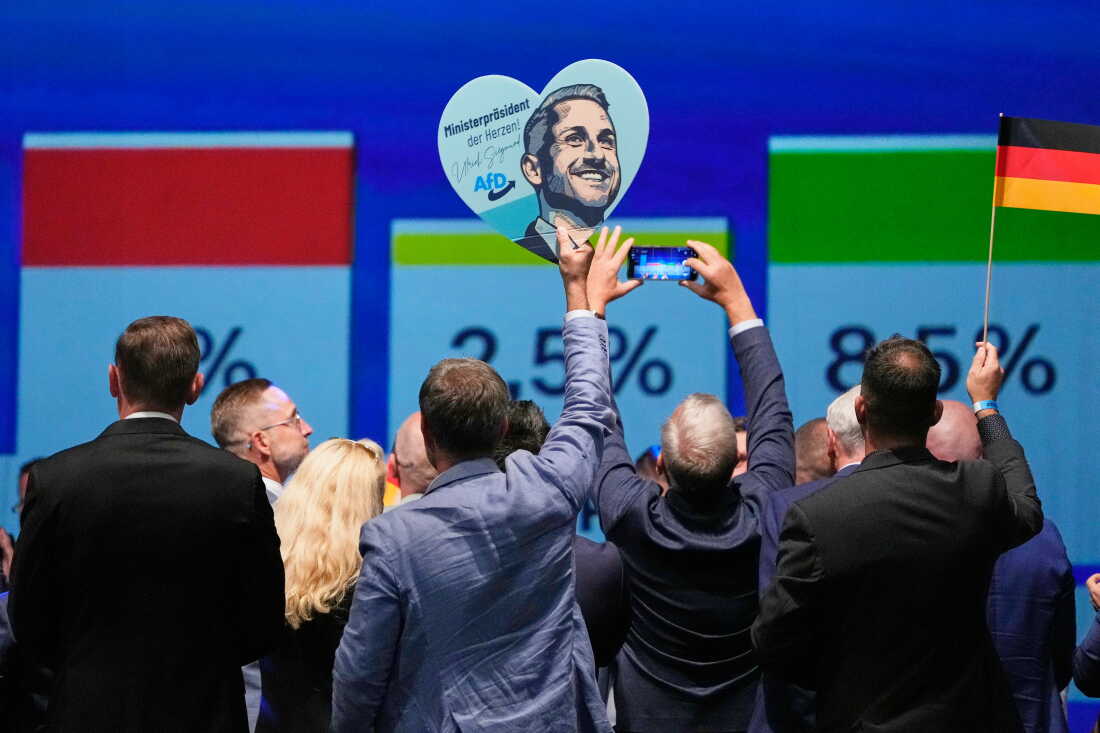
In the recent Saxony-Anhalt state election, supporters of the Alternative for Germany (AfD) party celebrated what they declared as a victory, marked by prominent displays featuring top candidate Ulrich Siegmund. This election, held on Sunday, September 6, 2026, revealed significant gains for the AfD, a populist, far-right party.
Election Results and Political Impact
The AfD managed to more than double its share of the votes, achieving 43.8%, according to preliminary results. This marks the party’s strongest performance in any German state election, edging close to obtaining political power unseen since the Nazi era. Despite missing an outright majority, the political climate in Saxony-Anhalt is shifting.
The Christian Democratic Union (CDU) saw its support halved, dropping to an all-time low of 17.2%. Meanwhile, the Social Democrats (SPD) garnered 9.3%, the Greens 8.9%, and the Left party 8.6%. All these parties have declared they will avoid coalition with the AfD. Nevertheless, the AfD might ally with the small, anti-immigration, left-wing BSW party, which won 5.3% of the vote. This alliance could grant them a parliamentary majority.
Ulrich Siegmund, AfD’s candidate for state governor, emphasized this result as a message to Berlin, asserting a desire for a return to a ‘secure’ Germany.
Reactions from Political Figures
Christian Democrat candidate Sven Schulze acknowledged AfD’s success. Despite prior polls, the CDU underperformed. It remains uncertain whether Schulze will attempt a coalition strategy to block the AfD from governance. This approach would require partnering with Die Linke, a far-left party, which the CDU is against.
Schulze remarked, “Some say this is a dark day for Saxony-Anhalt. I say this is democracy.”
Alice Weidel, AfD’s federal co-chair, predicted the CDU’s continued electoral struggles, citing national growth for the AfD.
Siegmund’s Strategy and AfD Policies
Siegmund, a 35-year-old former marketing executive, effectively engaged potential voters through positive slogans and social media presence. This upbeat approach contrasts the typical AfD tone. Despite this, Germany’s domestic intelligence recognizes the AfD in Saxony-Anhalt as extremist, highlighting their ‘remigration’ policy, which entails mass deportations, including for jobless Ukrainian refugees.
The party also advocates educational segregation for refugees and disabled children, alongside altering historical teachings to reflect a ‘positive’ national narrative.
International Reactions
Post-election, notable international figures reacted to the results. Former U.S. President Donald Trump and Russian envoy Kirill Dmitriev applauded the outcome. Tesla CEO Elon Musk also expressed support, which Siegmund publicly acknowledged.
Conversely, Polish Prime Minister Donald Tusk criticized any positive reaction to the AfD’s success, calling it idiocy or treachery. France’s Europe minister, Benjamin Haddad, warned of serious implications for Europe.
Leave a Reply