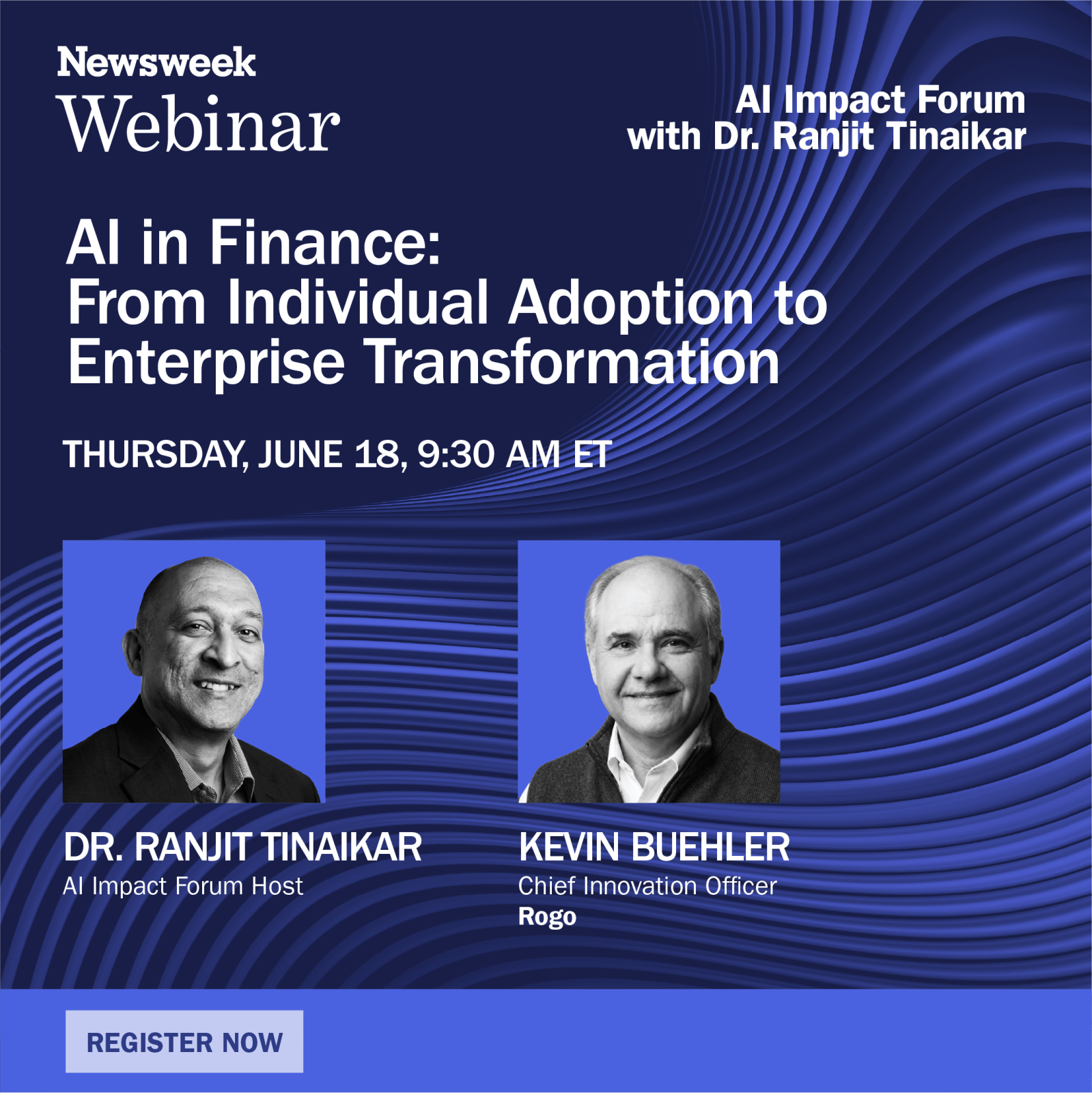
New AI tools are enhancing the efficiency of financial professionals in research, analysis, presentations, and client service. The crucial question, according to Kevin Buehler, chief innovation officer at Rogo and senior partner emeritus at McKinsey & Company, is how firms utilize this new capacity. Will it enable coverage of more clients, analysis of more markets, and a focus on critical judgment work? Or will AI improvements remain isolated, scattered gains across organizations?
These topics will be central in Newsweek’s upcoming webinar, “AI in Finance: From Individual Adoption to Enterprise Transformation,” on Thursday, June 18, at 9:30 a.m. Eastern. Dr. Ranjit Tinaikar, the host, will discuss with Buehler how agentic AI could revolutionize financial services, impacting analysts, investors, software companies, and service firms.
According to Buehler, AI already affects junior professionals clearly, especially in tasks involving PowerPoint, Excel, communications, and analysis. “AI tools and the rise of agentic AI are making significant differences at the operational level,” Buehler noted. However, individual adoption is just the initial phase.
The next phase could involve integrating AI into entire business processes rather than just individual tasks. Examples include client onboarding, M&A transactions, and lending, which are complex financial workflows ripe for AI-enhanced transformation. “Using AI to transform processes in these areas represents today’s frontier,” Buehler stated.
Jobs in the financial sector will also be debated, though Buehler does not see AI’s impact as a simple replacement narrative. The pressing concern is how institutions plan to repurpose the time and capacity AI creates. Some may opt for cost savings, while others might broaden their service coverage, focus more on client relationships, seek new opportunities, or invest time in training junior employees.
Faster individual productivity does not necessarily translate to enterprise-wide change. Firms must determine AI’s role within their overarching strategy. Buehler outlined three main stages of AI adoption.
- The first stage involves junior-level staff using AI to speed up daily tasks.
- The second stage includes senior leaders consistently incorporating AI and learning to manage AI-augmented teams.
- The third stage involves redesigning end-to-end workflows using AI.
According to Buehler, most firms have not yet reached this comprehensive third stage. Progress will require an economically driven strategy, support from senior business leaders, improved data systems, talent development, and change management efforts. “Good data often presents a challenge in these initiatives,” Buehler mentioned. “Additionally, employees need upskilling as hiring new talent to fill these roles is not always feasible.”
The June 18 session will also link AI adoption within financial institutions to the broader economic impacts of AI. Tinaikar and Buehler will explore the continuing importance of human curation, the value creation possible through domain-specific AI applications, and how commercial models might evolve as AI begins to perform rather than merely support some tasks.
The competitive edge could hinge on AI’s role, whether it stays a personal enhancement tool or becomes fundamental to business operations. Buehler observed that many firms are still at the “very early stages” of embracing AI-driven transformation.
Register for the webinar, free of charge, today to gain more insights.
Leave a Reply