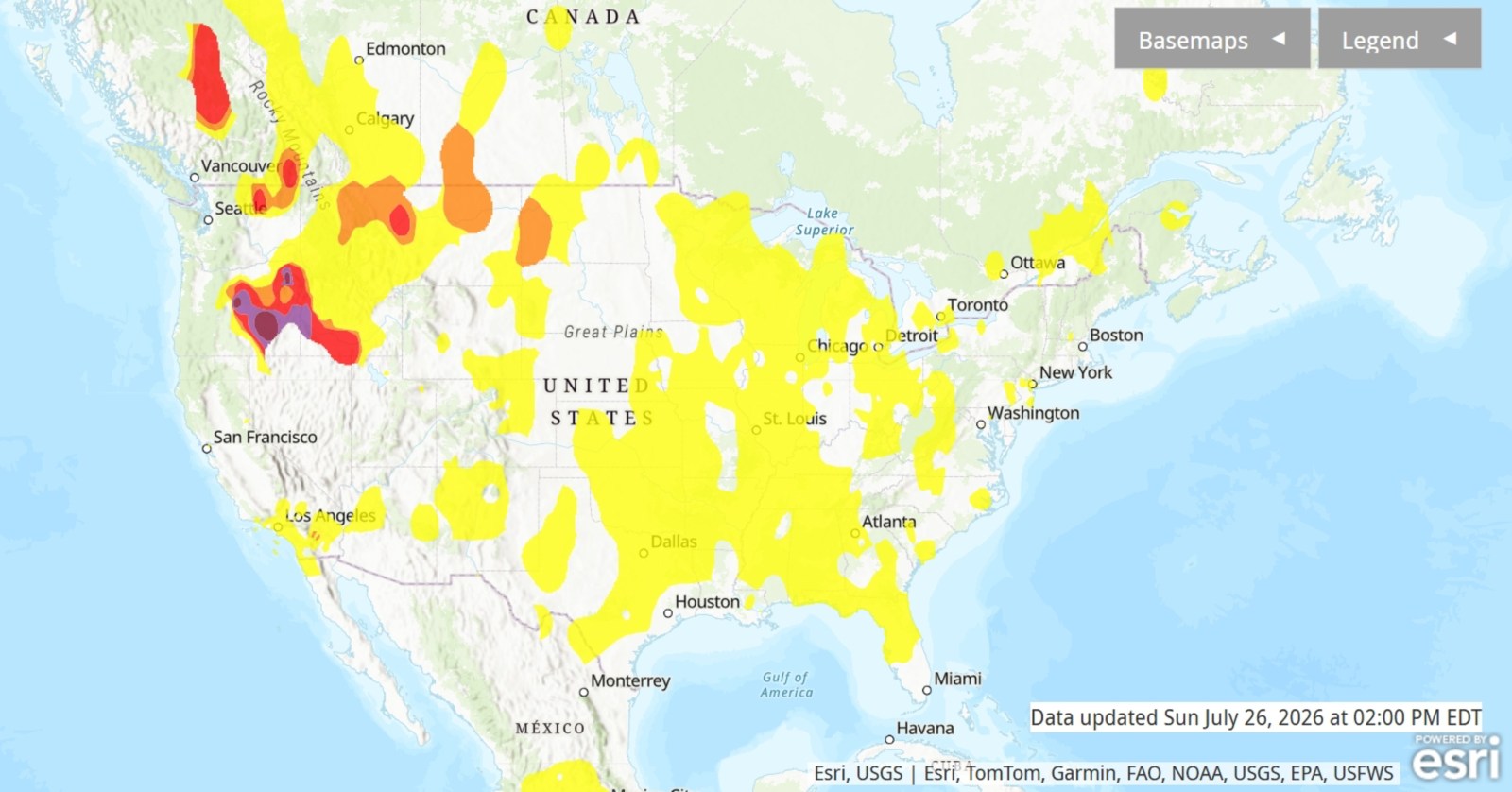
Air quality alerts have affected significant areas of the western United States. On Sunday, wildfire smoke and elevated ozone levels contributed to poor air conditions in Oregon, Idaho, Washington, Montana, Colorado, and California.
According to AirNow, a monitoring platform operated by the Environmental Protection Agency (EPA), smoke from ongoing fires in Canada and the Pacific Northwest primarily caused widespread “unhealthy” air conditions. Authorities advised those in impacted areas to stay indoors, limit outdoor activities, and exercise caution if they have asthma, heart conditions, or other respiratory issues.
Primary Health Threats
The main danger to health comes from fine particulate matter, known as PM2.5. These particles are small enough to reach deep into lung tissues, posing significant health risks.
Air Quality Warning Maps
AirNow maps revealed central and eastern Oregon experienced the most severe pollution, with some areas reaching the “Hazardous” category on the Air Quality Index (AQI), the highest level indicating emergency conditions affecting all individuals.
“Stay inside if possible. Keep windows and doors closed,” warned an alert from the Oregon Department of Environmental Quality for Baker County. This alert remains active until late Monday, covering over 16,000 residents.
Particulate concentrations can change quickly due to shifts in wind and weather patterns, as noted by Oregon officials.
Other Affected Regions
Conditions worsened to “unhealthy” and “very unhealthy” levels in neighboring Idaho. The Idaho Department of Environmental Quality (DEQ) issued an advisory for counties including Ada, Adams, Boise, and others until Tuesday afternoon. Advisories also extended across northern Idaho and the Nez Perce Reservation.
“Air pollutants can cause breathing difficulties for children, the elderly, and those with respiratory problems,” stated the Idaho DEQ in an alert. They advise sensitive individuals to avoid extended outdoor activities and have prohibited open burning. Others should limit outdoor exertion as well.
Washington State faced similar challenges with wildfire smoke, with “unhealthy” air flagged in north-central regions and “unhealthy for sensitive groups” in the northeastern area.
In Montana, the DEQ issued an alert for several counties, including Choteau and Missoula, due to high particulate levels from the smoke. This alert will expire at 9 a.m. on Monday.
Smog in Colorado and California
Meanwhile, concerns in Colorado and California arose from ozone rather than smoke. Colorado issued an Ozone Action Day Alert for Denver and nearby areas, where hot weather increased ozone to unhealthy levels for sensitive groups. In California, the South Coast Air Quality Management District warned of high smog levels in parts of Los Angeles County, including the San Fernando, San Gabriel, and Santa Clarita valleys.
Looking Ahead
Federal and state officials recommend that residents continually monitor AQI readings, as conditions can change quickly. AirNow’s Monday forecasts suggest that heavy smoke will impact Idaho and Washington more prominently, while Oregon’s air quality might improve. Public health agencies advise vulnerable individuals—such as children, the elderly, and those with heart or lung issues—to reduce outdoor activities and use indoor air filtration until alarms cease.
Leave a Reply