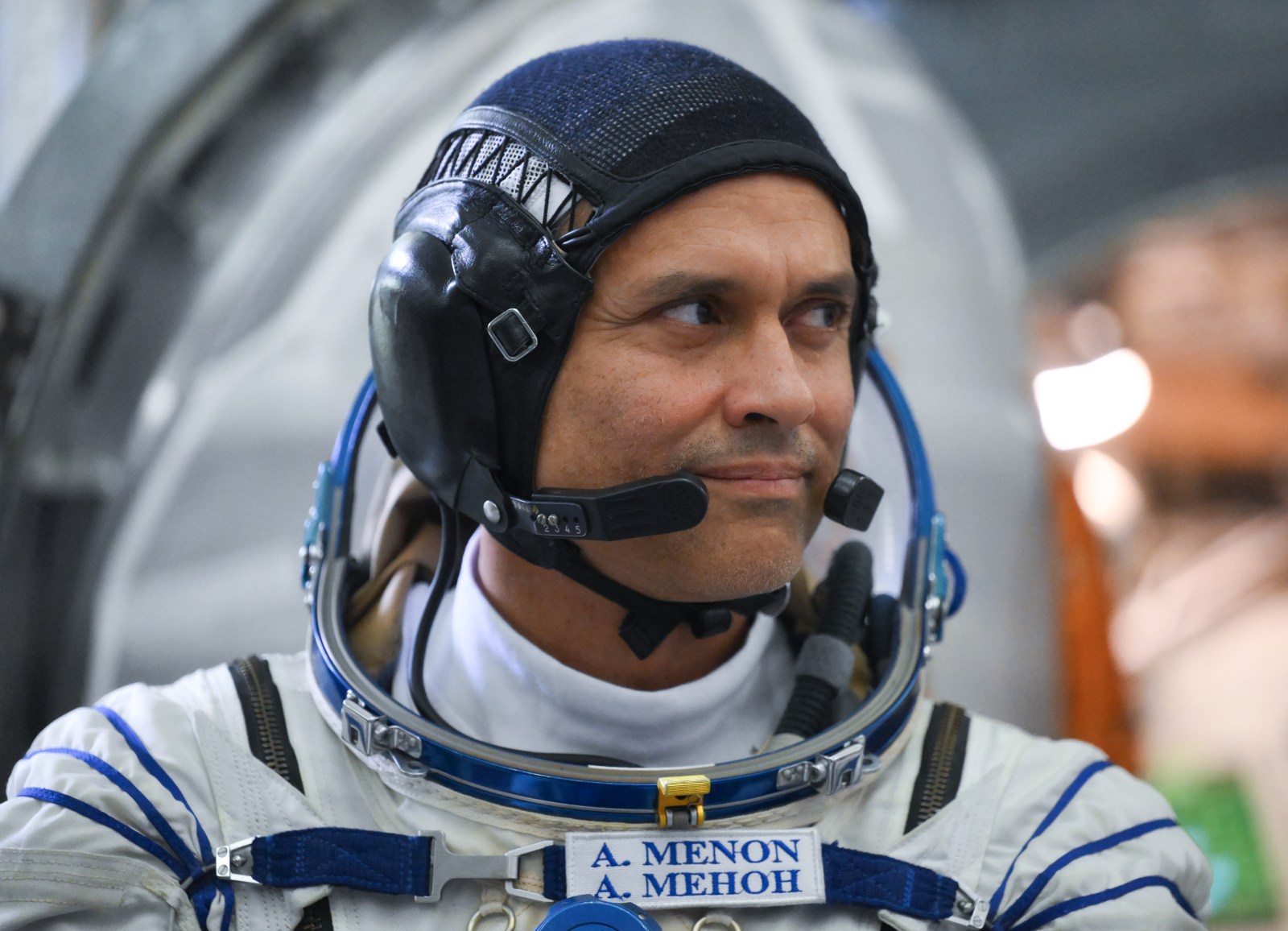
NASA astronaut Dr. Anil Menon is set to embark on an eight-month mission in orbit with a plan to investigate the possibility of extraterrestrial life. Dr. Menon, an emergency medicine physician and U.S. Space Force colonel, will launch aboard the Soyuz MS-29 mission. His work will primarily focus on the physiological impacts of extended spaceflight. However, he will also explore the potential presence of microbiological life through spacewalks.
Testing the Limits of Microbial Survival
Dr. Menon aims to discover whether any bacteria can survive the harsh conditions outside the International Space Station (ISS). This experiment will assess the resilience of biological organisms against space’s unfiltered environment, which includes cosmic radiation and extreme temperature variations. According to Dr. Menon, previous findings suggested it might be possible for bacteria to endure these conditions, but concerns about contamination persisted. He emphasized the importance of a controlled experiment to ensure accurate results.
The results of this investigation will be publicly shared, especially following the U.S. government’s decision to declassify numerous UFO sightings. Dr. Menon stated he would disclose any interactions with extraterrestrials if they occur.
Focusing on Human Physiology in Space
While the search for microbial life is a significant aspect of the mission, Dr. Menon’s primary focus will be assessing the effects of space travel on the human body. His education and background in medicine have prepared him to observe these changes firsthand. This research is crucial for advancing plans to travel to and potentially inhabit Mars.
Space travel poses unique challenges, such as the loss of bone mass. Studies have shown that astronauts can lose up to 3% of their bone mass each month in space. Through specialized resistance exercises, this can be mitigated. However, different approaches will be necessary on Mars due to its varying gravitational influence.
Preparing for Mars and Overcoming Challenges
Living on Mars could present further obstacles, including exposure to toxic elements like perchlorates. The ISS serves as a foundation to explore these challenges and devise solutions. Dr. Menon acknowledged the personal challenges of being away from his family but expressed gratitude for the ability to stay connected through video calls.
About Dr. Anil Menon
Dr. Anil Menon is a multifaceted individual, combining roles as a physician, engineer, military officer, and NASA astronaut. Raised in Minneapolis, his educational journey took him to Harvard for neurobiology, and then to Stanford, where he earned a medical degree and a master’s in mechanical engineering.
Prior to his astronaut career, Dr. Menon excelled in aerospace medicine, serving as a flight surgeon at NASA and SpaceX. His humanitarian efforts include providing medical aid after the Haiti earthquake in 2010 and the Nepal earthquake in 2015. Selected as a NASA astronaut in 2021, he completed training in 2024 and now prepares for his first spaceflight as part of Expedition 75 on the ISS.
Mission Details and Objectives
The Soyuz MS-29 mission, on which Dr. Menon will serve as a flight engineer, is bound for the ISS with Russian cosmonauts Pyotr Dubrov and Anna Kikina. The launch is set for July 14 from Baikonur Cosmodrome in Kazakhstan. The crew will engage in scientific research and technology demonstrations during their eight-month stay.
The mission emphasizes understanding human health in space, testing blood flow, vein structure, and blood composition in microgravity. Another critical aspect is experimenting with producing intravenous fluids from the station’s water—a vital step for future long-duration missions to the moon and Mars.
Broad Impacts of the Mission
This mission represents a major milestone for Dr. Menon, transitioning from a support role to an active astronaut. It also highlights humanity’s goal to use the space station as a springboard for future lunar and Martian exploration. Special attention is on addressing the effects of microgravity and the new environmental challenges on Mars.
Elon Musk’s vision of city-to-city travel using rockets underscores the technological milestones yet to be achieved. Dr. Menon notes the necessity of proving these technologies, emphasizing the ongoing learning process.
Public Interest in UFOs
The mission aligns with heightened interest in extraterrestrial matters, partly due to the U.S. government declassifying numerous Unidentified Anomalous Phenomena (UAP) records. Released since 2026, these records include military reports, videos, and documents detailing unusual sightings. Although this transparency effort aims to share more information, neither the Pentagon nor NASA has confirmed these as evidence of alien spacecraft.
Leave a Reply