Brazil employs forensic science to address illegal gold mining in the Amazon. This practice poses a major threat to the rainforest, Indigenous communities, and other populations, accelerating deforestation and creating hazardous mercury contamination levels.
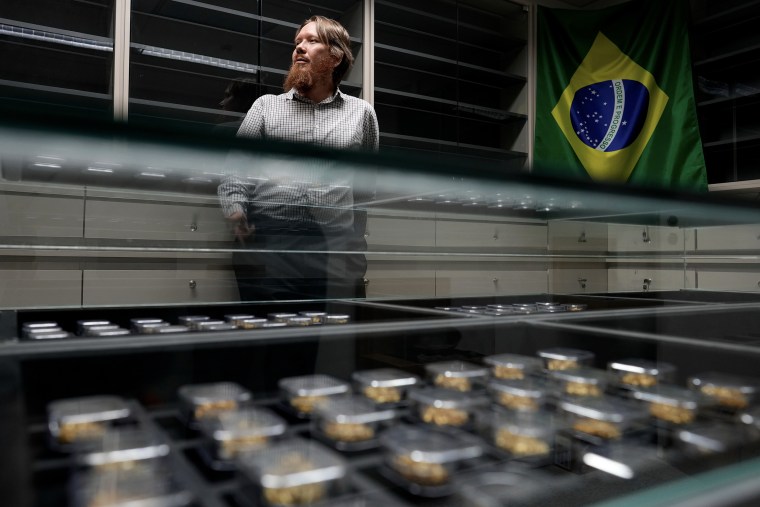
The National Institute of Criminalistics in Brasilia hosts a specialized ‘gold lab.’ The lab gathers and analyzes samples nationwide. The aim is to ascertain if a new gold sample, seized during a police raid for instance, originates from a protected area, indicating it was mined illegally. Experts refer to this process as ‘gold fingerprinting.’ It traces the origin of gold samples with high precision.
The Gold Fingerprinting Process
Tracing gold resembles analyzing a person’s DNA, according to experts. At the lab, small vessels hold gold flakes, each containing distinct data. Gold deposits absorb particles from the surrounding area, including silver and copper traces, forming a unique fingerprint. This allows investigators to determine whether gold seized during raids matches the data stored from protected areas.
Forensic expert Gustavo Geiser at Brasília’s National Institute of Criminalistics explains the process developed since 2019 with Brazilian universities. Techniques like X-ray fluorescence spectrometry and scanning electron microscopy are used.—Eraldo Peres, AP
Geiser notes the forensic examinations have grown complex. The central question remains: ‘Where did this gold originate from?’ If forensics confirm illegal mining, it assists police in building cases, advancing investigations, and potentially pressing charges.
Inserting Illegal Gold into Legal Markets
Environmental criminals in the Amazon often employ fraudulent means to introduce goods, such as gold, cattle, and timber, into legal markets. A rise in worldwide gold prices fuels this mining surge in the Amazon. Amazon Mining Watch estimates around 496,000 hectares of rainforest have been cut down for mining activities since 2023, impacting 223,000 hectares in the Brazilian Amazon.
Brazil’s Federal Court of Accounts revealed that mining permits granted to small-scale miners were misused to launder gold from protected regions. Greenpeace’s independent report in May detailed the fraudulent schemes, noting ‘ghost mine’ scams, where legal mine owners falsely report gold extraction while the operation occurs on bordering Indigenous lands.
A federal court in Para ordered institutions like the Central Bank and National Mining Agency to implement effective gold traceability. Federal prosecutors have filed lawsuits demanding better oversight of mining permits to prevent illegal activity.
Prosecutor André Porreca highlights how these permits front for laundering gold extracted by criminal organizations. Meanwhile, Geiser asserts the Brasilia gold lab plays a critical role by providing verification of legitimate gold origins, strengthening both gold supply chains and financial markets globally.
Challenges and Collaborative Efforts
Information on the number of criminals penalized through the lab’s efforts remains unquantified. However, Geiser acknowledges crime networks exploiting neighboring countries, sending samples to Brazil, where data continuously grows. This regional crime surge necessitated enhanced collaboration through the Amazon International Police Cooperation Center in Manaus.
Impact of Mercury Contamination
The Amazon rainforest plays a pivotal role in regulating global climate. Deforestation and degradation risk accelerating global warming. MapBiomas, a nonprofit monitoring land use, reports over 90% of Brazil’s mining occurs in Amazonia, with nearly 40% being illegal.
Illegal gold mining contributes less to deforestation compared to agriculture, yet causes irreversible harm due to mercury use. Mercury contaminates rivers, impacting water sources and the survival of Indigenous populations. A 2023 study by Fiocruz found that 21.3% of market fish exceeded WHO mercury safety limits, with young children consuming mercury at alarming levels.
Brazil signed the U.N. Minamata Convention to phase out mercury usage in gold mining, drafting proposals in discussion. Despite urgings from federal prosecutors, Indigenous groups, most affected by contamination, have not yet been consulted.
A total mercury ban would curb environmental damage and bolster forensic investigations. Geiser asserts detecting mercury traces would reinforce mining’s illegality.
Leave a Reply