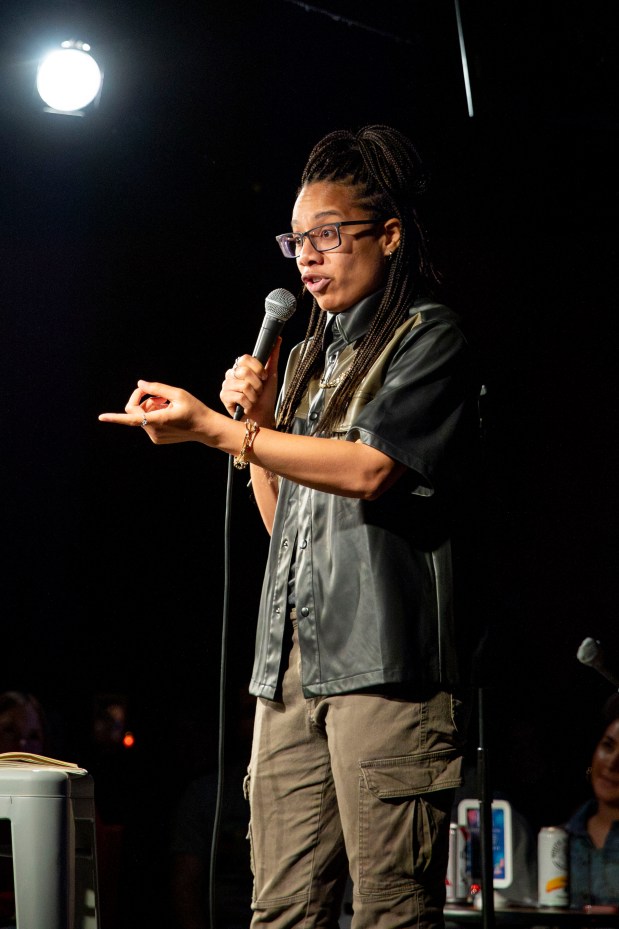
Letonia Copeland-Hardin places great value on earning the trust of her audience. As a postdoctoral researcher at the University of Chicago, she engages with community members in her studies on pollutant exposure and cancer risks. As a stand-up comedian, she connects with the audience each time she performs. Now, she is merging these two careers to enhance how researchers engage with communities. Alongside Myeshia Shelby and comedian Kelsie Huff, Copeland-Hardin developed ‘Reading and Working the Room,’ a workshop aimed at teaching scientists to use on-stage techniques for better community engagement.
Copeland-Hardin’s interest in comedy dates back to childhood, with aspirations to become a stand-up comedian marked in her school yearbook at age nine. However, she only pursued comedy in earnest in 2019, after a decade in research. ‘I started comedy to cope with the stress and isolation of graduate school,’ Copeland-Hardin explains. Although her careers might seem distinct, the workshop highlights their intersection.
Her research involves community-engaged approaches, fostering collaboration between scientists and community members. ‘You work with community instead of on communities,’ she states. In collaboration with historically harmed Chicago communities, trust-building becomes a crucial and necessary process.
Performing under the name LT, Copeland-Hardin excels in connecting with audiences. At the Future of Comedy Showcase in Chicago, she expertly engaged the crowd by transforming her monologue into a dialogue. The ease of her performance belied the complexity of her jokes. Her ability to weave complicated scientific concepts into her act captivated the audience, even when discussing dissecting a fruit fly’s brain.
The workshop curriculum encourages researchers to incorporate techniques like trust-building to address gaps in scientific training. Many researchers communicate effectively with academic audiences but lack skills for engaging the general public. The curriculum clarifies that humor is not essential in every research discussion. However, by using strategies from the workshop to personally engage with the audience, researchers can rebuild trust and enhance the quality of their data.
‘Reading and Working the Room’ is a freely accessible workshop that anyone can teach or study independently. Interested individuals can download the materials from zenodo.org, including slides and a facilitator’s guide. Copeland-Hardin acknowledges Research!America for funding the project, recognizing the need for enhancing public engagement in scientific training.
Copeland-Hardin believes in the responsibility of scientists to share knowledge with the public. Her dual career reflects a deep-seated desire to connect—with audiences, communities, or even a fruit fly. She consistently finds ways to build those connections.
Leave a Reply