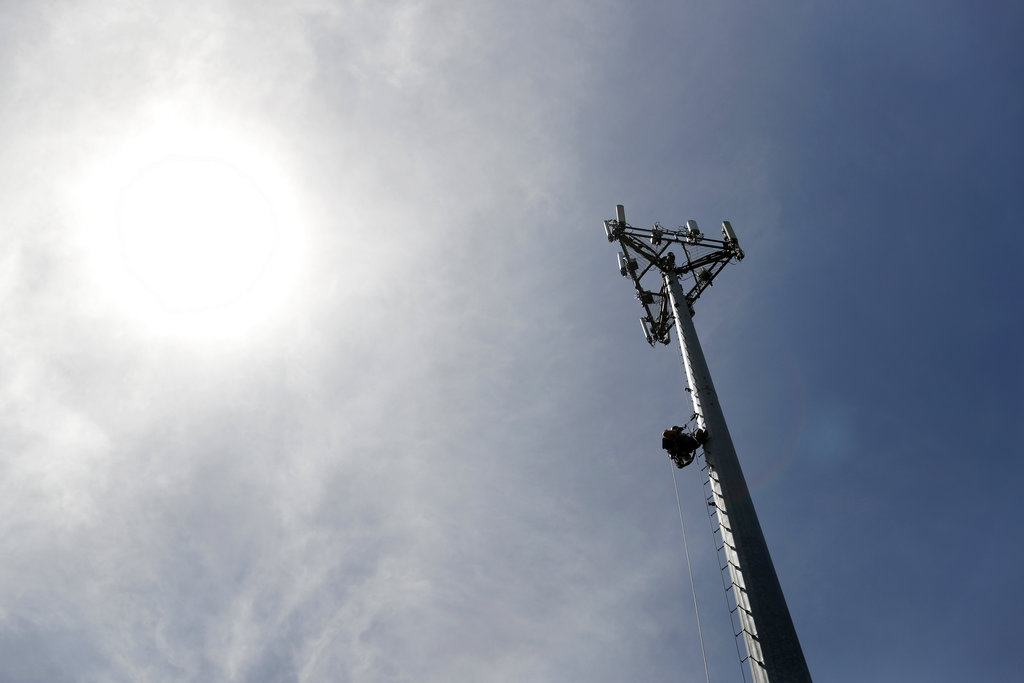
Nick Blase from True North Management Services climbed a cell tower on May 22, 2017, to perform maintenance in High Ridge, Missouri. This example highlights a pressing issue in the U.S. cellular network: coverage disparity. The Federal Communications Commission (FCC) found that while 95% of Americans have access to 5G from at least one provider, only 69% of road miles and 39% of land area receive this coverage. In rural regions, these numbers drop to 60% and 38%.
This challenge, known as the rural-mobile divide, goes beyond household broadband access. It impacts mobile connectivity during driving, farming, hiking, wildfire fighting, or emergency responses. Typical solutions focus on building more cell towers, yet extending networks to every remote area can be economically unfeasible.
The FCC plans to allocate up to $9 billion to enhance 5G networks. Instead of treating each dead zone as an infrastructure challenge, we should explore whether satellites can fill these gaps. Advancements in technology now enable typical cellphones to connect directly to satellites when terrestrial signals are absent. A satellite effectively functions as an orbital cell tower. No specialized equipment is necessary.
All three national carriers are exploring satellites in their mobile networks. T-Mobile offers satellite service via Starlink. This service is part of some T-Mobile plans and available for $10 monthly per line to other eligible users, including those subscribed to competing carriers. AT&T and Verizon have partnered with satellite firms, and the three carriers plan a joint venture to improve direct-to-device coverage and spectrum sharing.
While satellite service isn’t a full replacement for terrestrial 5G, its current capacity can support messaging, emergency communications, and low-bandwidth applications. Voice and advanced data services are in development. Basic connectivity can transform dead zones, enabling crucial activities such as summoning help or reporting incidents.
The deployment of this capability ties into the FCC’s 5G Fund for Rural America. Subsidizing mobile services in areas lacking private investment was suggested in the 2010 National Broadband Plan. Established in 2020, the 5G Fund allocates up to $9 billion over a decade to support mobile service in costly regions.
The current rules require 5G Fund beneficiaries to provide conventional 5G speeds, surpassing today’s satellite capabilities. Before committing to long-term conventional construction, the FCC should create a direct-to-device tier for basic coverage in cost-prohibitive towers zones. It should allow terrestrial-satellite partnerships to bid competitively to deliver the needed coverage.
The FCC could invite carriers to offer bids specifying the minimum subsidy necessary to provide satellite coverage in underserved areas, waiving extra charges. Carriers would only receive support upon satisfying conditions for availability, reliability, emergency communication, and handset compatibility. This aligns with the Communications Act’s promise of “reasonably comparable” urban and rural service access at equitable rates.
“Reasonably comparable” does not imply identical services or pricing. Courts permit the FCC to balance service comparability with affordability and prudent Universal Service Fund use. The balance is evident: exorbitant spending to extend terrestrial networks into tough terrains drains resources from viable tower projects. Leaving these terrains uncovered continues the rural divide, and extra charges on residents mainly encountering dead zones cost them $120 yearly for basic connectivity.
FCC’s requirements call for 5G Fund support recipients to offer rural services at comparable rates, terms, and conditions as their urban counterparts. Incorporating subsidized direct-to-device coverage aligns with established universal-service policies, rather than introducing new pricing rules.
Universal-service policy has consistently adapted to technological and economic shifts in network technology. Direct-to-device technology transforms these elements. The final cell tower to bridge the rural divide no longer needs to sit on a mountain. It can be deployed in orbit through an existing federal fund dedicated to providing remote mobile service economically unreachable by the market.
Blair Levin served as the chief of staff for the FCC and directed the development of the 2010 National Broadband Plan. Larry Downes is the co-author of ‘Big Bang Disruption’ and has written extensively on innovation.
Leave a Reply