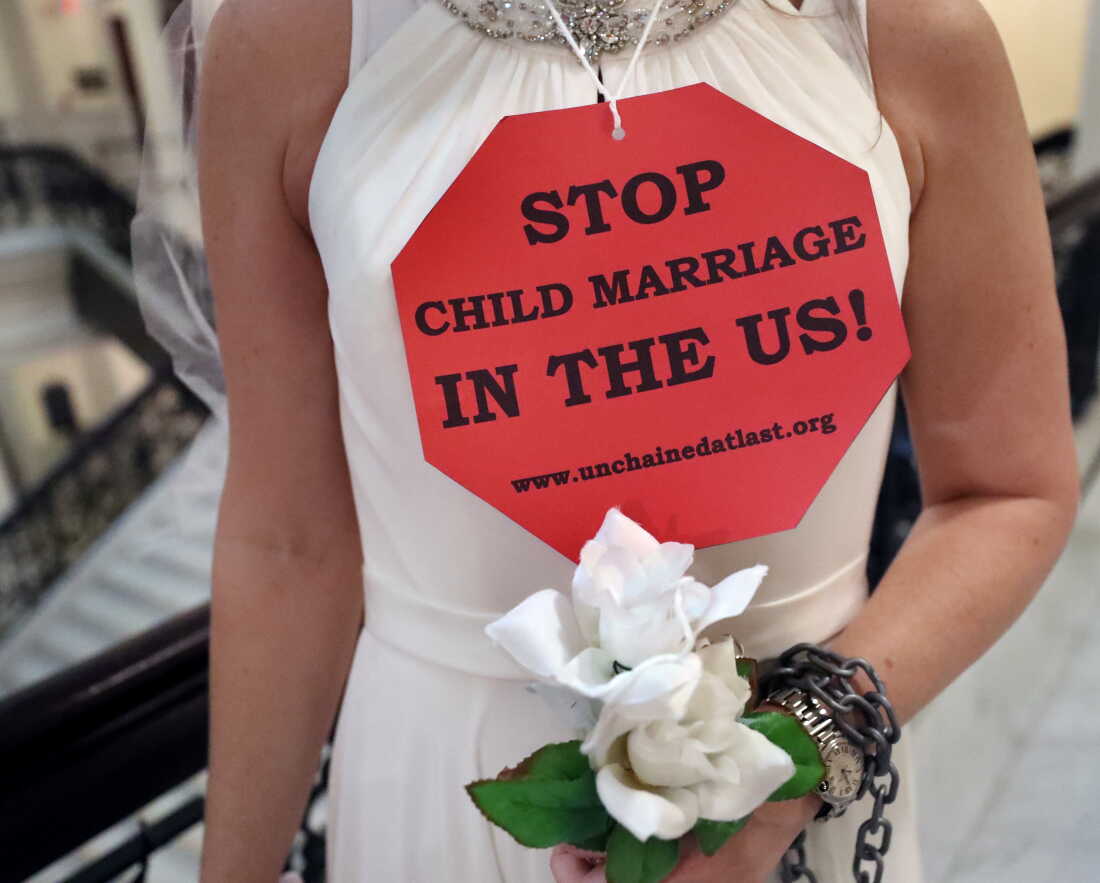
A protestor wearing a bridal gown participated in a demonstration in Massachusetts to urge legislators to end child marriage. This year has marked significant progress for activists fighting against child marriage in the U.S. On September 30, California Governor Gavin Newsom signed Bill AB 1267, establishing 18 as the minimum age for marriage in the state. This bill, authored by Assemblymember Gail Pellerin, was backed by Unchained at Last and the California Commission on the Status of Women and Girls. It repealed prior laws that permitted minors to marry with parental consent and judicial approval, effectively removing California’s lack of a statutory minimum marriage age. The law also disallows minors from entering domestic partnerships.
This achievement is the result of a campaign nearly ten years in the making by survivors and advocacy groups striving to outlaw underage marriage in California. The state becomes the 18th in the U.S. to ban child marriage without exceptions. In the remaining 32 states, such marriages are still legal under certain restrictions. Governor Newsom signed this measure alongside advocate Courtney Stodden, who had been permitted to marry at 16, exemplifying the personal impact of child marriage laws. As Pellerin noted, “The heart of this effort has always been the survivors.” Minors face difficulty in acquiring legal assistance and have limited means to escape potentially coercive marriages.
A Global Issue
Child marriage is a global concern, characterized by the United Nations as a “human rights violation.” It leads to adverse outcomes, including early pregnancy, social isolation, education disruption, and increased risks of domestic violence. The UN estimates 12 million girls become child brides annually. Child grooms face pressure to drop out of school and assume adult responsibilities prematurely. The global aim is to eradicate child marriage by 2030. Since 2021, legislation to set the marriage age at 18 has been enacted in countries including Sierra Leone, England, the Philippines, and the Dominican Republic.
Efforts in the United States
The matter of child marriage is also contentious in the U.S. As states like California initiate reforms, the nation debates the possibility of a federal solution. Federal legislation, introduced by U.S. Rep. Gwen Moore and multiple senators, proposes to establish a nationwide minimum marriage age of 18. As Moore pointed out, 34 states, including her own, still legally allow child marriage. From 2000 to 2021, over 314,000 minors were legally married in the U.S., a significant number being girls married to adult men. Advocates like Fraidy Reiss stress that the new federal legislation should support state efforts to address this issue more effectively.
However, some provisions of the proposed federal bill are critiqued. Section 6 suggests federal grants for states to “study” child marriage instead of outright banning it, which has drawn criticism. Moreover, Section 10 proposes allowing minors as young as 16 to qualify for U.S. spousal visas under special circumstances, raising concerns about encouraging trafficking under marriage pretenses. The opposition to increasing regulation is also evident in some states, where lawmakers view it as an overreach of government authority.
Comparisons to Global Efforts
Countries like Sierra Leone and Colombia have enacted stringent nationwide bans on child marriage. These laws prevent exceptions for parental consent or religious precincts and impose penalties on those facilitating such unions. Yet, global enforcement often remains uneven. In places like India, where such laws exist, cultural and socioeconomic factors perpetuate the practice. Efforts by organizations like Young Lives India highlight these complex dynamics. Despite national laws, early marriages are common due to traditions like dowries.
For legislative measures to hold, community-level change in perspectives is vital. The U.S., too, faces challenges in altering societal norms about gender roles and marriage. Advocates urge belief and behavior change to accompany legal reforms. Global efforts continue, gaining traction through campaigns like the U.N.’s declaration of an international day to combat child marriage. The alignment between community attitudes and strong laws is pivotal to achieving the worldwide goal of ending child marriage by 2030.
Leave a Reply