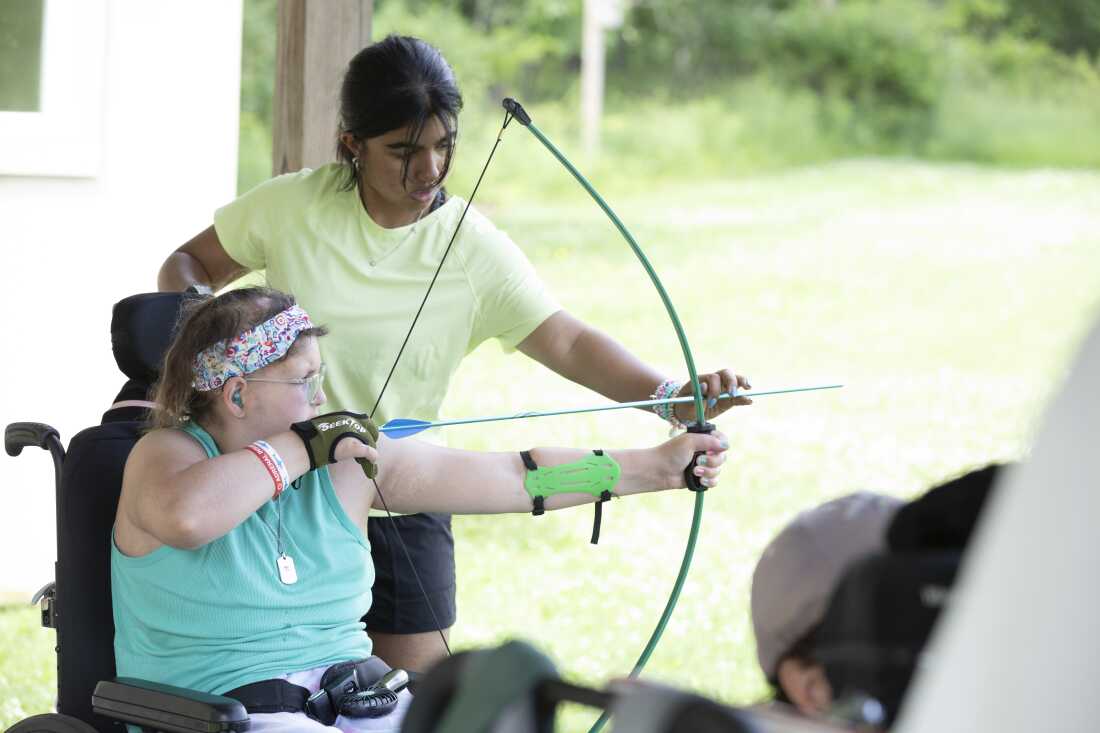
Anvitha Tharra, a counselor at Camp Cranium, assists participant Angelica Zander with mastering archery skills. The camp, located in Columbia County, Pennsylvania, is a weeklong event offering support and fun for children with brain injuries.
In an open field, arrows cut through the humid June air during archery hour at Camp Cranium. Cheers from both campers and counselors echoed through the air. Drew Meyer, the camp’s operations director, watched with emotion in his eyes. The campers, all survivors of brain injuries, managed to surprise him. ‘They shoot for hours,’ he noted, ‘and eventually, they hit the target.’ Campers aged 10 to 21 have been attending Camp Cranium since 2008. Some face severe brain injuries, requiring them to relearn basic skills like talking and tying shoelaces. Others use wheelchairs or crutches. During their week at camp, they engage in activities like rock climbing, swimming, and zip-lining through the forest.
Camp Cranium addresses a national trend: more people, including children, surviving brain injuries compared to the 1980s. Advances, including seat belt laws and research investments, have contributed to this. However, efforts to track and prevent traumatic brain injuries are uncertain. Congress failed to renew research funding, and in 2025, the CDC experienced staffing cuts, affecting teams tracking traumatic brain injuries.
‘Brain injury can happen to anybody,’ said Rebeccah Wolfkiel, executive director of the National Association of State Head Injury Administrators. ‘This community deserves more.’
Lucas Hardy, 14, climbed a 30-foot rock wall, aided by a hoist lifting him from his wheelchair. At age 3, a tree branch caused his brain injury during a birthday party. The Brain Injury Association of America estimates that 2.8 million Americans, including 475,000 children, have traumatic brain injuries annually. These figures are likely undercounts. A 2018 CDC survey suggested such injuries are more prevalent than hospitalization numbers indicate.
Mass layoffs at the CDC in 2025 interrupted plans for a nationwide concussion surveillance system. Emily Hilliard, a spokesperson for the Department of Health and Human Services, didn’t answer questions on the layoffs but stated the administration’s dedication to preventing brain injuries through various initiatives. The CDC’s TBI work continues under different staff at the National Center for Injury Prevention and Control.
Wolfkiel voiced concerns about the long-term impact of these changes on brain injury research and prevention. ‘The scarcity of resources is appalling,’ she remarked.
Federal Funding Uncertainty
Tony Sadowski, Camp Cranium’s executive director, recalled his son’s brain bleed at age 6, leading to a hemorrhagic stroke. Now 18, Bryan Sadowski has been a long-time camper. Tony expressed gratitude for the camp’s support.
The Traumatic Brain Injury Act of 1996 facilitated state grants for research and services, reauthorized until 2024, but now lapsed. Markwayne Mullin, Trump’s former Secretary of Homeland Security, once supported funding. Congress is still debating its reauthorization until 2030.
Despite federal funding lapses, state and CDC TBI programs received $8.25 million under the Consolidated Appropriations Act of 2026. This is significantly less than previous funding levels, which provided $23 million annually between 2020 and 2024. Rick Willis, president of the Brain Injury Association of America, emphasized the need for continued support. ‘The TBI Act is the sole federal funding source for traumatic brain injury,’ he stated. ‘We’re aiming to preserve what we have.’
However, camps like Camp Cranium aren’t reliant on this funding. As nonprofits, they mainly depend on private donations.
Brianna Engleman roamed the camp gathering song requests for an evening dance. At 5, she underwent surgery for seizures, resulting in additional brain injury. Having first joined Camp Cranium as a teen, she found acceptance and support from fellow campers. Engleman plans to return as a counselor. ‘I’ve gained confidence,’ she said. ‘Good people exist.’
Leave a Reply