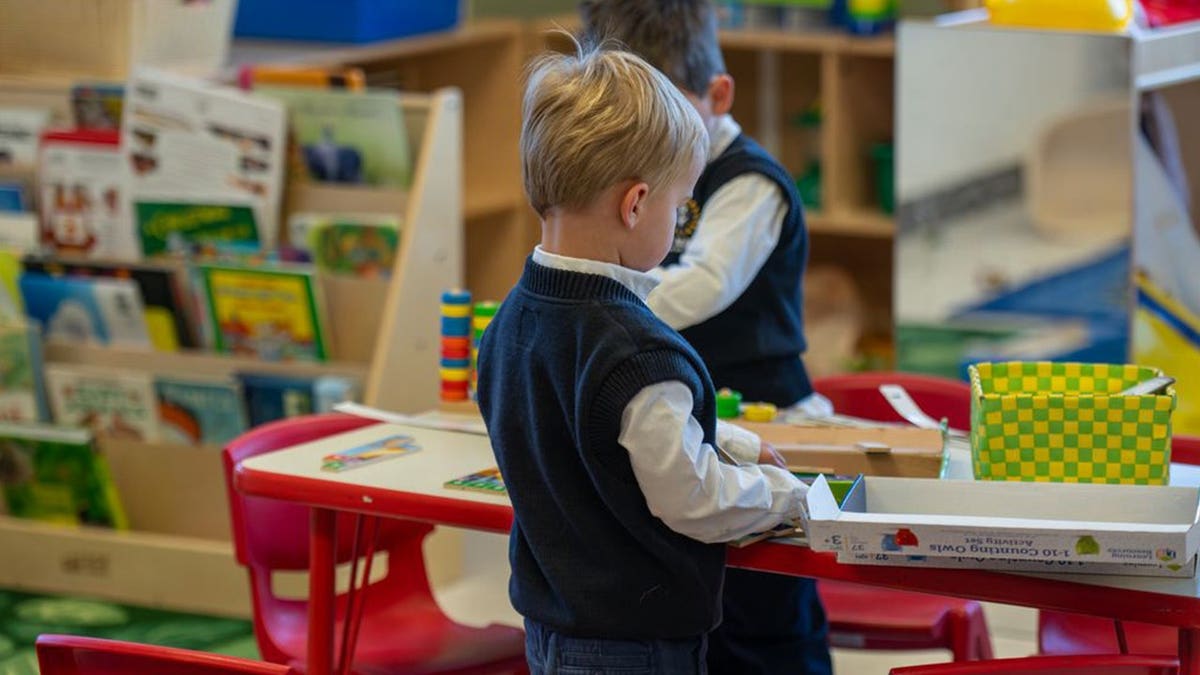
A father in Colorado pays for his children’s Catholic preschool out of pocket, while tax funds help other children attend different preschools. One of his children has spina bifida, and the family stays in the state because Medicaid covers her needs. An additional $6,000 could significantly aid in her care. A mother working at a lumber company, married to a house painter with seasonal work, has six children with another on the way. She once thought Catholic schools were for wealthy families.
Another mother started a floral business to pay tuition. Three of her children attend a Catholic school in Denver, but she couldn’t afford preschool there for her youngest, who now attends a Lutheran preschool funded by the state program. She expresses frustration, stating, “I’m choosing just a faith, and here I’m being punished for that.”
A fourth parent took a lower-paying job at her children’s parish school for a tuition discount and observed families leaving due to pre-K costs.
The Supreme Court will hear St. Mary Catholic Parish v. Roy on November 3. This case involves Catholic families, including Dan and Lisa Sheley from Denver, who, along with the Archdiocese of Denver, challenge the state’s funding rules. They have spent thousands on faith-based preschool education that the state won’t fund.
Colorado’s universal preschool program was meant to aid families like theirs. Yet, a clause requiring schools to promise “equal opportunity,” covering sexual orientation and gender identity, prevents Catholic schools from participating without compromising their teachings. The state’s rule effectively excludes Catholic schools without mentioning them directly.
This situation resembles historical moves like the Blaine amendments, which targeted Catholic schools by barring public funds from sectarian schools. Despite this, the amendment passed the House overwhelmingly but failed in the Senate. Many states adopted similar clauses in their constitutions, often using “sectarian” as a code for “Catholic.”
Colorado’s program offers 4-year-olds a benefit worth around $6,000 at the school of their parents’ choice. However, the equal opportunity clause is a non-negotiable cost that Catholic schools cannot bear, thus excluding them.
The Supreme Court has been working to dismantle the legacy of the Blaine amendments, ruling that states cannot disqualify schools from public benefits for being religious or practicing their faith. Colorado’s current mandate uses modern terminology but maintains the same exclusionary effect.
While many preschools accept the state’s terms, those upholding specific views on marriage and human identity opposed by the state remain excluded. Colorado’s system allows exceptions for various social groups but leaves no room for Catholic schools.
The exclusion has affected about 1,500 children across 30 schools and reduced Catholic preschool enrollment by around 20%, causing two preschools to close.
The Supreme Court will decide if exceptions for mission-focused providers can include Catholic preschools. This decision will follow cases like Masterpiece Cakeshop and 303 Creative, which criticized Colorado for intolerance, reinforcing that constitutional guarantees remain intact against ideological pressures.
Andrea Picciotti-Bayer, director of the Conscience Project, states that a state supporting private education should not exclude Catholic schools dedicated to their faith values.
Leave a Reply