Historical Anniversary at Pullman National Historical Park
This weekend’s Pullman Railroad Days event marks the 100th anniversary of a pivotal decision that dramatically increased ridership for the South Shore Line. The celebration, held at Pullman National Historical Park in Chicago, commemorates the electrification of Illinois Central trains, a crucial development that occurred last Tuesday.
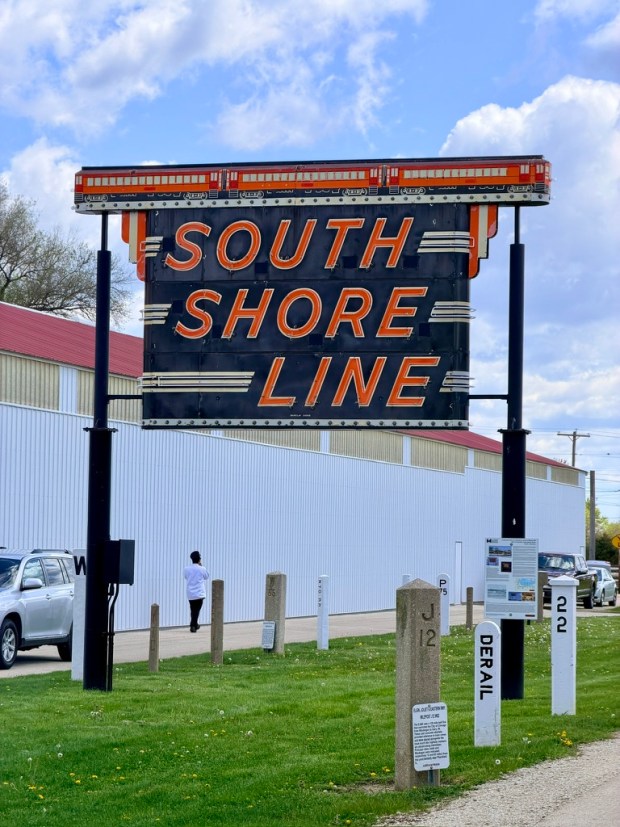
This sign for the South Shore Line once stood in front of the railroad’s downtown Gary station. It now stands at the Illinois Railway Museum in Union, Illinois. (Doug Ross/for the Post-Tribune)
South Shore Line riders today are familiar with the modern, silver trains with orange stripes built by Nippon Sharyo. These trains appeared after the creation of the Northern Indiana Commuter Transportation District in 1977, a move designed to rescue the commuter rail line. Longtime passengers may remember the older orange rail cars that traversed the tracks prior to this period. These cars were directly influenced by the electrification of the Illinois Central.
Innovations in Rail Technology
Norman Carlson, the president and managing editor of the Shore Line Interurban Historical Society, serves as the unofficial historian for the South Shore Line. He expressed his enthusiasm for the Pullman event, noting that he would be actively involved throughout the celebration.
Originally, South Shore Line cars ran on 660 volts of alternating current (AC) power before switching to 1,500 volts of direct current (DC) power as a consequence of the Illinois Central’s electrification. This switch in power types was a significant upgrade, and electricity became a central element in powering these trains.
Samuel Insull’s Vision
In 1978, Carlson interviewed Samuel Insull Jr. to gain insight into his father’s impact on the region and railroads. Samuel Insull utilized railways to increase demand for electricity, which he supplied through his company, Commonwealth Edison. His strategic maneuvers included acquiring entities like the Chicago Rapid Transit Co., which faced difficulties with electric payments.
Insull’s business strategies included incorporating the South Shore Line into his broader plans, capitalizing on its proximity to a coal-fired power plant in Michigan City. This was part of his broader vision to transform the railway into a profitable venture.
Connection to Downtown Chicago
Samuel Insull transformed the South Shore Line a century ago, switching its cars from AC to DC power so they could run all the way to downtown Chicago via the Illinois Central, now Metra Electric, tracks. (Doug Ross/for the Post-Tribune)
Integrating the South Shore Line with downtown Chicago was crucial. Trains initially stopped at 111th Street, where passengers required an Illinois Central steam engine to continue their journey downtown. The transition to electric trains allowed for direct downtown commute, significantly enhancing the transportation experience for users.
Ordinance Against Smoke
The electrification of the Illinois Central Railway was motivated by practical reasons. The need to curb smoke emissions was acute, as these trains operated along the lakefront. Therefore, an ordinance passed in 1909 mandated that trains switch to electric power by 1930 for passenger services. While the Illinois Central complied, freight railroads used diesel-electric engines as a workaround to meet regulations.
Impact on Chicago’s Development
The Illinois Central was instrumental in reshaping Chicago’s landscape. From 1856 to 1926, the railroad infilled land east of its tracks, transforming areas like Millennium Station and Museum Campus from parts of Lake Michigan into firm ground.
On July 21, 1926, electrified Illinois Central cars began operating, while South Shore Line commenced direct trips to downtown on August 29, 1926. This inaugurated a remarkable boost in ridership, making a lasting impact on regional rail commuting.
Luxurious Rail Experience
The 1926 rail cars were extravagant, maintaining service until mid-1980s and embodying luxury features. In 1927, dining and parlor car services commenced, offering full meals or sandwiches to passengers. Although the Great Depression took a toll on these amenities, they marked a historically prosperous period for railway services.
Challenges and Adjustments
Despite Depression-era struggles, South Shore Line adapted by modifying rail cars for increased seating, even retrofitting dining cars and parlor cars accordingly. During World War II, railroad equipment further endured stress due to increased troop transport.
Robert Harris, a collector of these rail cars, previously produced a film viewed by 4 million people on PBS stations in Chicago and Indiana, increasing public interest in regional rail history.
Preserving Rail Heritage
Harris’s fascination with historical rail cars resulted in acquiring numerous old orange cars for preservation and spare parts. Restoration projects continue, with specific cars awaiting completion in Tennessee.
The transition to newer trains began with NICTD’s 1977 takeover, but ongoing efforts aim to revive historical rail cars, exemplified by restored South Shore Line trains displayed at Pullman National Historical Park.
Embracing the Future of Rail
The sticker on a rail car at the Illinois Railway Museum advertised the South Shore Line as “The Little Engine That Could.” (Doug Ross/for the Post-Tribune)
The ongoing end-life rebuild program ensures reliability and safety for South Shore Line’s 1982-built trains. These efforts provide a temporary extension to vehicle lifespan, with future strategies under consideration for adopting advanced rail technology. Metra, for example, explores battery-powered locomotives, which could influence South Shore Line modernization.
Efforts to enhance the rail system include service extensions, infrastructure updates, and improved operational reliability. Strategic plans anticipate continued expansion of services within Indiana and efforts to upgrade stations and tracks.
Leave a Reply