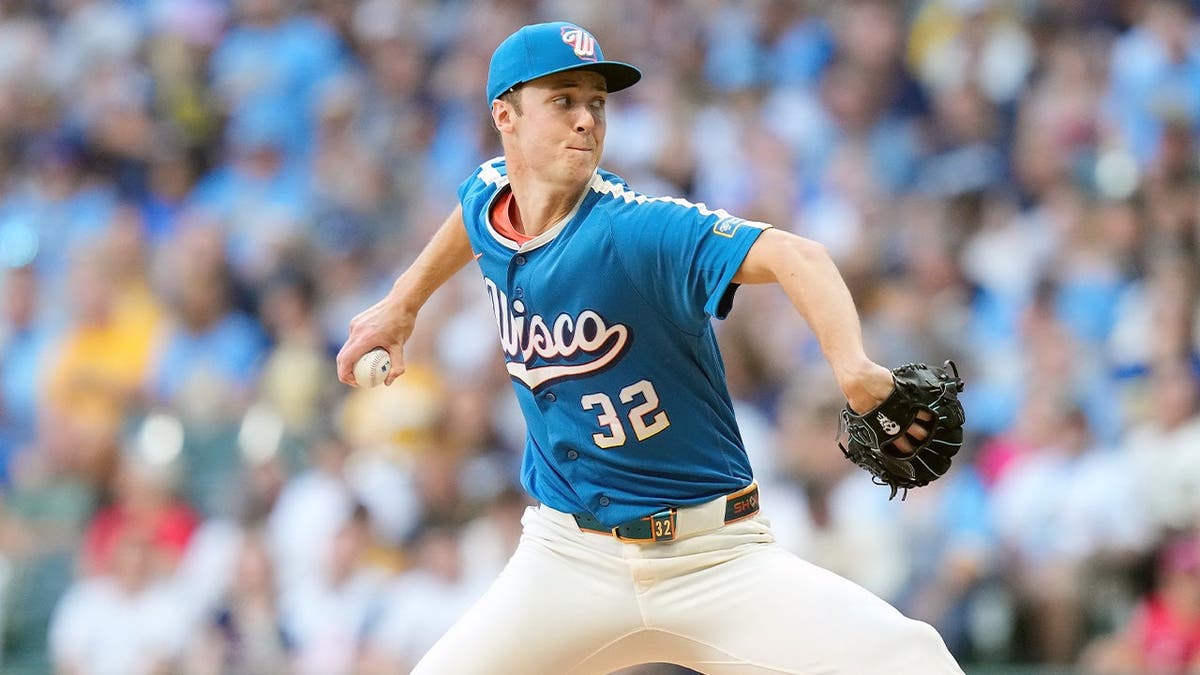
In 2026, hitting in Major League Baseball faces unprecedented challenges. Pitchers like Jacob Misiorowski are showcasing high-velocity throws, with Misiorowski reaching speeds of 104 mph alongside impressive 93 mph sliders. Just a decade ago, the average fastball velocity was 93 mph. Through his initial 15 starts, Misiorowski has allowed only 15 earned runs.
Relief pitchers are demonstrating strong performances too. Mason Miller of the San Diego Padres has permitted only three earned runs over 32 innings. He has faced 123 hitters, striking out 63, and his hard-hit percentage is a mere 7%, compared to the league average of 40%.
While Misiorowski and Miller are exceptional, they’re part of a broader trend where pitching surpasses hitting. Advances in pitch science and extensive data have enabled players to identify optimal pitch combinations.
Milwaukee Brewers’ Jacob Misiorowski Breaks Records
Jacob Misiorowski of the Milwaukee Brewers set records with a 104.5 mph pitch against the Yankees. (Photo by John Fisher/Getty Images)
Despite pitchers’ advantages, offense surged in recent months. What’s caused this increase in hitting? The baseball itself has changed. According to Eno Sarris from The Athletic, drag on the baseball recently decreased, similar to levels from 2019. Lower drag allows balls to travel further due to reduced air resistance. The 2019 season saw high offensive stats, with ten players hitting over 40 home runs and a league-wide .252/.323/.425 batting line. In 2025, with higher drag, the league’s line dropped to .245/.315/.404.
Research by Sean Zerillo highlighted significant increases in offensive data. Barrel distance grew by 10.2 feet from April 2026, marking the largest in-season increase since Statcast’s inception. Zerillo discovered that this increase correlated closely with decreased drag starting in June. Even controlled environments, like domed stadiums, showed a 10.4 feet increase in ball travel.
Variations in baseball production occur annually, with the league controlling ball production and installing humidors at all stadiums. It’s uncertain whether MLB Commissioner Rob Manfred influences drag reduction, but MLB’s interest in boosting offense is clear. Changes in 2023 aimed to increase scoring, such as banning the shift. While initial results showed increased runs per game, figures slightly declined by 2025.
As pitching improves, MLB may be adjusting ball specifications to balance the competition. Fans often prefer home runs over pitching duels. An additional six feet in ball travel enhances players like Shohei Ohtani and Aaron Judge hitting home runs, turning potential fly balls into fence-clearers and gap doubles.
As the season progresses, these changes and their impact will be significant, especially in October when home runs are crucial. Ian Miller contributes as a writer at OutKick.
Leave a Reply