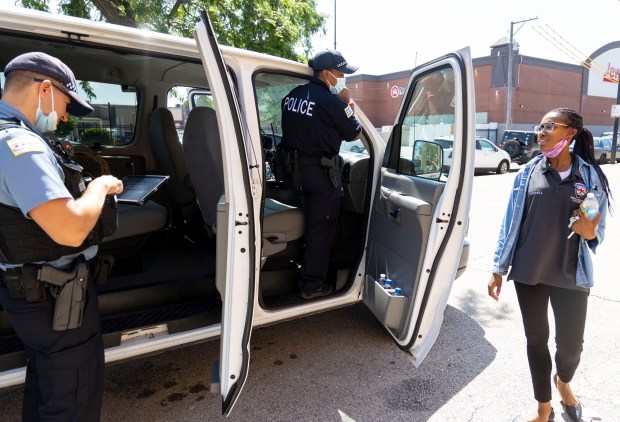
Mayor Brandon Johnson is putting the spotlight on his campaign pledge to create non-police mental health response teams in Chicago. His administration has launched a comprehensive media campaign to promote this initiative. Johnson recently shared videos of himself participating in rides with the city’s Crisis Assistance Response and Engagement (CARE) teams. These teams have seen a significant increase in response calls since May.
In the coming days, the city plans to introduce an evening shift for these teams, a cornerstone of Johnson’s progressive platform. The teams consist of behavioral health workers and emergency medical technicians (EMTs).
Officers such as Dantra Daniel and clinicians like Gabrielle Mitchell are part of the CARE team, which prepares daily for service. Despite some earlier claims of low demand, call volume rose by 51%, resulting in more than 100 responses from May to August. This increase coincides with earlier issues from spring, involving bureaucratic challenges and political conflicts within the administration.
Dr. Olusimbo “Simbo” Ige, a former health commissioner, had argued against the perceived demand for CARE before her departure in May. Dr. Garth Walker has since taken over as head of the Chicago Department of Public Health. From May to August, CARE handled 115 emergency calls, and an additional 72 were managed via non-urgent email requests, according to Arturo Carrillo, the Deputy Mayor of Health and Human Services.
Johnson acknowledged the challenges faced by CARE, explaining that it’s a new governmental entity, and perfection is not a necessity for effectiveness. Ald. Rossana Rodriguez-Sanchez echoed his sentiments, noting unexpected obstacles in the program’s rollout.
Key lessons from the program include the need for citywide reach, better interdepartmental coordination, and improved dispatch protocols. So far, the program has expanded to cover ages 6 to 65 and increased its crisis response criteria. Starting Monday, its operational hours will extend from 8 a.m. to 10 p.m.
Despite these expansions, some experts, like Jim Poole from the National Alliance on Mental Illness Chicago, believe CARE’s usage remains limited. He stresses that addressing fundamental issues in response to mental health emergencies is vital.
Although Johnson pledged to move away from the previous co-responder model involving police and paramedics, police remain involved in some responses. Lt. Rhonda Anderson confirmed ongoing support from the Chicago Police Department, citing instances of planned joint responses believed to offer better resident outcomes. In August, police conducted an 8-hour de-escalation training for the CARE team.
Johnson defended these joint responses, emphasizing that they depend on individual situations. The goal is to cease the historical approach to trauma that lacks compassion.
The transition to non-police response teams faced obstacles, including labor tensions and technological challenges. A key technological component, the Computer-Aided Dispatch (CAD) system, is still under development.
Despite these hurdles, a commitment to improve mental health care in Chicago unites voices across the political spectrum. In a recent city presentation, Mayor Johnson reiterated the need for specialized response teams for mental health emergencies. While most 911 calls do not qualify for CARE, the initiative’s importance is recognized.
Growing pains and political scrutiny, including campaign criticisms, underscore the importance of the move towards non-police mental health response. Ald. Rodriguez-Sanchez highlighted that this initiative did not emerge overnight but is part of a continuing effort for public safety reform since 2020.
While acknowledging the ongoing challenges, stakeholders stress perseverance as essential in achieving a major systemic and cultural change.
Leave a Reply