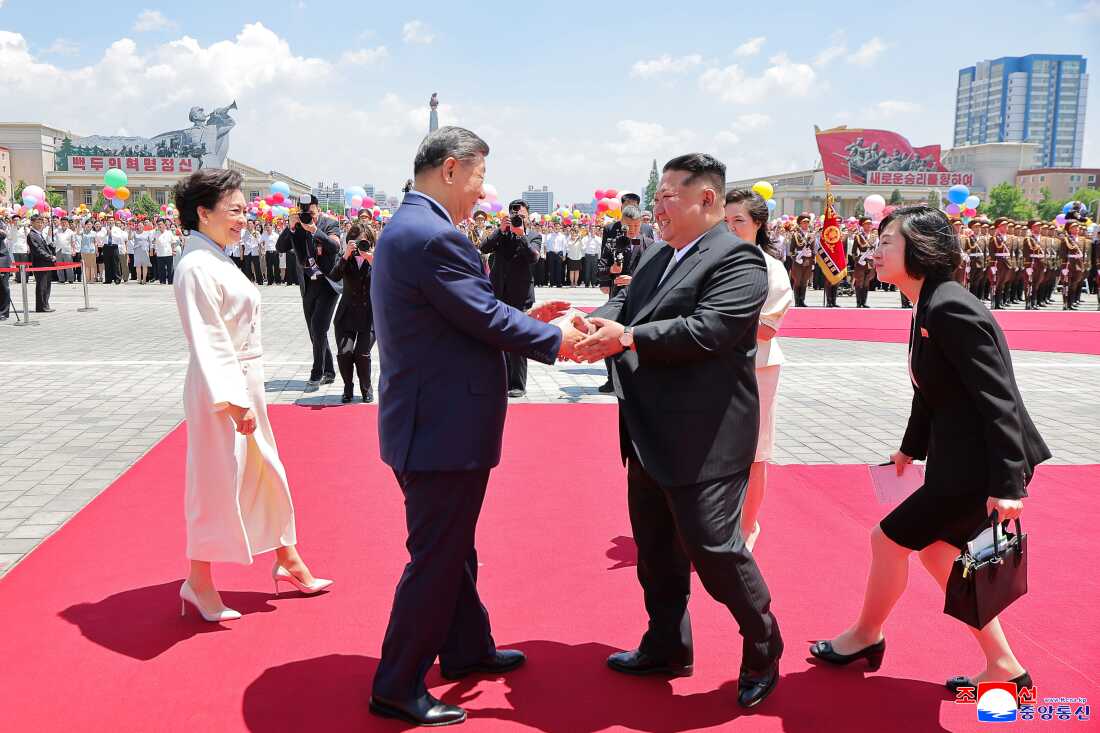
Chinese President Xi Jinping recently met with North Korean leader Kim Jong Un in Pyongyang. During the meeting, the two leaders emphasized their strategic cooperation, while sidestepping the issue of North Korea’s nuclear weapons program.
This meeting marked Xi’s first visit to North Korea in nearly seven years. It followed his discussion with President Trump in Beijing. During those talks, the White House indicated both sides agreed on working towards denuclearization. However, China did not publicly confirm Washington’s claim, and Xi did not mention denuclearization in Pyongyang.
Chinese state media reported Xi’s focus on China’s commitment to safeguarding the shared interests of both nations. North Korean media quoted Kim Jong Un stating that ties with China are a primary strategic concern for his country. This suggests Kim is trying to balance relations with both China and Russia.
China appears to downplay North Korea’s nuclear program to improve its bilateral relations with Pyongyang.
Tong Zhao, a fellow at the Carnegie Endowment for International Peace, noted this shift in China’s priorities. This approach might strengthen U.S. alliances with South Korea and Japan, leading them to reinforce security ties with Washington.
Both China and North Korea aim to extend their alliance beyond the Korean Peninsula. Recently, both countries have moved away from endorsing denuclearization to focusing on opposing U.S. sanctions and military actions against North Korea.
Choo Jaewoo from Kyung Hee University highlighted the shared ambitions of Xi and Kim to expand their alliances further, potentially involving North Korea in other regional issues like Taiwan. This week, agreements were made to enhance exchanges, including military cooperation.
Seong-hyon Lee from Harvard University’s Asia Center described the relationship among China, Russia, Iran, and North Korea as loose alignment rather than a formal alliance. While these alliances are evolving, the U.S. and South Korea are also revisiting their strategic approaches to counter these developments.
Contributions to this report came from NPR’s Se Eun Gong in Seoul and Jasmine Ling in Beijing.
Leave a Reply