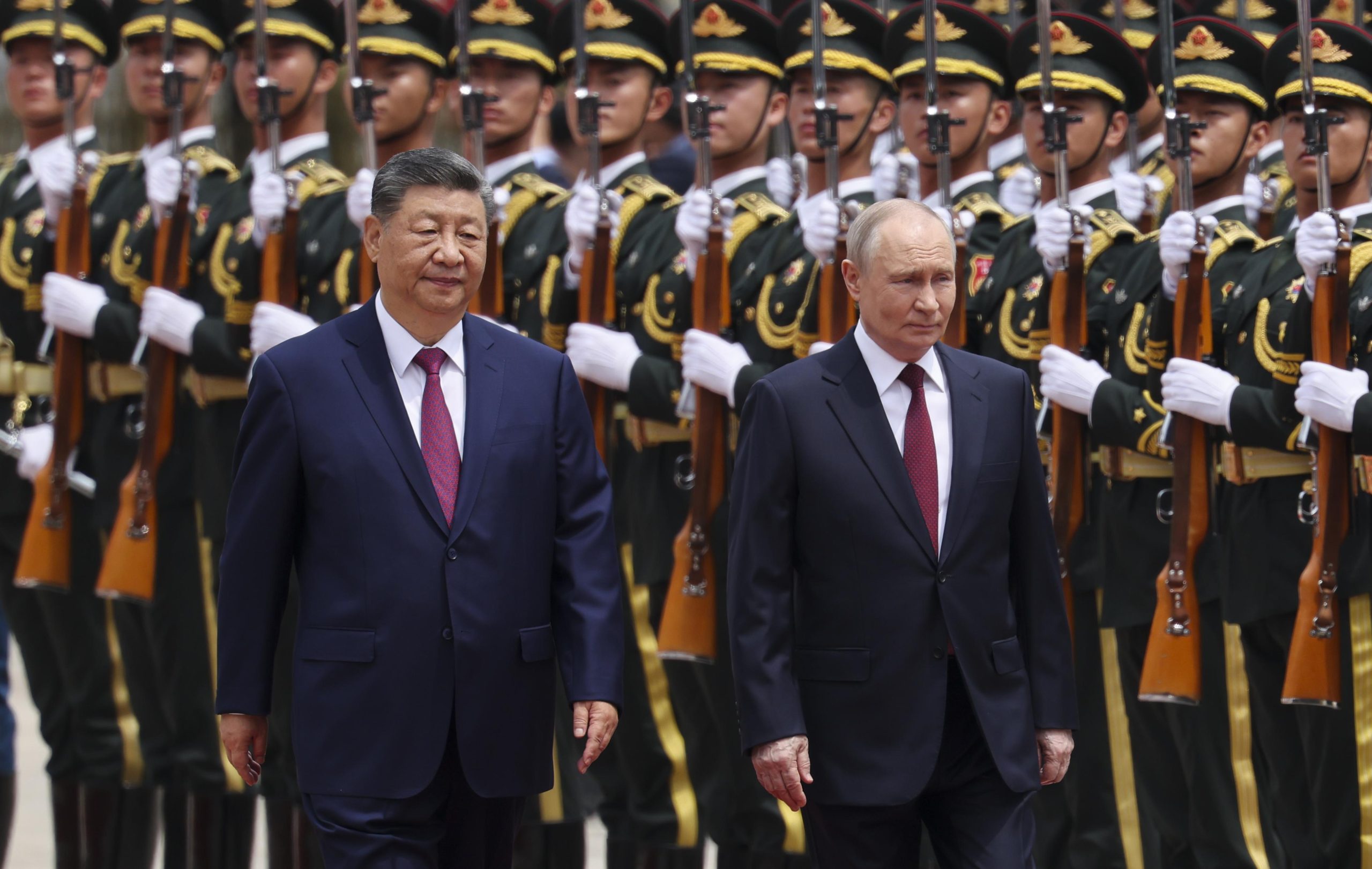
The United States had a significant impact on a summit held in Beijing on Wednesday involving Russian President Vladimir Putin and Chinese President Xi Jinping. This gathering marked Putin’s 25th visit to China during his long-term leadership in Russia. It occurred amidst the ongoing conflict in Ukraine that has persisted for five years.
The meeting with Xi provided an ideal opportunity for China to showcase its influence. Xi, in remarks translated from a Kremlin statement, criticized unilateral and hegemonic actions, indirectly referring to the United States.
Both leaders expressed concerns over U.S. nuclear policy and criticized plans for a missile interceptor system, calling them irresponsible. Xi emphasized that China and Russia, as major world powers and permanent UN Security Council members, should prioritize strategic cooperation.
While the two sides agreed on over 20 deals for cooperation in technology and visa policies, there was no progress on the Power of Siberia 2 pipeline project, a strategic initiative for Russia.
“China is supportive of Russia’s economy, but the pipeline favors Russia more,” stated Callum Fraser, a researcher at the Royal United Services Institute.
The welcoming ceremonies for Trump and Putin showcased notable differences. Xi first hosted Trump with extensive time and ceremonies, while Putin’s reception, although warm, was less formal.
Kremlin spokesperson Dmitry Peskov emphasized that the content of the discussions was more important than the ceremonies. Trump focused on potential deals, while discussions with Putin highlighted strategic partnership and energy collaboration.
Putin’s delegation primarily comprised energy and banking representatives, contrasting with Trump’s business-focused entourage. Putin’s visit coincided with the China-Russia Expo featuring numerous Russian companies.
During the talks, Putin reiterated Russia’s reliability in resource supply, despite conflicts affecting global energy supply. Trade between China and Russia has flourished, with exchanges reaching record heights.
China has absorbed much of Russia’s discounted oil and gas since the Ukraine conflict began. There are discussions about China diversifying its oil sources, including potentially renewing U.S. imports.
The strategic alliance between Russia and China has strengthened with joint military activities and coordinated diplomatic narratives. Despite Western accusations of enabling Russian military efforts, China has denied any arms trade and maintained a call for peace in Ukraine.
Within China, Putin’s visit generated significant interest on social media. It highlighted the country’s growing diplomatic influence as state-controlled media touted Beijing’s central role in world affairs.
The consecutive visits from global leaders, including the U.S. and Russia, highlighted Beijing’s increasing diplomatic significance. However, experts warn against assuming these visits indicate allegiance to China.
Lye Liang Fook from Singapore’s ISEAS-Yusof Ishak Institute noted, “Countries aim for practical collaborations despite not agreeing on all issues.”
This evolving global diplomatic landscape reflects China’s rising challenge to established powers.
Leave a Reply