Teaching and learning math pose distinct challenges. To ensure your children acquire the necessary skills to excel with the curriculum, consider using math learning resources. These resources can complement your child’s current math education or provide additional practice to enhance their understanding of concepts. Today, you can choose from traditional workbooks and a variety of digital materials to help your child develop their abilities and confidence.
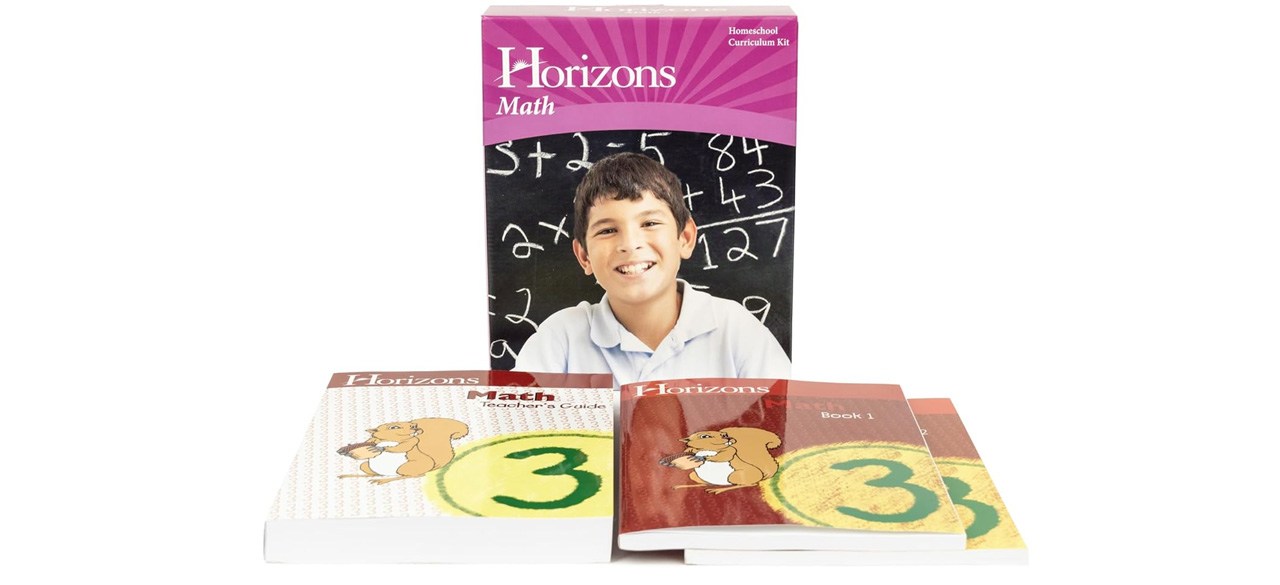
If you’re unsure which materials suit your child, explore our buying guide. We provide recommendations, including our top choice: Horizons’ Math Third Grade Complete Set. This engaging set includes manipulatives like play money, flashcards, and games.
Factors to Consider When Selecting Math Learning Materials
Common Core vs. Traditional Math
Introduced in 2010, Common Core establishes consistent standards for what skills are taught at each grade level and how they are taught. In math, Common Core emphasizes real-world application and conceptual understanding instead of memorization. Traditional math focuses on teaching individual tasks that are later combined to solve complex problems. It also relies on pattern recognition, reasoning, and some memorization.
Mastery vs. Spiral Approaches
Math is primarily taught through mastery or spiral approaches. In the mastery approach, students tackle one new skill at a time and must fully master it before advancing. This provides a strong foundation. The spiral approach revisits concepts repeatedly, starting with basics and adding complexities each time. This approach engages some students but can be too fast for others.
Features of Math Learning Materials
Digital Resources vs. Workbooks
Digital math materials include video tutorials, interactive games, and online exercises. These resources are ideal for self-paced learning but are better suited for practice rather than introducing new concepts. Physical workbooks offer exercises, practice tests, and reproducible pages, favored for supervised learning or side-by-side instruction due to their lack of interactivity.
Teacher’s Guide and Answer Key
When comparing math learning materials, you might discover teacher’s guides and answer keys. Teacher’s guides offer instructional resources, including lesson plans. Answer keys provide solutions to exercises, saving you time.
Manipulatives
Manipulatives are colorful tools that help visualize and understand abstract concepts. They often include paper money, flashcards, blocks, charts, dice, or measuring instruments. Whether lessons specify their use or not, manipulatives can enhance learning.
Cost of Math Learning Materials
Math resources with basic or limited curriculum range from $10 to $17. Materials with diverse exercises and activities cost between $25 and $40. Comprehensive resources, including those for homeschooling, range from $60 to $100.
Frequently Asked Questions
Should I buy additional classroom or visual aids?
Many parents choose whiteboards, which are helpful for instruction and allow practice beyond computers and notebooks. Age-appropriate educational games and manipulatives like cubes, puzzles, blocks, or Legos are also common choices.
Do workbook materials offer digital access?
Some workbooks include digital resources. For both resources, consider a comprehensive set. Typically, these come with licenses or serial numbers, providing limited access.
Top Math Learning Materials
Horizons’ Math Third Grade Complete Set
This set offers a wide range of materials, including workbooks and planners. The spiral method keeps concepts fresh, although the set lacks manipulatives.
Math Mammoth Grade 2-A Workbook
This book provides half a year’s curriculum at a reasonable price, featuring a mastery-oriented approach. However, it does not cover an entire year or include an answer key.
Singapore Math 70 Must-Know Word Problems for Level 6/Grade 7
This set uses the Singapore method for concept mastery and thinking. It includes common problems and step-by-step solutions but can be challenging.
Leave a Reply