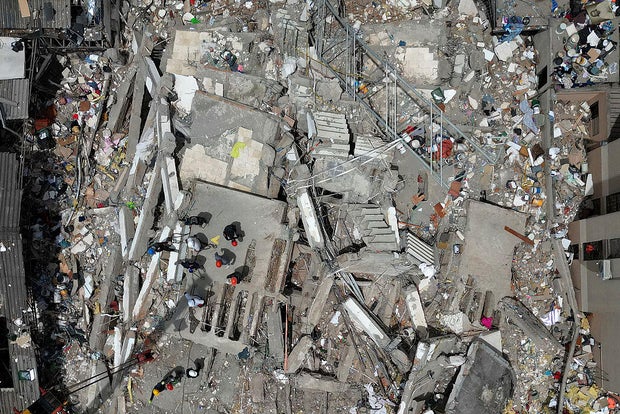
On Wednesday, aid from regional partners arrived in Colombia following a devastating earthquake that demolished structures, damaged roads, and crushed vehicles. The urgent search for survivors continued as Colombia’s new president, Abelardo de la Espriella, and his government faced the challenge of organizing an effective response. The disaster also mobilized civil society to support the most affected communities.
President de la Espriella announced on Wednesday evening that the 7.4 magnitude earthquake in western Colombia had claimed at least 265 lives. Nearly 500 were reported missing, although civilian-run databases suggest over 4,100. The earthquake impacted more than 25,800 families, according to the president.
“Our efforts are focused on the disappeared,” he emphasized in a press briefing in Colombia’s capital. Aerial footage depicted rescuers in Cali searching through debris.
Efforts to find survivors in cities such as Cali, Pereira, Manizales, and Quibdo intensified, with the first 48 to 72 hours deemed crucial for rescues. Rescue teams remained hopeful, searching for signs of life beneath the ruins.
Alejandro Eder, Cali’s mayor, highlighted the critical nature of the upcoming hours in saving lives. Video footage from social media captured the rescue of a baby from collapsed rubble in Cali, amplifying hope amidst the tragedy. In Pereira, 32-year-old Daniela Largo was rescued after an arduous 12-hour operation that involved stabilizing her with IV fluids. Her successful extraction was celebrated by the rescue team and bystanders alike.
Among the rescue missions, a somber moment occurred as a lifeless man was pulled from debris in the same city. During operations, maintaining silence was key to detecting any faint indications of life.
The fear of aftershocks haunted Colombians, particularly in the coffee-growing regions severely affected by the quake. Authorities converted public spaces into shelters for thousands of displaced residents. In Pereira and Cali, some families chose open parks over unstable homes, fearing further tremors. Colombia’s geological service recorded 130 aftershocks post-quake.
Edith Penagos, a 48-year-old residing in a temporary tent in a Pereira park, acknowledged the importance of basic needs like shelter, food, and water being met.
Rodrigo León Loya, a seismologist, discussed the ongoing seismic risk in Colombia. He pointed out that while another major earthquake in the same region is unlikely soon, Colombia’s many active fault lines pose a continual threat.
The earthquake’s impact was compounded in places like Choco, the epicenter, where ongoing issues like poverty and conflict had already displaced many. The area remained largely disconnected due to the loss of cell service.
Giovanni Rizzo of the Norwegian Refugee Council urged for increased support, highlighting the compounded humanitarian challenges.
Aid organizations, already present in Choco for other humanitarian reasons, swiftly shifted focus to disaster relief. U.N. resident coordinator, María José Torres, noted their advantageous presence on the ground.
International aid funneled in, with the U.S. deploying disaster response teams and pledging over $15 million. Mexico contributed 19.5 tons of food and personnel, with plans for more assistance. Salvadoran President Nayib Bukele offered significant aid as well.
Pope Leo XIV expressed solidarity with those affected, acknowledging the recovery efforts.
An upcoming benefit concert in Miami featuring artists like Marc Anthony and others aims to support victims in Colombia and neighboring Venezuela, which faced similar disasters in June.
Leave a Reply