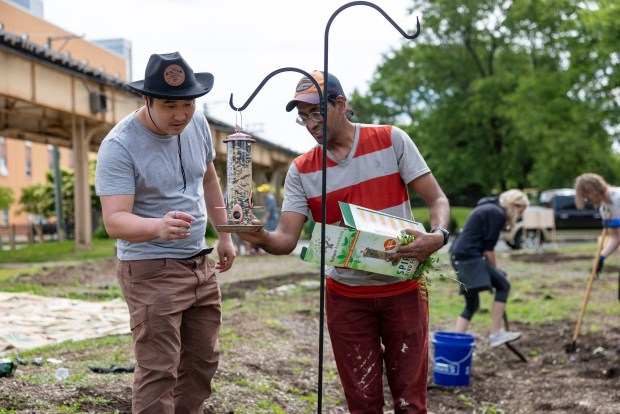
David Bippes had a vision when he brought his parents to a small plot of land in Englewood. This land, wedged between a railway track and homes, was set to become his latest community project. An Eagle Scout, Bippes found his calling for community gardens in high school. He now leads Litter Caterpillars, a volunteer cleanup group in Chicago. Last year, Bippes and three other leaders purchased the land through a citywide auction, aiming to transform it into a community green space.
The group, extending Bippes’s childhood project, turned the 6,000-square-foot site into a park. They added mulch, garden beds for tomatoes, and native plants like prairie grasses and yellow coneflowers. The park opened on April 12. However, during a visit shortly after, they found piles of landscaping debris dumped on the property, blocking the sidewalk and complicating their mission to reduce litter.
Bippes and co-founder Kevin Tao do not know who left the debris, but it poses a challenge in building trust with the community. The project’s success relies on community investment, which illegal dumping hinders. The park stems from a land purchase in April 2025, involving two lots at 6316 and 6318 S. Sangamon St. for $10,000, acquired through an auction organized by Hilco. This auction featured over 800 parcels in South and West Chicago. Improvements have cost the group another $10,000.
Caterpillar Park, reflecting the group’s mission of transformation, signifies renewal and change, akin to caterpillars turning into butterflies. This project is supported by Bippes, Tao, and two other co-founders. Over five years, their team has organized cleanups with over 100 volunteers. For Bippes, enhancing Chicago, especially areas lacking investment like Englewood, is crucial. His parents bought their home through an auction, making the concept of transforming vacant land appealing to Tao.
Tao recalls tough times affecting his mindset and believes altering environments can drive positive change. Bippes describes the project as overhauled, with team members learning to build a park from scratch, networking extensively for guidance. Each holds a full-time job, with Bippes in consulting and Tao in a reproductive health business. The group aims to make Chicago better, a sentiment shared with nearby residents.
Distance between project leaders and Englewood has complicated efforts. Bippes lives an hour away in Edgewater. Local farming groups worry about the park’s longevity given the owners’ remote locations. The Litter Caterpillars visit every other Sunday, dividing time between cleanups in North Side neighborhoods and the park maintenance.
Cedillo’s Fresh Produce co-founder, Dulce Morales, an Englewood urban farmer, highlights the need for consistent space care to prevent issues like weeds. As a former Cedillo’s volunteer, Tao sought Morales’s advice for gaining community support. They aim for a community garden, dependent on local participation. Organizers are engaging locals through door-knocking and distributing flyers, though illegal dumping strains their initial impression with residents.
Morales notes the risk that lack of presence increases misuse potential. Cedillo’s has experienced similar dumping and break-ins, with community support crucial in reducing these. For Caterpillar Park, resolving dumping issues is pressing. Bippes has pressed city authorities for help, sharing his actions via social media for visibility. The Department of Streets and Sanitation removed one debris pile in response to their complaints.
Despite challenges, organizers are committed to community engagement. Former local, Roosevelt Gordon, who previously lived nearby, supports the park if it serves existing residents, perhaps as a space for children to learn. He hopes the park’s focus remains community-oriented, not altering its core.
Bippes and his team view the ongoing dumping as a mystery. Engaging with those responsible could reveal shared interests in Caterpillar Park’s mission, potentially aligning community efforts.
Leave a Reply