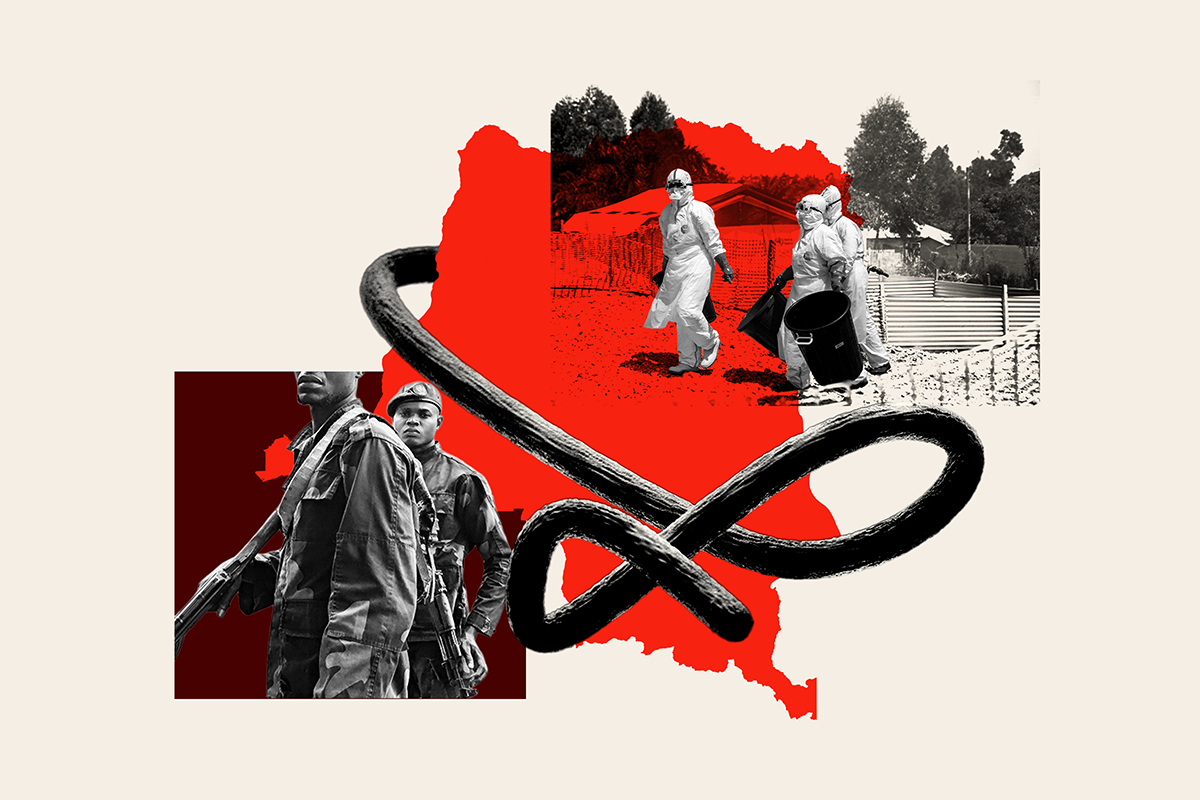
Multiple conflicts in the Democratic Republic of the Congo (DRC) are complicating efforts to control an Ebola outbreak, risking both the spread of disease and further instability beyond its borders. The DRC, with a population over 120 million, covers a vast area larger than France, Germany, Italy, Poland, and the United Kingdom combined. It faces ongoing challenges due to numerous insurgent groups fighting for power, exacerbating a history of deadly wars.
Since the First and Second Congo Wars and subsequent conflicts, over 6 million people have died. Most deaths are linked not to direct violence but to diseases, malnutrition, and a deteriorated healthcare system. An Ebola outbreak has now added to these issues, recording over 1,000 deaths and infecting more than 2,500 individuals. The outbreak has reached Uganda, indicating potential for wider spread.
The security situation greatly complicates Ebola containment efforts by limiting access to affected areas, disrupting surveillance and vaccination, fostering distrust, and displacing populations, according to Jennifer Nuzzo, an epidemiology professor at Brown University. These factors increase the risk of cross-border spread and add to the challenge of halting the outbreak.
In the DRC, conflict lines are fluid and poorly defined, especially in the east near Uganda, Rwanda, and Burundi. Various groups, both state and non-state, engage based on pragmatic gains. The DRC Armed Forces and irregular militias battle groups like M23, backed by Rwanda, ISIS-affiliated ADF, and CODECO.
Armed clashes and factional disputes complicate humanitarian efforts, making health interventions challenging. M23, with Rwandan support, showcases its governance to gain legitimacy, raising concerns about underreporting of Ebola cases.
The Trump administration attempted to mediate peace between the DRC and Rwanda, focusing on factions like M23 and the Democratic Forces for the Liberation of Rwanda (DFLR). Negotiations stalled, shifting the focus as U.S. policies unintentionally worsened the humanitarian crisis.
Ebola has begun to spread towards more vulnerable regions like South Sudan and Central African Republic. Ituri, the hardest-hit area, faces ongoing violence from groups like CODECO and the Convention for the Popular Revolution. Armed attacks against health workers and facilities complicate containment efforts.
This kind of violence Marissa Corley, Monitor This conflict creates logistical challenges in responding to the outbreak and highlights the broader challenge of health and security interference.
The intertwined nature of conflict and disease is historically established. For example, the Spanish flu spread rapidly due to World War I, killing more people than the war itself. Similarly, the largest Ebola outbreak in West Africa thrived amid conflict and poverty, claiming over 11,000 lives between 2013 and 2016.
Conflict-led displacement, low vaccination rates, and malnutrition heighten disease spread, according to Debby Guha-Sapir at Université catholique de Louvain. The current global response is deemed insufficient.
Besides Ebola, the DRC struggles with other diseases like river blindness and sleeping sickness. Lack of interest from funders and limited public health focus has hindered disease management. The emergence of the Bundibugyo strain of Ebola, unanticipated in major vaccine development efforts, underscores these gaps.
This oversight by international funders and public health programs poses ongoing risks of instability and disease spread, warns Gilbert Burnham from Johns Hopkins University.
Leave a Reply