Many residents in Illinois might not be aware of 7-OH, despite a federal official highlighting its potential to trigger a new wave of the opioid crisis. This substance, often found in tablet, liquid, and gummy forms in local vape shops and convenience stores, is now under scrutiny. A federal proposal to prohibit 7-OH has led business owners in Illinois to quickly remove it from shelves, while some addiction recovery centers prepare for an increase in patients due to its absence.
Dr. David Kushner, medical director at Brightside Recovery in Northbrook, noted a “dramatic” threefold increase in new patients related to 7-OH in recent weeks. 7-OH, short for 7-hydroxymitragynine, originates in minimal quantities from the kratom plant. However, recent years have seen a surge in products containing artificial, high concentrations of 7-OH, which mimic opioid effects on the body.
In the summer, the U.S. Drug Enforcement Administration proposed temporarily listing products with elevated 7-OH levels as Schedule I substances, classified with no recognized medical use and a high potential for abuse. This change would make 7-OH illegal, aligning it with drugs like LSD and heroin. The comment period for this proposal ended on September 10, but it’s uncertain if or when the change will be finalized. A DEA representative indicated that the process is ongoing, with no clear timeline available.
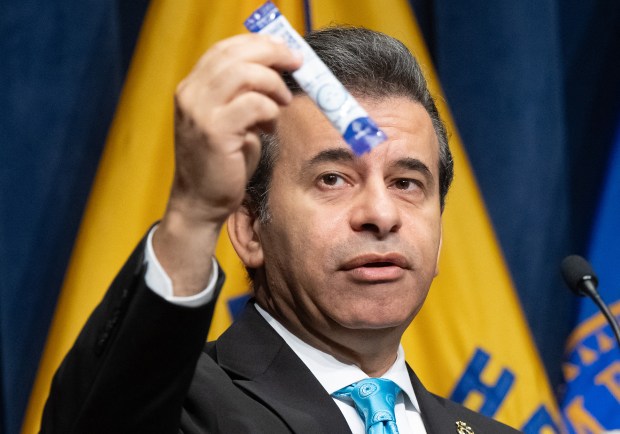
If enacted, 7-OH may be placed on Schedule I for up to two years, according to the U.S. Food and Drug Administration. Illinois businesses, meanwhile, haven’t waited for final decisions. Dr. Marty Makary, serving as the Food and Drug Administration commissioner, held up a 7-OH product during a Washington news conference on July 29, 2025, highlighting its significance.
One vape shop owner near Chicago, choosing anonymity, cleared his stock following news of the impending ban. Businesses like Brightside offered support by distributing cards to local shops, informing them of possible changes and offering treatment options to customers.
Anticipating the ban, concerns arise over withdrawal symptoms that include nausea, weakness, diarrhea, pain, and depression – issues comparable to severe flu symptoms. Laura Fry from Live4Lali, an Arlington Heights-based group, stated that people will resort to measures to avoid getting sick. The group observed a rise in hotline calls from individuals dealing with 7-OH dependency.
Dr. Puneet Lakhmani from Rosecrance Therapies noted that many users initially didn’t recognize 7-OH as an opioid. He attributed an increase in treatment interest due to 7-OH’s decreasing availability. Jim Scarpace from Alpharus Health observed that those using 7-OH often sought it as an alternative to other opioids, a plan that sometimes led back to stronger substances due to adverse effects like seizures.
Ryan, a Chicago suburbanite, shared his journey with 7-OH. Prescribed Vicodin for a back injury, he became addicted before seeking treatment. He later turned to kratom, and subsequently, 7-OH. Despite efforts to quit, he faced intense withdrawal symptoms. Only a rehabilitation push from his spouse prompted change, leading to sobriety.
Regulatory debates focus on outright banning versus controlled regulation, seeing 7-OH users as depending on the substance for chronic pain relief. Critics note that banning 7-OH but not kratom lacks consistency.
Illinois lawmakers have attempted to legislate against high 7-OH concentrations, but efforts stalled. However, some cities like Rockford and Naperville have independently outlawed these products. Other states, such as Kentucky and Kansas, mirrored this move.
Maryann Mason from Northwestern Medicine considered a potential designation of 7-OH as a Schedule I substance a step forward, though acknowledged the history of drug scheduling showing new replacements often arise.
If you or a family member are struggling with mental health or substance use disorders, the helpline 1-800-662-HELP (4357), managed by the federal Substance Abuse and Mental Health Services Administration, offers referrals. You can also text your five-digit ZIP code to 435748 (HELP4U).
Leave a Reply