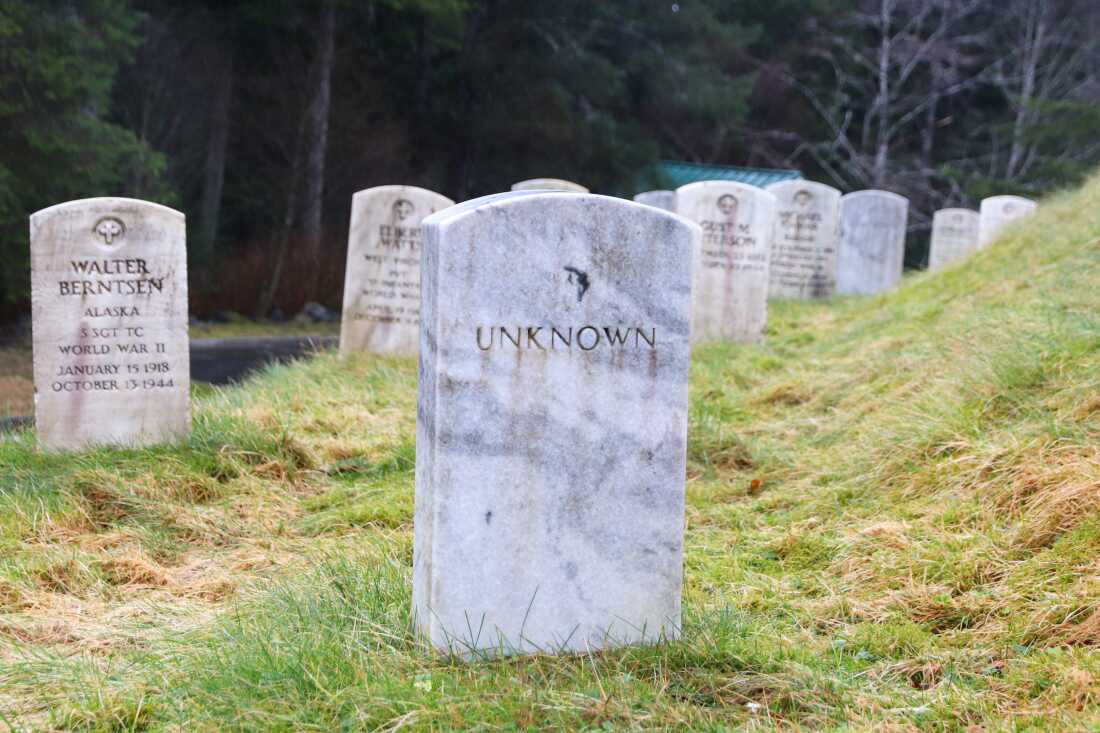
The headstone of an unidentified soldier, referred to as “X-3,” bears the label “Unknown” at Sitka National Cemetery in Sitka, Alaska.
In June, a small gathering of service members, veterans, police, and fire personnel stood in solemn salute in Sitka, Alaska. Two U.S. Coast Guardsmen carried a flag-adorned case from a cemetery to a hearse. The ceremony did not honor a recently deceased soldier but marked the disinterment and transport of an unidentified soldier known as “X-3,” deceased for over 80 years.
“X-3” represents more than 81,000 U.S. service members whose remains are never found or identified. Most of these are missing from World War II, the Vietnam War, and the Korean War. The Department of Defense has an agency tasked with locating and identifying these individuals. The remains are seldom found on U.S. soil, as it wasn’t the primary theater of war. However, Hawaii and Alaska, where WWII military actions occurred, have more missing soldiers. The DOD reports approximately 120 unidentified soldiers in Alaska and over 1,900 in Hawaii.
The remains of “X-3” were transported from Sitka, Alaska, to a Midwest forensics lab for further investigation.
A plane crash in the Aleutians
The story of “X-3” dates back to June 3, 1942, during an attack by Japan on Unalaska, also known as Dutch Harbor, about 800 air miles from Anchorage in the Aleutian Islands. The U.S. military responded by sending resources to defend against the attack. A twin-motor C-53B crashed outside Cold Bay, Alaska Peninsula, resulting in the loss of all 16 service members onboard. Michael Livingston, a local history enthusiast, shared that ten of those servicemen were never found. A local fur trapper discovered six bodies onshore and buried them temporarily. The U.S. military later re-buried them in a local cemetery and, after the war, moved most to their respective communities, except “X-3,” who was then moved to Sitka.
For years, efforts have been made to identify “X-3,” with Livingston advocating for identification without success.
Meanwhile, Chris Pfeiffer, aged 71, from Texas, has been searching for information about his grandmother’s brother, 2nd Lt. Eugene Christensen, believed to be on that flight. Pfeiffer has collected extensive records and also requested the DOD to disinter “X-3”. He remains hopeful yet realistic, acknowledging that “X-3” might not be his great uncle.
Pfeiffer expressed disappointment over the delayed disinterment approval, wishing earlier family generations would have known what happened to Christensen.
According to Aaron Cummings, a senior planner with the DPAA, the agency had been working on “X-3’s” case since 2017. Progress accelerated when Pfeiffer became involved.
Unique and challenging disinterment
In late June, a recovery team from the DPAA worked over several days to hand-dig the grave of “X-3”. The team faced challenges due to potential shifts in the casket positioned on a hill in Sitka since 1948. On their mission, they previously encountered an empty grave, underscoring the difficulty of these efforts.
Despite obstacles, the team successfully recovered “X-3″‘s remains, preserved in a metal-lined wooden casket just three feet beneath the surface. Now, the focus is on combining historical records with modern techniques, including dental and DNA testing, to confirm “X-3’s” identity and provide a final resting place.
Should “X-3” be identified as Christensen, Pfeiffer plans to inter the remains in Nebraska alongside family. Regardless of “X-3’s” true identity, Cummings emphasizes the importance of these missions for family closure and national commitment to honor fallen heroes.
Leave a Reply