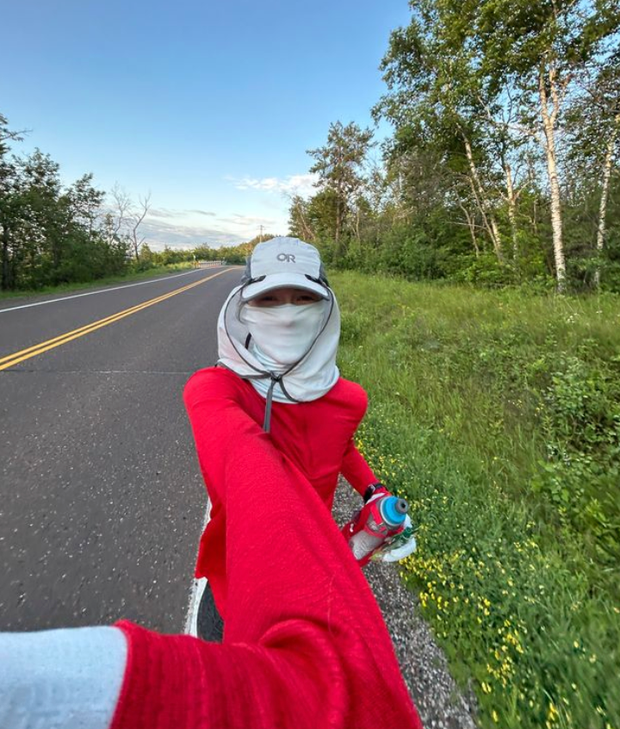
Emily Pearson faced significant challenges at a young age. At eight, her time in the sun was intensely painful, leaving her extremities feeling as if they were burning while being pierced by needles. Her family’s attempts to identify the issue through sunblock and protective clothing offered no relief. Family vacations became increasingly difficult as any exposure to sunlight caused agony in her hands, feet, and face.
“The pain was insufferable,” Pearson, from Minneapolis, said. At 17, she finally received a diagnosis: erythropoietic protoporphyria (EPP), a rare disorder akin to being allergic to sunlight. Discovering the cause provided some relief but also meant accepting little could be done about her ailment.
Despite the limitations imposed by EPP, Pearson found solace in running. Having been a competitive swimmer for 12 years, she turned to running half-marathons after high school. Racing at times like sunrise or sunset had become routine to avoid reactions, but the thrill of running outweighed these challenges.
However, the desire to run a marathon seemed out of reach. Everyday activities like grocery shopping or filling up the car added to her stress. “Constantly managing activities to prevent reactions was exhausting,” she admitted.
In 2025, Pearson volunteered at Sun Escape, a camp for children with EPP. There, she learned about a drug trial for a medication named bitopertin, which piqued her curiosity amidst concerns about its effectiveness.
“Bitopertin targets protoporphyrin IX,” explained Dr. Sioban Keel, a porphyria specialist. This molecule’s overproduction in EPP sufferers causes painful skin reactions. Bitopertin, taken daily, reduces this molecule, potentially easing symptoms.
Pearson joined the trial’s second phase in July 2025, receiving regular monitoring in Boston. Her sunlight tolerance soon improved. Dr. Keel, though not treating Pearson, noted similar beneficial outcomes in other patients.
Disc Medicine’s clinical data indicates that bitopertin significantly reduced protoporphyrin-IX levels with no notable safety issues, leading to better sunlight tolerance.
Currently part of an open-label extension, Pearson continues bitopertin treatment. The drug remains in phase 3 of the clinical trial, awaiting more extensive data before possible FDA approval.
“My life has changed dramatically,” Pearson said. In October 2025, she ran her first marathon wearing shorts and a T-shirt, free from her past restrictions.
Buoyed by her marathon success, she ran another race in June and enjoyed her time at her family’s cabin without anxiety, despite minor reactions after prolonged sun exposure.
Looking ahead, Pearson plans another marathon and even considers a triathlon to combine her love for running and swimming. Now, without former fears restricting her outdoor time, each day is filled with new opportunities.
“Living without constant worry is liberating,” she said. “I’m far happier and more energetic, with a future full of possibilities.”
Leave a Reply