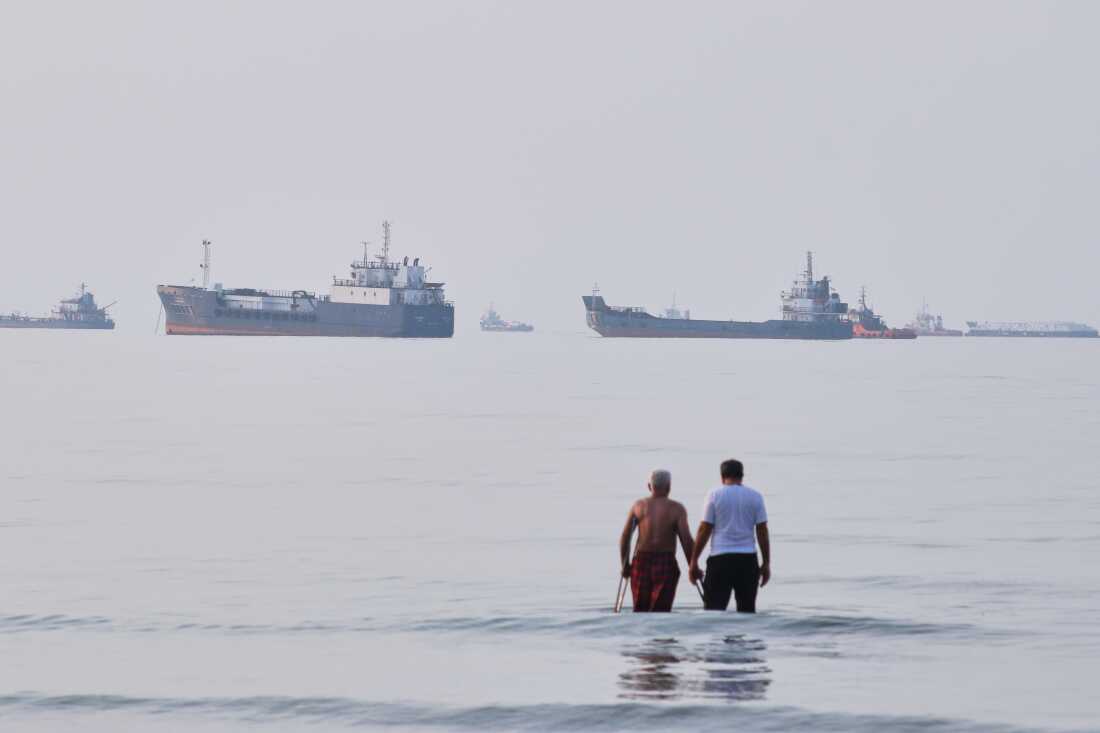
Two men traverse the waters of the Strait of Hormuz off Bandar Abbas, Iran, as vessels remain anchored in the backdrop. The conflict between the United States and Iran continued on Saturday with both nations exchanging blows targeting infrastructure and military sites. This confrontation centers on control over the strategic Strait of Hormuz.
Following the breakdown of an interim ceasefire, the war, which began over four months ago with the involvement of the U.S. and Israel, shows no sign of resolution. On Saturday, the U.S. Central Command reported its seventh consecutive night of strikes. Targets included surveillance sites, military logistics infrastructure, underground weapons storage, and maritime capabilities.
Regional tensions heightened as Kuwait intercepted Iranian missiles and drones. Iraq reported the downing of attack drones over Irbil. Meanwhile, Jordan’s state-run Petra news agency claimed that the kingdom’s air defenses had thwarted Iranian missiles, while Bahrain experienced air sirens.
Iranian authorities reported dozens of fatalities and hundreds of injuries due to recent U.S. strikes. Further casualties were noted on Friday, aligning with the U.S. acknowledgment of service members injured in action. Since the onset of conflicts on February 28, Iran has effectively closed the strait to shipping traffic, escalating oil prices while enhancing Iran’s negotiation leverage. On Friday, the price of oil soared above $86 a barrel as vessel passages through the strait fell to a three-week low, per an international shipping tracker.
In a Thursday address, President Trump assured the American public of progress, stating, “We are winning in Iran and the results will be evident soon.” Prior to the conflict, the U.S. engaged in discussions with Iran regarding its nuclear agenda. The ongoing war places political pressure on Trump to end the conflict and avoid an extended Middle Eastern engagement contrary to his campaign assurances.
U.S. Strikes on Key Infrastructure
Iranian state media reported U.S. airstrikes targeting bridges in southeastern Hormozgan province. The strikes on Bandar Khamir aimed to disrupt connectivity between Bandar Abbas, Iran’s main port, and central Iran, extending to Tehran. Iran also acknowledged attacks on its power infrastructure during the U.S. campaign. The Energy Ministry encouraged reduced power usage in the southern provinces experiencing high temperatures.
Reportedly, U.S. strikes resulted in at least 46 deaths and over 400 injuries, including eight fatalities from a bridge strike on Friday. U.S. reports stated 13 more service members—10 Army and three Navy—were wounded recently, totaling 14 U.S. fatalities and 427 injuries since the war’s inception.
Key Port Infrastructure Targeted
The collapse of a tower at the Chabahar port in Iran, a significant trade route for landlocked Afghanistan, occurred as a result of U.S. airstrikes. Managed with India’s support, the Chabahar port consistently faces American attack. According to Iran, the tower monitored commercial port traffic. However, the U.S. argues that it was integral to a surveillance network used by Iran’s Revolutionary Guard.
On Friday evening, Iranian media reported explosions across Iran, including central and southern regions, with attacks around Ahvaz mentioned. Authorities in Lar, Yazd, and Sirik also reported explosions while Iran targeted strategic sites across the region in retaliation.
Iran’s Retaliation Targets the Region
On Friday, Iran fired missiles at Qatar, triggering public safety advisories. Debris from intercepted missiles injured a child. Iran also targeted Bahrain and Kuwait. Kuwait reported attacks on a power and water desalination plant, leading to severe damage. A Kuwaiti defense ministry spokesman confirmed injuries from drone attacks on military facilities.
Jordan’s military intercepted incoming missiles on Friday launched by Iran. Explosions occurred in northern Iraq’s Kurdish region, targeting the dissident group Komala, resulting in fatalities and injuries. An anonymous official cited security concerns for anonymity. Iran has not claimed responsibility but has targeted Komala previously.
A tanker traversing the Strait of Hormuz came under attack, sustaining minor damage. The United Kingdom’s Maritime Trade Operations center verified the incident, likely executed by Iran.
Strategic Struggle for Strait Control
Iran asserts sole authority over the Strait of Hormuz and argues that vessels should pay fees to Tehran, though traditionally considered international waters. President Trump reiterated threats to target Iran’s power stations and bridges to pressure retreat. The U.S. reinstated a naval blockade on Iranian ports, curbing crude oil shipments. Crossings through the strait dropped to a three-week low, recorded at only eight vessels on Thursday, per MarineTraffic.com. While the region increasingly relies on pipeline energy transportation, it doesn’t sufficiently counterbalance decreased strait shipping.
Leave a Reply