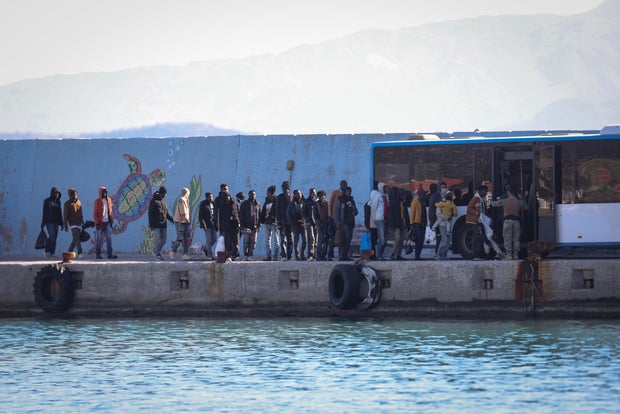
Five European Union countries are making progress in plans to deport asylum seekers, whose applications have been denied, to third countries outside the EU. This comes after new rules were approved that enable this practice. The countries involved are Greece, Germany, Austria, Denmark, and the Netherlands.
The plan involves creating ‘return hubs’ outside the EU for people who have exhausted their legal options to remain in Europe, and who cannot be returned to their countries of origin. Danish Interior Minister Morten Bødskov stated that the initiative is progressing well with expectations to transfer irregular migrants outside the EU by 2027. Greece plans a pilot project by early next year, according to Greek Migration Minister Thanos Plevris.
No specific countries have been confirmed as destinations for these return hubs. However, it has been suggested that they could be set up in Africa. A Greek government statement mentioned that the hubs would be located in safe third countries.
A discussion paper from the EU’s European Council indicated that these hubs might deter irregular immigration. It could promote voluntary returns, particularly if migrants face transfer to a hub as a consequence of not complying with a deportation order.
The EU’s new legal framework allows member states to form agreements with non-EU countries, provided they adhere to international human rights standards and uphold the principle of non-refoulement. This principle ensures that individuals are not sent back to countries where they might face severe harm.
U.S. and U.K. Precedents
The U.S. under the Trump administration previously used third-country deportations, sending more than 100 deportees to eight African countries over a period of ten days. The approach was praised by Greek Migration Minister Thanos Plevris, highlighting influence across borders on migration policies.
However, similar policies have faced challenges. Britain’s former Conservative government tried to send asylum seekers to Rwanda for claim processing, but the U.K. Supreme Court ruled the move unlawful due to potential risks to asylum seekers. The plan was abandoned by the subsequent Labour government.
Significant expenses for the failed Rwandan plan highlighted potential financial pitfalls, with £715 million spent without achieving significant relocations.
Challenges and Implications
The creation of return hubs reflects a broader strategy to tighten immigration controls in Europe. Jacob Reynolds from the Freedom and Sovereignty Initiative Europe recognized the EU’s steps towards managing borders, but warned of deeper issues. He emphasized the need for comprehensive reforms to address the liberal policies towards asylum seekers in the region.
This initiative illustrates how countries continue to grapple with balancing humanitarian obligations against the challenges of immigration management.
Leave a Reply