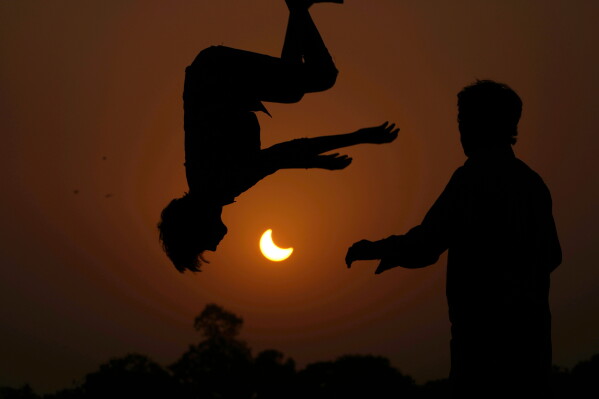
This week, the skies over Europe are set to witness a significant astronomical event. A total solar eclipse will sweep across the continent, offering a rare spectacle. Though not as dramatic as North America’s previous coast-to-coast eclipses, this is Europe’s first total solar eclipse since 1999.
Totality Path
The eclipse will kick off near the North Pole, moving swiftly over Greenland, Iceland, and parts of Spain and Portugal. While the totality will last only a few minutes, it provides an extraordinary experience for viewers in these regions. Notably, Spain will see another, more prolonged total eclipse next August, along with parts of North Africa and the Middle East.
North America’s Eclipse History
The Great American Eclipse of 2017 captured the attention of millions, as totality stretched from Oregon to South Carolina for over two minutes. That excitement was set to peak in 2024, with an eclipse traversing diagonally from Mexico to Newfoundland. Unfortunately, the next U.S. coast-to-coast total solar eclipse won’t appear until 2045.
Partial Eclipse Viewing
On Wednesday, parts of the U.S. and Canada will experience a partial solar eclipse. Here are some cities that may get a glimpse, provided the skies remain clear. Remember to use certified eclipse glasses to protect your eyes.
- Anchorage, Alaska: 28% coverage. Begins at 7:36 a.m., ends at 9:09 a.m., with the peak at 8:21 a.m.
- Bangor, Maine: 24% coverage. Begins at 12:54 p.m., ends at 2:49 p.m., with the peak at 1:53 p.m.
- Detroit: 3% coverage. Begins at 1:03 p.m., ends at 2:08 p.m., with the peak at 1:36 p.m.
- Montreal, Quebec: 18% coverage. Begins at 12:50 p.m., ends at 2:38 p.m., with the peak at 1:45 p.m.
- New York City: 9% coverage. Begins at 1:07 p.m., ends at 2:38 p.m., with the peak at 1:54 p.m.
- Philadelphia: 7% coverage. Begins at 1:11 p.m., ends at 2:35 p.m., with the peak at 1:53 p.m.
- St. Johns, Newfoundland and Labrador: 53% coverage. Begins at 2:28 p.m., ends at 4:37 p.m., with the peak at 3:35 p.m.
- Toronto, Ontario: 8% coverage. Begins at 12:55 p.m., ends at 2:23 p.m., with the peak at 1:40 p.m.
- Washington, D.C.: 4% coverage. Begins at 1:17 p.m., ends at 2:27 p.m., with the peak at 1:53 p.m.
- Winnipeg, Manitoba: 5% coverage. Begins at 11:25 a.m., ends at 12:40 p.m., with the peak at 12:02 p.m.
The cosmic event reminds us of the wonders of astronomy, captivating both Europe and parts of North America. Don’t miss the chance to be part of this celestial spectacle.
This report was supported by the Howard Hughes Medical Institute’s Department of Science Education and the Robert Wood Johnson Foundation. Responsibility for content lies with the Associated Press.
Leave a Reply