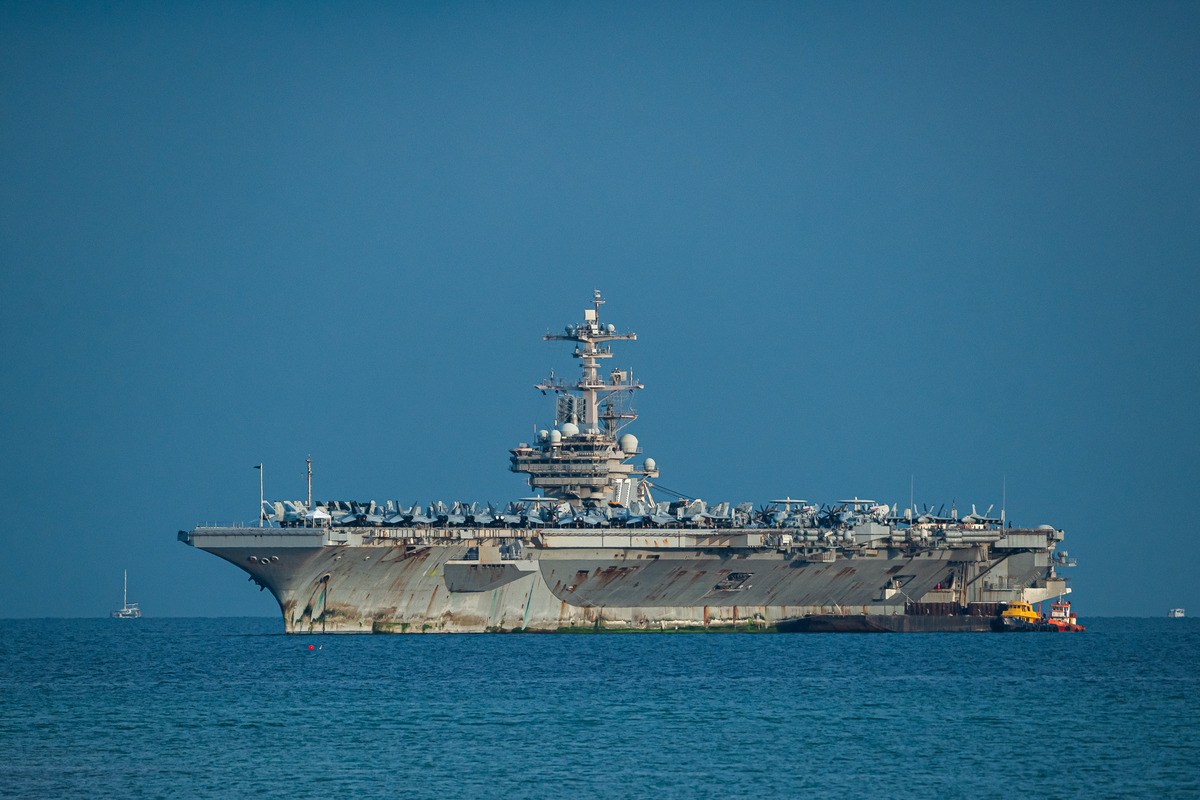
The deployment of the USS George H.W. Bush aircraft carrier in the Middle East has been extended, raising concerns highlighted by the recent long deployment of the USS Abraham Lincoln. The Lincoln’s record-breaking deployment drew attention to the stress and welfare challenges faced by U.S. personnel at sea for extended periods.
According to a meeting recording obtained by MSNOW, U.S. Navy officials informed the families of service members aboard the Bush that the deployment might last up to a year, which means missing the holidays. The Department of Defense declined to discuss “future or hypothetical movements” to maintain operational security, a Pentagon official told Newsweek.
Carrier deployments typically last six to seven months and include port calls to restock supplies and give the crew some rest. An aircraft carrier operates as part of a larger group of ships, known as a carrier strike group, including destroyers and an embarked air wing. Currently, the Bush carrier strike group is in the Arabian Sea, accompanied by the USS George Washington and other ships.
The USS George H.W. Bush departed Norfolk, Virginia, on March 31. In contrast, the USS Abraham Lincoln returned to San Diego, California, on October 8, following its departure from the West Coast in November 2025. The Lincoln made stops in Guam and Oman, spending 208 consecutive days at sea between these visits, setting a modern record for aircraft carriers.
Concerns about overwork and lack of basic supplies, such as hygiene and nutrition, were raised in the weeks before the Lincoln arrived in Thailand. A study by the U.S. Naval Health Research Center in 2025 found Navy personnel experienced high stress at sea, with nearly half of 441 sailors surveyed citing inadequate support services.
Acting Navy Secretary Hung Cao noted in a letter to Senator Kirsten Gillibrand that there were eight suicide attempts during the Lincoln’s deployment. Addressing family members of the Bush crew in Norfolk, Cao empathized with the hardships families face during prolonged deployments.
Before stopping in Thailand for four days in early October, the Bush crew had gone 187 days without a port call, as reported by MSNOW. Admiral Karl Thomas, commander of U.S. Fleet Forces Command, told family members that U.S. ships in the region faced drone threats, reflecting tension in the area.
Eight months have passed since U.S. and Israeli strikes against Iran, yet peace seems distant, though conflict intensity has decreased.
Comparing Bush and Lincoln
Both the Bush and Lincoln are among the Navy’s Nimitz-class nuclear-powered aircraft carriers, which include ten operational vessels. The Nimitz class and the newer Ford class are the two categories of such carriers, with the Ford class expected to replace the older ships gradually.
Commissioned in January 2009, the Bush includes numerous upgrades, such as improved data systems and redesigned propellers. In contrast, the older Lincoln underwent a significant refurbishment known as a Refueling and Complex Overhaul in 2017, involving nuclear reactor refueling and aircraft-launch system upgrades.
The Lincoln’s deployment spanned 321 days. Meanwhile, the Bush is expected to match or exceed this duration, based on warnings to family members.
If you or someone you know struggles with suicidal thoughts, contact the 988 Suicide & Crisis Lifeline for confidential support. Service members and veterans can also reach out to the Veterans/Military Crisis Line or Military OneSource for assistance.
Leave a Reply