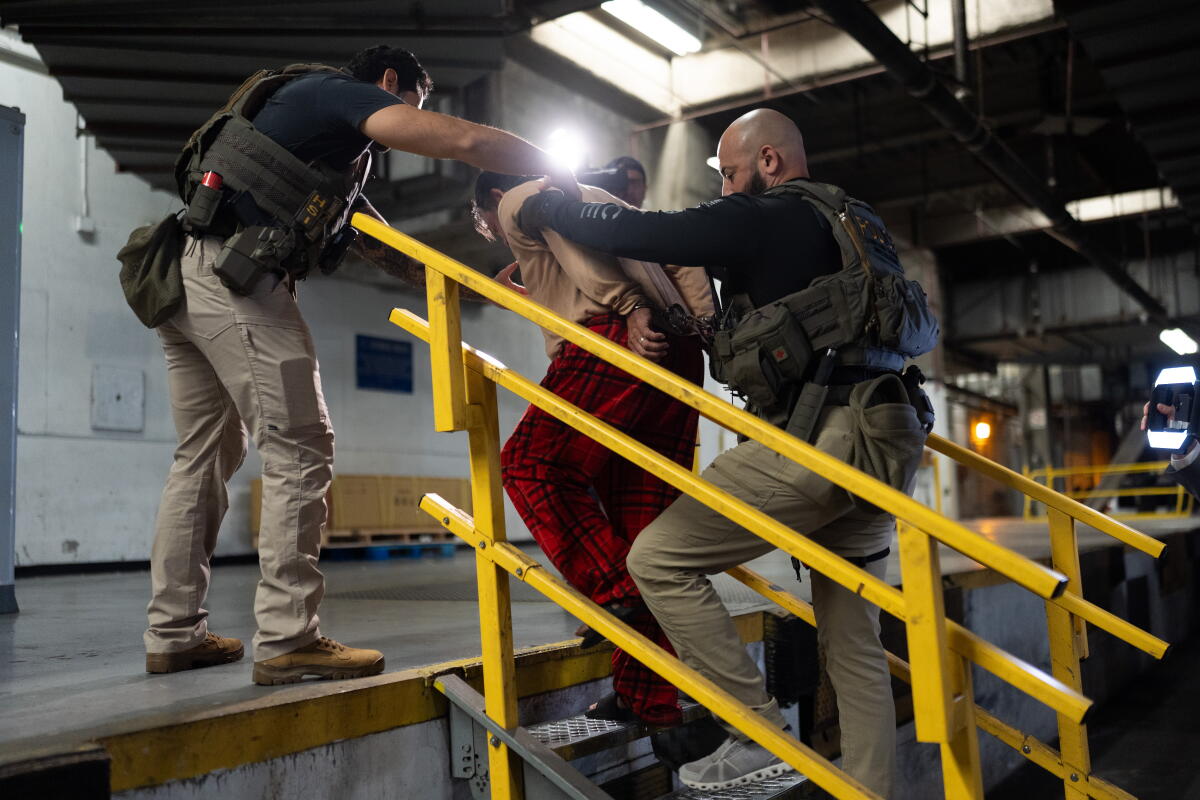
Late Monday, a group of green card holders, arrested in Los Angeles, expressed confusion over voter fraud charges against them. Among those charged was 60-year-old Ana Domínguez, originally from El Salvador and now a lawful permanent resident in Long Beach. Federal authorities accuse her of fraudulently registering to vote in 2006 and making false statements during her naturalization process in 2026. Domínguez insists she has no memory of registering to vote.
Similarly, another man facing identical charges asserted that he never registered to vote, despite federal prosecutors’ claims. These individuals are part of a group of 28 people arrested on charges including fraudulent voter registration and making false statements in their naturalization applications.
Federal prosecutors, along with Justice Department officials, announced these arrests as evidence of alleged corruption in California elections due to noncitizen voters. This aligns with previous claims by President Trump. Californian state officials, however, argue these cases do not indicate widespread voter fraud, suggesting instead that they result from administrative errors or misinterpretations.
Rick Hasen, director of the Safeguarding Democracy Project at UCLA, noted that voter registration errors can happen unintentionally, such as during DMV visits. He emphasized that a crime only occurs if there is a demonstrable violation of federal law.
The first court appearances for four defendants took place later that afternoon. Family members of those charged, anxious and concerned, gathered at the courthouse. Domínguez’s daughter, among others, was visibly distressed as she awaited her mother’s hearing. Inside the courtroom, Domínguez faced her family with affection, despite being shackled and wearing a black back brace.
Another defendant, 72-year-old Omar Muñoz from Belize, appeared in court after being photographed during his arrest in Commerce. He faced similar voter fraud charges, including claims of voting multiple times between 2020 and 2024, and allegedly lying on his citizenship application.
Muñoz’s case highlights the widespread media attention accompanying the arrests, intended to underscore the perceived severity of noncitizen voting issues in California. However, Hasen argued the reality likely involves fewer cases with no malicious intent.
The First Assistant U.S. Attorney in Los Angeles, Bill Essayli, defended the arrests as a strong effort to prevent noncitizens from impacting legitimate U.S. voters. Essayli dismissed claims that those charged were unaware of their actions, stating that voter registration requires active participation.
Among those appearing in court was José Antonio Bañuelos-Díaz, a Mexican national resident from West Adams, who was arrested en route to work. During court hearings, defendants acknowledged understanding the charges but were released on personal recognizance without detention. They are set to return for a preliminary hearing on November 9.
The daughter of Muñoz, Lliani Orantes, expressed dismay at the handling of her father’s arrest. She questioned whether he was mistaken for another relative sharing his name. Orantes criticized the display of media during the operation, condemning it as a political maneuver rather than a focus on public safety.
The news conference announcing the charges included Acting U.S. Deputy Attorney General Trent McCotter. California Attorney General Rob Bonta, defending state and local election officials, opposed claims of rampant voter fraud, pointing to the small number of cases out of millions of California voters.
As the court concluded, the defendants exited to be reunited with waiting family members. Domínguez reflected on her arrest, displaying bruises on her wrists from handcuffs. She reiterated her innocence, questioning the validity of years-long accusations despite her lack of voting history.
Federal authorities’ allegations claimed that out of 28 defendants, 21 had voted, though Domínguez was not one of them. She has been a lawful permanent resident since the late 1980s and filed for U.S. citizenship earlier this year, asserting only her husband and daughter were registered voters in her household.
Meanwhile, Muñoz and his family emerged from the courthouse reluctantly discussing the charges. Muñoz called for a less aggressive approach, suggesting a simple court notification could have sufficed. He expressed shock at the resources expended for his arrest.
Muñoz’s son and wife questioned the necessity of deploying numerous agents and vehicles, highlighting the traumatic impact on their family. They emphasized due process and the presumption of innocence, while pointing out the strain imposed by the manner of arrest.
Leave a Reply