Former Chinese Premier Zhu Rongji has died, as reported by state media. Zhu, known for his impatience and sharp tongue, played a critical role in China’s massive economic growth by enforcing transformative changes in state industries during the 1990s. He also led China into the World Trade Organization (WTO).
The Xinhua news agency stated that Zhu passed away from an illness in Beijing at around 11 a.m. on Wednesday. He was 97 years old. During his tenure as premier from 1998 to 2003, Zhu implemented numerous reforms that were crucial for China’s economic development.
Zhu challenged Communist Party traditionalists and industrial leaders, pushing state-owned enterprises to become efficient and profitable. Although this led to millions losing their jobs, it helped China overtake Japan as the second-largest economy by 2010, after the United States.
Building on reforms initiated by former leader Deng Xiaoping in 1979, Zhu demonstrated the determination and creativity needed to drive transformative changes. This period saw China gaining membership in the WTO, significantly enhancing its status as a leading global exporter.
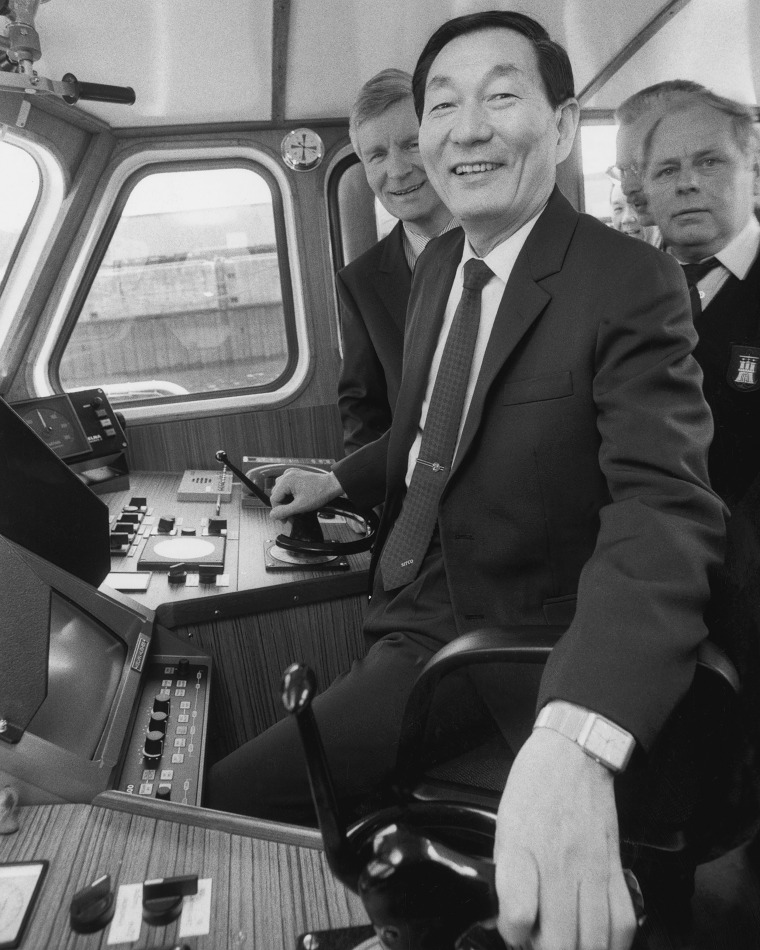
Zhu Rongji during a visit to Hamburg in 1991.Ullstein Bild / Getty Images
These reforms allowed China to maintain economic growth rates exceeding 8% annually from 2000 to 2010, peaking at 14.2% in 2007. Named premier in 1998 at the age of 69, Zhu became popular for his criticism of inefficient government practices and corruption. He was known for his straightforward approach and once famously said, “I have prepared 100 coffins here — 99 for corrupt officials and one for myself,” according to the People’s Daily.
Zhu ranked third in the Communist Party’s hierarchy, following President Jiang Zemin and Li Peng, chair of the National People’s Congress. Despite not having his own power base, which allowed officials to ignore directives, he was well-regarded for his technical expertise.
As a deputy premier in the 1990s, Zhu gained fame by controlling inflation. He imposed price controls and cut loans to unprofitable state companies, resisting opposition from local leaders. Zhu replicated this strategy when promoting reforms against conservative forces.
He led efforts to achieve WTO membership through extended negotiations that began in the 1980s. This accomplishment entrenched free trade as a national policy and gave Zhu leverage to curb local protectionism. His breakthrough came after a challenging trip to Washington in 1999 to seek U.S. approval for China’s WTO bid. Despite initial rejection from the Clinton administration, Zhu secured China’s accession to the WTO in December 2001.
Former U.S. President Bill Clinton and Zhu Rongji at the White House in 1999.Getty Images
In 1998, Zhu initiated China’s home ownership boom by selling apartments owned by state companies, leading to rapid privatization of urban housing.
Born on October 23, 1928, in Hunan province, Zhu’s career was marked by a willingness to take risks. He faced exile to the countryside during the Cultural Revolution due to his criticism of party policies but returned to prominence in 1979. His political ascent was swift, becoming deputy Shanghai party secretary in 1987 and mayor the following year.
As Shanghai’s mayor in 1989, Zhu was praised for peacefully handling protests, notably avoiding military intervention. He was acknowledged for his tactful resolutions in tense situations, which earned him recognition from international observers.
Zhu’s political career advanced as he was promoted to deputy premier in 1991 and joined the party’s ruling Standing Committee in 1993. He often openly admitted government shortcomings, breaking from the party’s norm of infallibility.
In 1998, after disastrous floods, Zhu criticized official mismanagement, saying some flood barriers were no stronger than bean curd. He continued to address government shortcomings, apologizing for failures like the fatal schoolhouse explosion in southern China that killed dozens of children.
Zhu Rongji in Beijing in 2015.Ng Han Guan / AP file
Known for his humor, Zhu lightened the party’s image with his wit. During a 1999 press event, he joked about a photo that “made me look like a dead man.” He prided himself on crafting a tax system that increased revenues for Beijing and once humorously claimed it was worthy of a Nobel Prize.
After stepping down, Zhu rarely appeared in public.
Leave a Reply