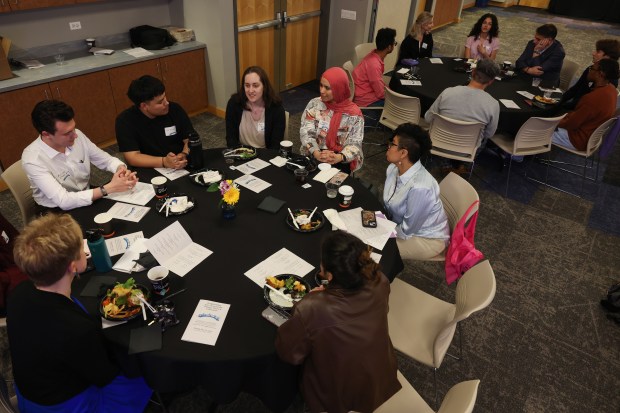
Isabela Torres Reyes reflects on how her approach to conversations has evolved over the past six months. Initially eager to jump into discussions, the DePaul University graduate now listens and responds thoughtfully. This change came after completing a 10-week dialogue course as part of DePaul’s Bridgebuilding Fellowship. The program helps students develop skills to engage across diverse ideologies.
The fellowship encouraged Torres Reyes to consider people’s backgrounds and experiences in shaping their views. She found herself asking, “What do you care about that I’m not seeing?” rather than focusing solely on differing opinions. She emphasized the challenge of finding space to think and respond in conversations without interruption. Lucas Reynoso, another student, added, “Practicing open communication is crucial, especially within campus environments.”
Dialogue programs are becoming more common at colleges, addressing what some see as a lack of conversation opportunities in higher education. In an era of divisive politics and social media, campuses, once hubs of idea exchange, risk becoming more polarized. According to a Pew Research Center survey in October 2025, nearly half of colleges do a fair or poor job of exposing students to diverse viewpoints. Similarly, 46% said there is a shortfall in providing students opportunities to express their views.
At the University of Chicago, Tyler Shasteen worked with the civic policy institute to engage students in meaningful dialogue with those holding different beliefs. “There’s a collective and cohesive effort to build community,” Shasteen noted. DePaul’s Torres Reyes echoed this sentiment, finding value in engaging with differing perspectives to explore the reasons behind viewpoints while maintaining her focus.
DePaul University’s efforts, such as the Bridgebuilding Fellowship launched in 2025, are part of broader initiatives in Chicago to bridge divisions through dialogue. Students participate in classes emphasizing communication techniques, recognizing the impact of tone and delivery, and understanding how childhood shapes perspectives. These experiences help students learn to see beyond opinions.
Programs at other universities, like the U. of C.’s Institute of Politics, also focus on fostering engagement amid polarization. Ava Partridge, a recent graduate who served as co-chair of the Student Advisory Board, highlighted the value of in-person meetings to humanize differing views. She and her peers prioritized learning rather than changing each other’s opinions.
At DePaul, graduate Umar Ryan credited the fellowship with helping him break out of his shell. Sharing personal stories with classmates revealed the backgrounds informing opinions, humanizing participants. “People aren’t just their opinions,” Ryan said, noting the importance of understanding that to avoid further division.
U. of C.’s Shasteen emphasized the role of dialogue in sparking “intellectual curiosity,” allowing students to disagree respectfully and walk away without animosity. He noted, “It’s about understanding there’s a reason behind different beliefs rather than seeing them as adversarial.”
Other Chicago institutions, such as Loyola University’s Community Circles and Northwestern University’s Litowitz Center for Enlightened Disagreement, also prioritize dialogue and understanding. Northwestern’s program, which began in September 2025, aims to help students recognize cognitive biases and work collaboratively.
In an email to the Tribune, senior director Mark Engberg reported that nearly all participants in Northwestern’s residential program improved their listening skills, gained insight into their views, and identified real sources of disagreement. “The impact is cultural and practical, shifting norms around disagreement,” Engberg wrote.
DePaul President Robert Manuel emphasized the importance of productive dialogue within higher education during the Bridgebuilding Fellowship’s year-end celebration. “This should be the norm, reflecting how the DNA of our community is connection,” Manuel stated.
Leave a Reply