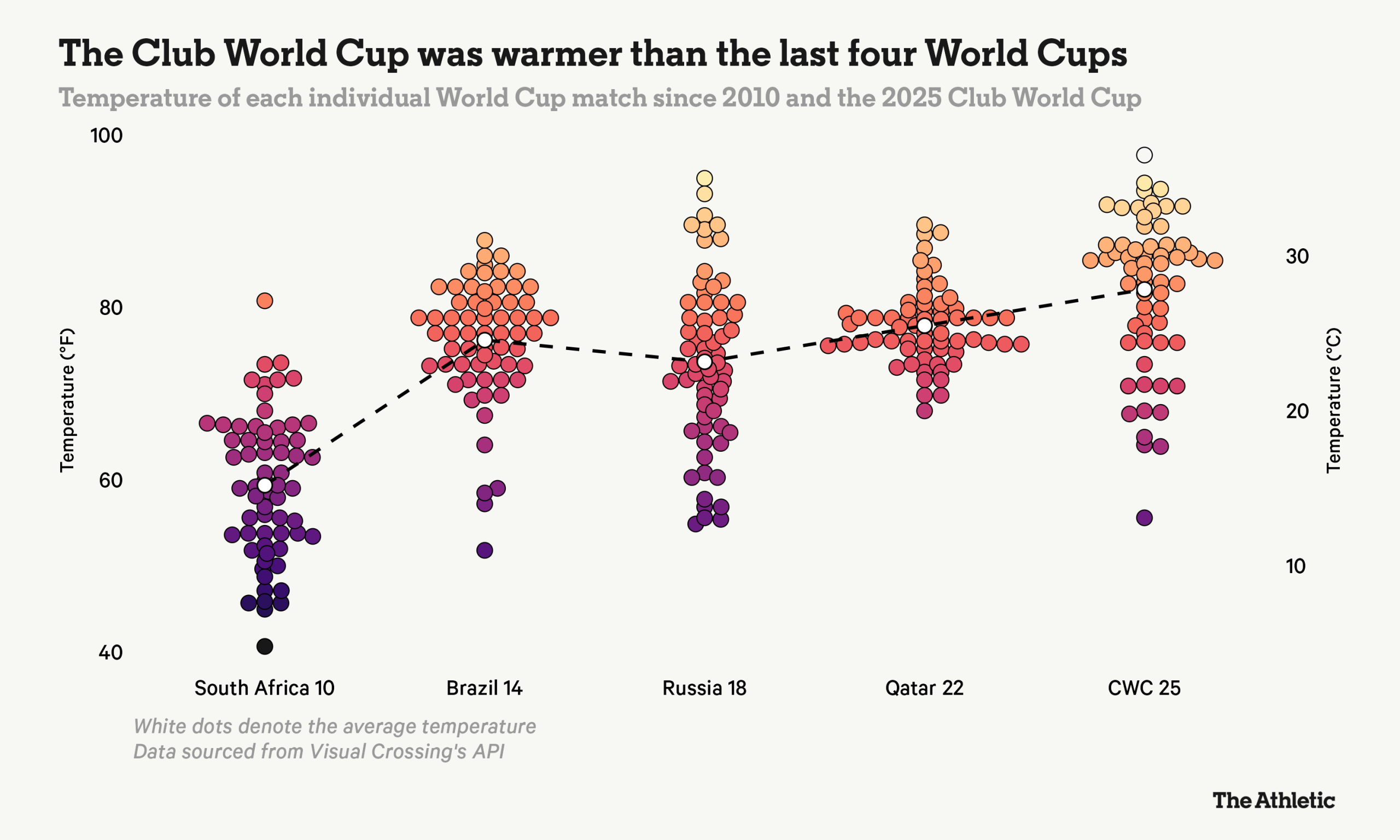
The upcoming World Cup will take place in hot conditions, with many games expected to see temperatures above 90F (32C). This could make it one of the hottest editions since the U.S. hosted it in 1994. During that tournament, a majority of the matches were played before 5pm local time, often under an intense afternoon sun. Notably, in Orlando, temperatures soared to 117F during Mexico’s 2-1 victory over the Republic of Ireland.
FIFA recently held the Club World Cup in the U.S., which served as a trial for the upcoming event. Data from Visual Crossing indicates that last summer’s conditions were warmer than those of the previous four World Cups. The current tournament, however, will also include matches spread across Mexico and Canada, not solely the U.S.
The Athletic conducted an extensive analysis of a decade’s hourly weather data for each fixture. This included using the scheduled kick-off time, plus an hour either side, across a seven-day window around the match date. For instance, the upcoming quarter-final in Kansas City on July 11 at 8pm was analyzed by examining weather conditions from 7pm to 9pm between July 8 and July 14 over the past 10 years.
Results show AT&T Stadium in Dallas could average around 90F (32C), closely followed by Estadio BBVA in Monterrey. Temperatures might peak at AT&T Stadium at 93F (34C) during a 2pm semi-final on July 14. Dallas, Atlanta, and Houston stadiums will feature closed roofs and air conditioning, which should help manage conditions. Open-air stadiums are less forgiving, with some experiencing temperatures above 100F at kick-off.
According to Aaron Mentkowski, chief meteorologist for WKBW-TV Buffalo, conditions at pitch level can feel more intense, especially on days with light winds and full sunshine. Fields absorb and radiate solar heat back, making the environment difficult for players. Mentkowski is The Athletic’s World Cup weather expert and will provide daily forecasts during the tournament.
Players’ performance might decline under these conditions, as Jurgen Klinsmann noted from his 1994 experience playing against Bolivia. Some teams, like Norway, are attempting to acclimate to the climate. Norway’s players were seen training under the sun in North Carolina, experiencing temperatures far from their native conditions.
Mentkowski argues that players from colder climates might adjust after a week or two in hot conditions. Most players compete in clubs outside their home countries, experiencing similar conditions regularly. A team’s ability to handle the heat could influence their success.
Beyond heat, thunderstorms present logistical challenges. U.S. protocols require match suspensions if lightning occurs within an eight-mile radius, causing potential delays. Last year, a Club World Cup match took over four hours due to lightning delays.
Certain venues like Miami and Mexico City are susceptible to daily afternoon storms. Kansas City, Boston, Philadelphia, and New York might see increased storms depending on atmospheric conditions. These weather interruptions could disrupt game momentum and require teams to adjust nutrition and hydration plans.
Success in this World Cup might hinge on adaptability to harsh weather, proving as crucial as tactics or player skills.
Leave a Reply