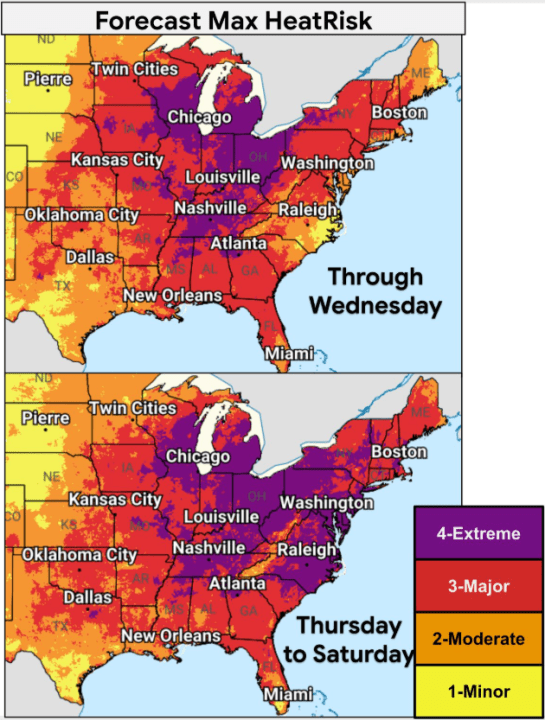
Communities across the central and eastern United States are bracing for a significant heat wave. It’s expected to peak ahead of the July Fourth holiday. The dangerous conditions result from high temperatures combined with elevated humidity levels.
Record-Breaking Heat
The heat index — which includes humidity effects — could reach between 105 and 115 degrees Fahrenheit, according to Nexstar’s Chief Meteorologist Brian James. By Tuesday, many parts of the Midwest and South already experienced triple-digit heat indices. Chicago and Minneapolis reported temperatures well above 100 degrees Fahrenheit.
The National Weather Service (NWS) predicts several days of high temperatures. Some areas, such as the lower Great Lakes, mid-Atlantic, and the Mississippi and Ohio River valleys, could see temperatures exceeding 100 degrees Fahrenheit. Meteorologist Bryan Putnam noted that record highs might occur from the lower Great Lakes to the mid-Atlantic and New England regions.
Impact on Major Cities
Many large cities might experience their highest temperatures of the year, coinciding with events like World Cup matches and the celebration of America’s 250th anniversary. High temperatures are anticipated in East Coast cities, including New York, Philadelphia, Washington, and Baltimore. Midwest and Great Lakes cities like Chicago, Indianapolis, St. Louis, and Detroit expect similar conditions. Southern cities such as Dallas, Little Rock, and Memphis will not be spared either.
Predicted Temperature Records
Wednesday:
- Binghamton, NY: 91°F, Previous Record 90°F (2018)
- Burlington, VT: 97°F, Previous Record 96°F (2018)
- Cleveland, OH: 97°F, Previous Record 95°F (2002)
- Washington Dulles, VA: 100°F, Previous Record 96°F (2012)
- Manchester, NH: 98°F, Previous Record 97°F (1971)
Thursday:
- Albany, NY: 99°F, Previous Record 98°F (1966)
- Wilkes-Barre/Scranton, PA: 99°F, Previous Record 98°F (1966)
- Westfield/Springfield, MA: 102°F, Previous Record 94°F (2018)
- Hartford, CT: 102°F, Previous Record 99°F (1966)
- Bangor, ME: 94°F, Previous Record 93°F (1941)
Friday:
- Westfield/Springfield, MA: 100°F, Previous Record 97°F (2002)
- Charlotte, NC: 100°F, Previous Record 99°F (1931)
- Danville, VA: 101°F, Previous Record 100°F (1955)
- Washington D.C. National Airport: 104°F, Previous Record 101°F (1966)
Saturday:
- Baltimore/Washington International, MD: 101°F, Previous Record 100°F (2002)
- Charlottesville, VA: 101°F, Previous Record 100°F (2012)
- Portland, ME: 97°F, Previous Record 93°F (2018)
Understanding the Heat Dome
This extreme heat event is driven by a phenomenon known as a “heat dome.” A heat dome is a high-pressure system that traps heat by compressing the air and reducing cloud cover. The National Oceanic and Atmospheric Administration (NOAA) states that this results in minimal chances for rain, causing a buildup of surface heat.
The high pressure of the heat dome also diverts storms, reducing the likelihood of thunderstorms that might offer temporary relief.
Recommendations for Staying Cool
The NWS advises keeping in contact with vulnerable groups such as young children, older adults, and individuals with chronic illnesses. It is crucial to stay hydrated and take breaks from working outside in shaded areas. Avoid strenuous outdoor activities and never leave children or pets in an unattended vehicle.
Note: This material is sourced from Nexstar Media Inc. and is used with permission.
Leave a Reply