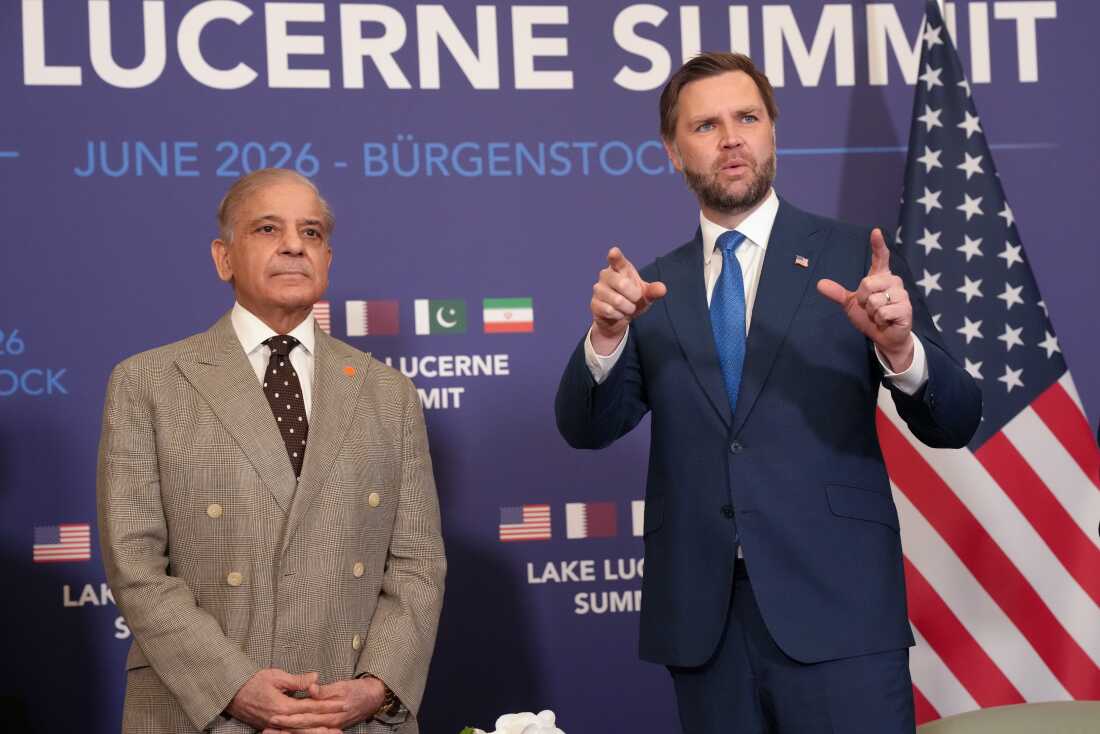
On Sunday, U.S. Vice President JD Vance met with Pakistan’s Prime Minister, Shehbaz Sharif, at the Bürgenstock Resort in Switzerland. The meeting aimed to advance a deal to end the Middle East conflict. Along with Pakistani representatives, Field Marshal Asim Munir and other mediators, the talks included Iranian officials and Rafael Grossi, chief of the International Atomic Energy Agency.
The discussions focus on a Memorandum of Understanding signed last week by the U.S. and Iran. Despite this, tensions remain high. President Trump threatened more attacks on Iran if proxy activities in Lebanon, allegedly funded by Iran, don’t cease. “If they don’t, we’ll hit Iran very hard again,” Trump posted on social media.
On Saturday, Iran’s military announced the closure of the Strait of Hormuz, citing Israeli strikes in Lebanon against Hezbollah. They accused the U.S. of violating the tentative agreement by failing to control Israel. However, U.S. Central Command stated that shipping through the strait continued normally.
Iran’s nuclear program remains a key topic. Iranian President Masoud Pezeshkian declared that Iran will not relinquish its uranium enrichment rights. Iran insists its nuclear intentions are peaceful, but this is a contentious issue.
Friday’s ceasefire did not prevent further conflict. Israeli forces and Hezbollah exchanged intense fire on Saturday, straining the negotiations. At least 16 people died in Israeli strikes that day, according to the Lebanese National News Agency. Israel reported these as counteractions to Hezbollah’s overnight projectiles. Hezbollah fired in response to Israeli advances toward Lebanese territory.
Vice President Vance remained optimistic, stating, “We’ve already made great progress,” while acknowledging the process’s complexity. He emphasized that the U.S. has “done more to stop the conflict in Lebanon than any government anywhere in the world.” For the first time since March, the United Nations Interim Force in Lebanon noted no attacks on Sunday.
Neither Israel nor Lebanon has signed the Memorandum of Understanding. The agreement calls for respecting Lebanese sovereignty and halting military operations in the region, elements Iran insists the U.S. must uphold.
NPR’s Jane Arraf conveyed these developments, illustrating the ongoing challenges in reaching a lasting peace agreement.
Leave a Reply