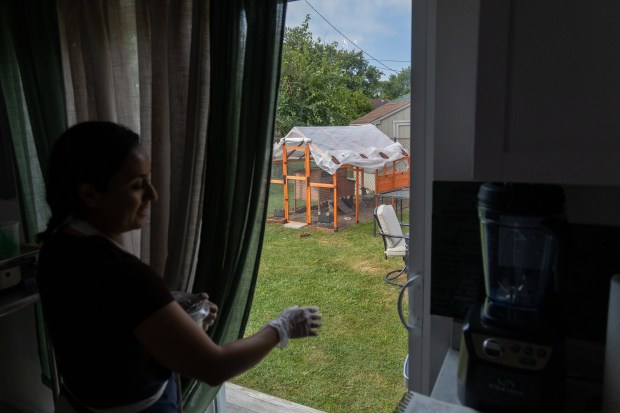
Scottsdale Avenue, located on Chicago’s southwest edge near Burbank, appears as an average neighborhood with brick houses and small, well-kept yards. Kids enjoy the grass, soaking up the last days of summer. However, weekends bring crowds to the sidewalks, eager to purchase fresh pastries from local home bakers. Samaria Pérez, wrapped in a blue apron, begins her croissant dough on a recent Thursday. Her baked goods sell out within hours after sharing online ordering links. By Saturday, 500 pastries are boxed and tagged with ‘Samaria’s Kitchen’ stickers, ready for pickup.
Her kitchen, a licensed micro-bakery, resembles a brick-and-mortar bakery, only separated by her nearby living room. Pérez, at 30 years old, uses two commercial ovens and a 40-quart mixer with large attachments. Another room, meticulously organized, holds an extra fridge, freezer drawers, rolling racks, and bins of flour and sugar. Various baking tools are neatly stored. Outside, a coop houses four chickens. ‘I use my chickens’ eggs in as many recipes as possible, especially curds,’ Pérez said. ‘It can change the flavor. Customers notice and they tell me, ‘There’s something different about this pastry.” It’s the eggs.’
Pérez emphasizes quality ingredients, using Kerrygold Irish Butter and sourcing raw honey from local beekeepers. Her milk choice from Target is USDA-certified organic, free from added growth hormones and pesticides. ‘I remember my grandma’s kitchen in Mexico,’ Pérez recalls, smiling. ‘She prioritized quality, cleanliness, and ingredient details.’ When launching her home-based business, these fundamentals guided her. The weekly bake sale showcases community devotion to small business, akin to large Michelin-starred venues.
On a recent Thursday, Pérez focused on croissants while her sister and business partner, Arely Pérez, handled cookie dough preparation. The duo avoids expensive brick-and-mortar costs, preferring scalable operations. Pérez aims for her pastry quality to sustain popularity. ‘Social media is necessary to attract people,’ she said, despite being a reluctant user. ‘Showing ingredients could change the system gradually.’
Pérez began baking for family and friends years ago. Before launching Samaria’s Kitchen in June, bake sale pop-ups showcased pastries that locals say rival popular Chicago bakeries. Neighbor Juanita Cano praised Pérez’s olive oil orange cake with mascarpone frosting. A few weeks later, Cano observed nearly sold-out conditions by 9:30 a.m. ‘What is happening?’ she asked.
On rainy Saturdays, customer lines extend down the block for Pérez’s pastries. Cano’s mother doubted the popularity, but after tasting the pastries, she found them worth the hype. Pérez recently shifted to online ordering, producing only what’s sold in advance. Despite having 3,000 organic Instagram followers, Pérez’s customer loyalty fuels her success. A viral video showing customers in the rain brought both promotions and debates. ‘There’s confusion over labeling the pastries as ‘Mexican bread,’ which they’re not,’ Pérez clarified. Mexican flavors enhance her pastries, but typical panaderías don’t offer croissants.
One bestseller, sourdough bread, is limited to 16 loaves weekly. Pérez plans Mexican sweet bread for pan de muerto season, but her offerings are diverse. Recent croissant flavors included pistachio, chocolate, almond, and salted honey-orange knots. Savory options such as rajas con queso croissant knots feature cotija cheese and tortilla chips.
Pérez manages her croissant process to ensure flaky layers. ‘I manually roll the dough for control,’ she said, focusing on butter texture. Kerrygold butter, blended with flour, flattens to achieve ideal plasticity before chilling, forming pliable bricks for dough folding. Pérez prepares butter books, then dough, using organic flour, laminating for layers.
Sisterly discussions lead to flavor planning and pastry counts. Pérez’s experience in professional kitchens, spanning 13 years, eases operations. Her family emigrated from Nuevo Laredo to Chicago, facing initial cultural and language challenges. At Robert Morris College, she changed course from law to culinary arts, obtaining an associate’s degree and ServSafe certification. Shifted from savory to pastry, Pérez experimented with techniques for ideal crumb and flakiness.
Business management experts highlight technological advancements in micro-business growth. ‘Online tools reduce startup costs compared to traditional methods,’ said Sean Higgins, Northwestern University’s Kellogg School professor. An oversaturation of micro-bakeries caters to consumer niches, offering specific preferences.
Pérez targets customers seeking high-quality, locally made pastries. She invested $20,000 in equipping her home-bakery, showcasing appliances and ingredient transparency in her bilingual Instagram posts. Honesty fosters trust in home-based businesses. Pérez values personalized catering with intentionality underpinning every order.
Thursday’s baking featured Mexican piloncillo, delivering caramelized complexity, alongside sharp Mexican chocolate folded into cookie dough using milled flours. Weekly Hotplate storefront links allow direct customer purchases, with frequent sellouts.
Saturday mornings involve family collaboration boxing pastries, including her 4-year-old son and husband. ‘I enjoy my life aspects now,’ Pérez said. ‘Working for myself keeps negativity at bay, letting me decide offerings and ingredients.’
Leave a Reply