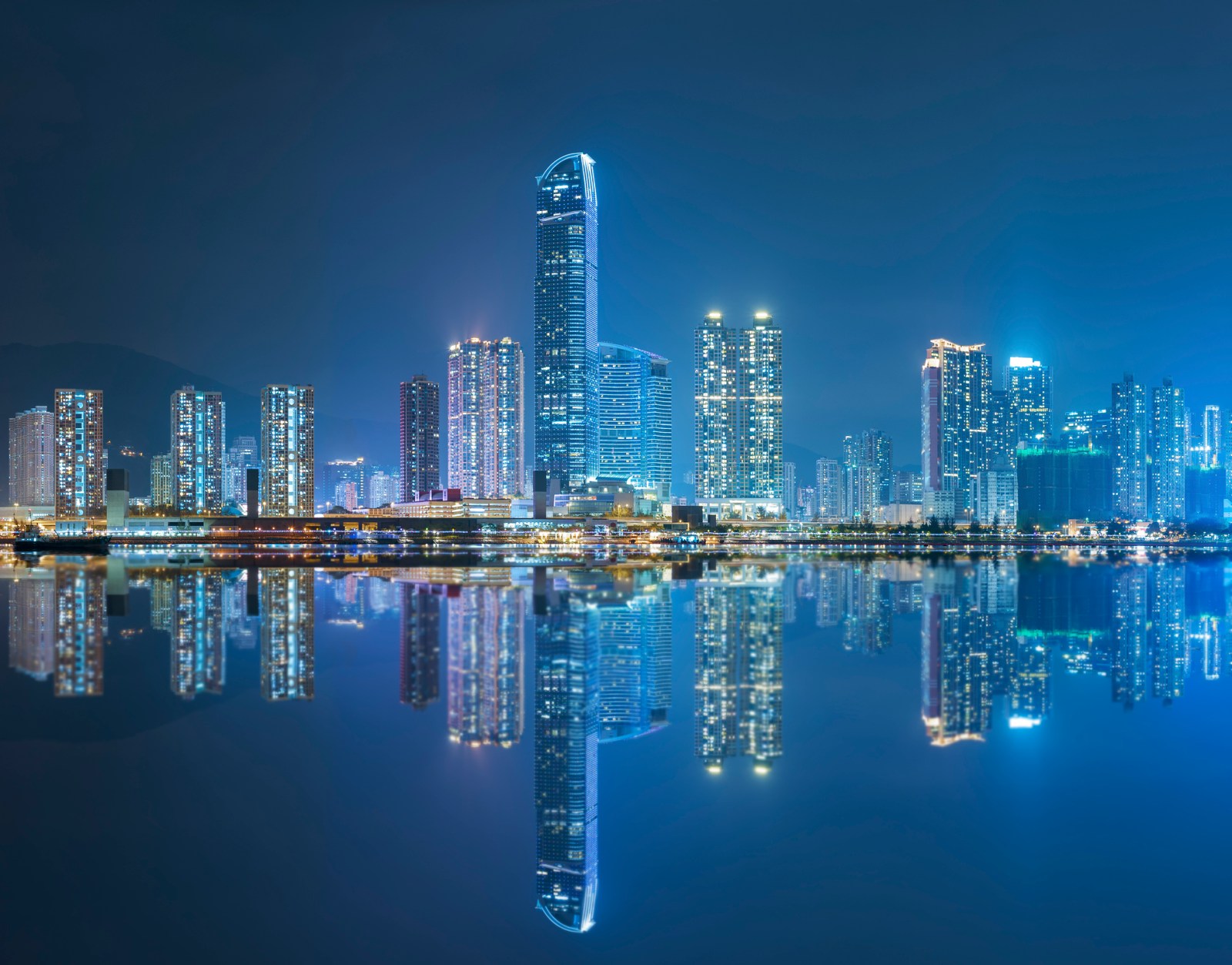
Hong Kong boasts more skyscrapers than any other city worldwide. With 569 buildings exceeding 150 meters in height, it surpasses New York City, which has just over 320 such structures, based on data from the Council on Vertical Urbanism.
The council categorizes a ‘tall building’ as one typically rising above 14 stories or 50 meters. Hong Kong’s skyscrapers have overshadowed this standard, transforming the city into an extremely vertically dense environment.
Hong Kong’s skyline features 102 buildings taller than 200 meters, along with six ‘supertall’ towers surpassing 300 meters. The quantity of buildings over 150 meters tall is nearly double that of New York City and significantly outpaces Chicago, the birthplace of the modern skyscraper, which has 137.
As cities like Hong Kong, New York, and Dubai enhance vertical design, the competition to construct taller buildings is intensifying; however, this progress presents environmental challenges.
The World Green Building Council reports that buildings and construction together contribute 39 percent of global energy-related carbon emissions: 28 percent from operational energy use and 11 percent from materials and construction.
A considerable portion of these emissions materialize before buildings are occupied. Known as ‘upfront carbon,’ these emissions occur during material extraction, manufacturing, and construction. The World Green Building Council highlights that upfront carbon could represent half of the carbon footprint of new constructions by 2050, coinciding with a predicted doubling of the global building stock.
Earlier this month, Gordon Gill, the architect behind the Jeddah Tower, discussed the issue, pointing out that embodied carbon—emissions released during the lifecycle of building products—is often concealed within buildings’ structural systems.
Gill expressed to Newsweek, ‘The majority of embodied carbon we’re seeing is primarily in the infrastructure and the structure of these buildings,’ likening it to an unseen ‘city underneath the asphalt.’
This situation creates significant tension for cities striving for taller towers. There’s now a need to balance density and height with efforts to reduce emissions and redesign high-rise buildings.
A City Built Up, Not Out
Hong Kong’s emergence as a skyscraper hub is attributed to geographical and economic factors.
Architect James von Klemperer, president at the global architectural firm KPF, explained that high-rise buildings proliferated due to two main conditions: the limited availability of land owing to island and mountain landscapes, coupled with increased building area demands driven by economic prosperity.
Approximately a quarter of Hong Kong’s land is developed, with the remainder preserved as nature reserves. This arrangement necessitated vertical growth, enabling residents to stay close to nature.
Hong Kong’s global role as a conduit between China and the world bolstered its expansion. Von Klemperer mentioned that Hong Kong’s status as a major market city propelled office, residential, and retail space growth, which began in the 1970s, gained momentum in the 1980s, and flourished into the 1990s and 2000s.
Engineer John Peronto, managing principal at Thornton Tomasetti and Jeddah Tower project manager, reiterated this perspective. ‘There was a reason to build high… because they needed to,’ he noted, comparing Hong Kong to early Chicago where limited land led to vertical construction. In Hong Kong, dense conditions make upward construction the only option.
Can Other Cities Follow Hong Kong’s Lead?
Despite Hong Kong’s influence, replicating its model is difficult.
Klemperer emphasized that knowledge from one city can inform another, but blindly exporting and importing architecture and design innovations without adaptation isn’t advisable.
Factors like climate, cultural habits, and natural force vulnerability necessitate specialized solutions. Success in high-rise city development hinges on adapting design to local surroundings—a strategy that characterizes Hong Kong’s ascent as the world’s most vertical city.
For architecture or design-related stories, contact Newsweek via [email protected]. Your story could appear in Newsweek.
Contact Newsweek editors on this story: Sirena Bergman and Emma Lee-Sang.
Leave a Reply