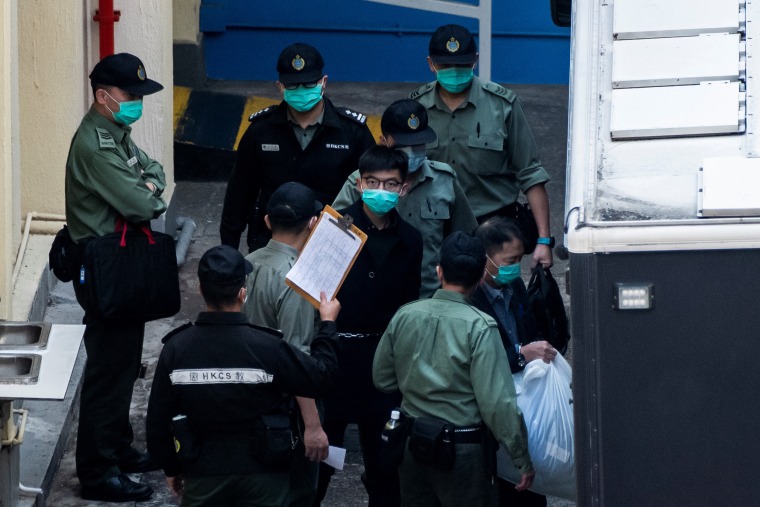
Prominent Hong Kong pro-democracy figure Joshua Wong admitted guilt on Wednesday for conspiring to collude with foreign forces, violating a national security law enforced by Beijing. This law has significantly dampened the region’s pro-democracy movement.
This represents Wong’s second prosecution under the national security law established in Hong Kong in 2020. This law was designed to suppress the extensive anti-government protests that shook the city in 2019. Wong, a former student leader and a recognizable face of the movement, appeared thinner and wore a blue shirt as he entered his plea.
Wong awaits sentencing, and the offense carries a possible prison term of three to ten years, or life imprisonment if considered severe. A guilty plea may lead to a reduced sentence. He is currently serving four years and eight months for a separate national security case concerning an unofficial political primary. He was initially anticipated to be released next January, prior to his June 2025 arrest related to the collusion charges.
Critics view Wong’s prosecution as a demonstration of the authorities’ determination to suppress dissent and chill activism. Beijing regards Wong as an anti-China activist who supports Hong Kong independence, an intolerable stance for the government.
Prosecutors accused Wong of plotting with fellow activist Nathan Law and others, requesting foreign entities to impose sanctions or hostile actions against Hong Kong or China from July 1 to November 23, 2020. Wong allegedly amplified Law’s online petition urging forensic companies to stop cooperating with the police via social media. Following this, one company halted its digital intelligence sales to Hong Kong and China.
The prosecution argued Wong and Law planned international lobbying for democratic self-determination. This includes seeking foreign-imposed sanctions or blockades against Hong Kong and China. After the law’s implementation, Law and others, having left Hong Kong, continued lobbying abroad through meetings with politicians and petition initiatives. Wong reportedly supported these endeavors from Hong Kong via media and social platforms to garner international attention and push for sanctions.
During the trial, it was revealed Wong mentioned in a report his role in ending a company’s supply of forensic software to the police. He had also contacted foreign firms about their cooperation with the Chinese government.
Before the hearing, a supporter encouraged Wong with words of motivation. Wong’s friend, Louis Lee, shared that Wong has been reading, studying, learning guitar, and exercising in prison. Lee expressed hope to reunite with Wong outside prison soon. “I believe he and I, or friends outside, will continue our efforts in our own areas,” he mentioned.
Wong became known in 2012 as a student leading protests against national education in Hong Kong schools. He later became a student leader in the 2014 Occupy Movement. Wong co-founded Demosisto, a political party, in 2016 alongside other activists, such as Nathan Law, who became Hong Kong’s youngest lawmaker that year. During the 2019 protests, Wong sought international support for the democracy cause, including from the United States. Beijing accused him of soliciting foreign interference.
Demosisto dissolved after the security law was imposed, aimed at restoring stability in the city. Several key activists, including former media tycoon Jimmy Lai, are jailed under this law. Others have fled to democracies such as the U.S. and the U.K.
Hong Kong authorities have separately offered rewards worth 1 million Hong Kong dollars ($127,600) for tips leading to the arrest of Nathan Law, who relocated to Britain, and other activists based overseas.
Leave a Reply