Hong Kong – Two former organizers of the longstanding vigil in Hong Kong for the 1989 Tiananmen Square crackdown have been convicted in a national security trial under a China-imposed law. This law has significantly dampened Hong Kong’s pro-democracy movement.
Lee Cheuk-yan and Chow Hang-tung, who led the Hong Kong Alliance in Support of Patriotic Democratic Movements of China, were charged in 2021 with inciting subversion. Both pleaded not guilty and confront penalties up to 10 years in prison. The alliance was also found culpable.
The verdict is among many recent ones affecting the once lively pro-democracy movement in Hong Kong, which has faced extensive suppression by local and Chinese authorities.
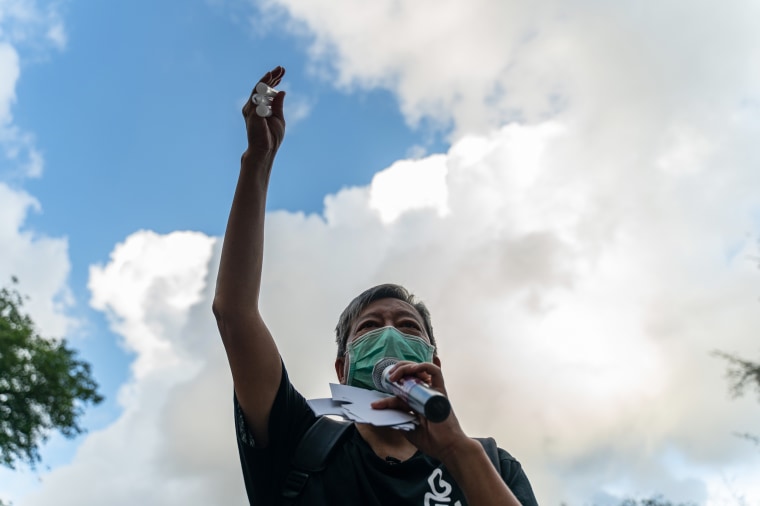
Lee Cheuk-yan addressed the public before the annual vigil on June 4, 2020, in Hong Kong.
For three decades, the vigil organized by the alliance was the only major public memorial for the Tiananmen Square event in Hong Kong, drawing massive crowds yearly. In 2020, the vigil was banned amid Covid-19 concerns shortly before Beijing implemented the national security law to counteract 2019’s extensive protests.
Observers argue that this trial highlights diminished freedom of expression in Hong Kong, a former British colony that transitioned to Chinese control in 1997.
Lee and Chow, detained since being charged, are awaiting sentencing. Judges have deferred the full judgment online publication.
Eric Lai, senior fellow at Georgetown Center for Asian Law, commented that inciting subversion is commonly utilized in mainland China to target human rights lawyers, activists, and intellectuals, including Nobel laureate Liu Xiaobo. Lai noted that Hong Kong’s judiciary appears to reflect the mainland’s party-led legal system through these rulings.
Heavy security surrounded the court during the verdict.
Prosecutors argued that the trial was apolitical and revolved around the alliance’s call to overturn China’s Communist Party leadership. The call for “ending one-party rule” was highlighted.
Lee asserted in court that this demand aimed towards democracy, allowing people to choose their leadership, not merely dismantle party authority.
Representing herself, Chow remarked that ending one-party rule involves restricting unchecked power. She highlighted the distortion of moral standards in the trial.
In a Patreon message, Chow described her shackled journeys to court, akin to being led “like a dog” by correctional officers.
Chow proclaimed justice endures in people’s hearts, unaffected by verdicts.
The trial initially scheduled for 75 days ended sooner, concluding on day 24. Albert Ho, another defendant, pleaded guilty, often leading to reduced sentences.
Lee and Chow are expected to argue for leniency in separate hearings, possibly alongside Ho.
Despite rain, people queued early outside the court for the hearing.
Tang Ngok-kwan faced police caution about “sensitive” materials like June 4 bookmarks. Choosing not to enter the court, Tang reflected that a guilty alliance verdict would challenge his legal perspective.
Margaret Chan, a former vigil attendee, questioned the alliance’s patriotic name and its alleged incitement.
Hundreds or thousands perished during the 1989 crackdown in Beijing. This event marked a turning point in China, solidifying economic reforms without political liberalization.
Post-Covid restrictions, the vigil site now hosts a pro-Beijing carnival during the Tiananmen anniversary.
Beijing defended the security law’s necessity for stability, which led to many activist imprisonments, including media tycoon Jimmy Lai. These political shifts resulted in civil society group dissolutions, including the alliance.
Leave a Reply